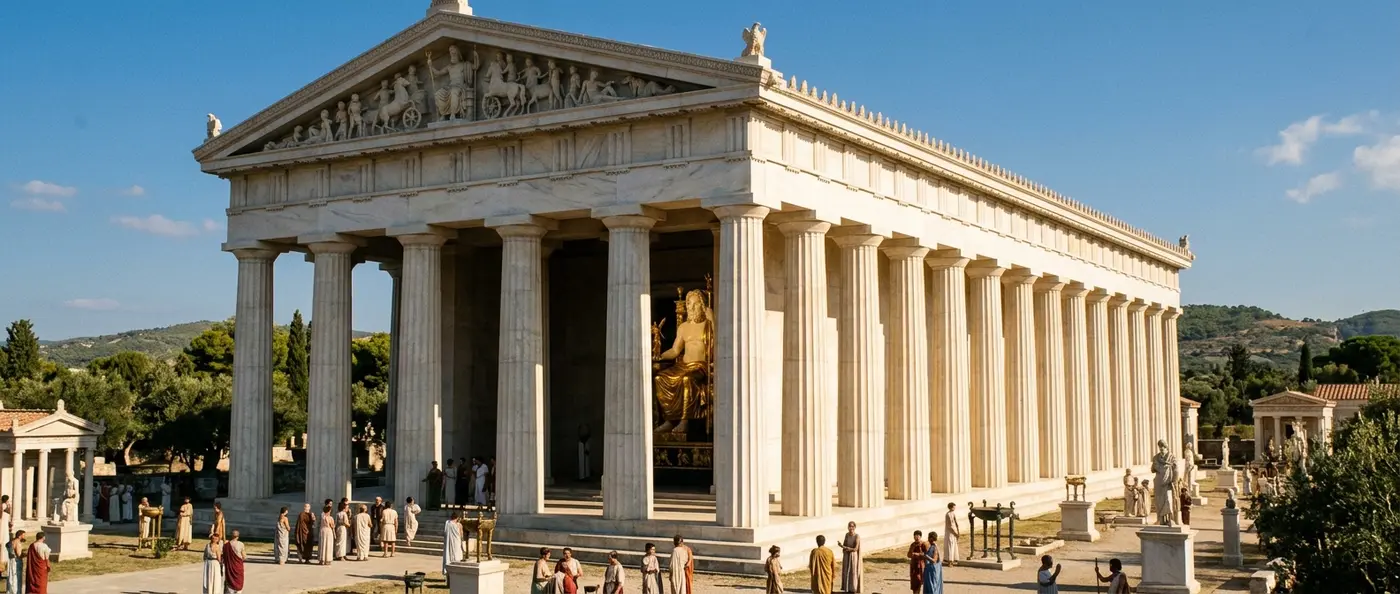
In the heart of the Peloponnese, where thousands of athletes once competed for glory, stood one of the Seven Wonders of the Ancient World. The Temple of Zeus at Olympia wasn't just a religious monument — it housed a 40-foot chryselephantine colossus that brought visitors to their knees in awe.
🏛️ The Sacred Altis and Zeus' Temple
Olympia wasn't a city in the traditional sense. It was a sacred precinct, the Altis, dedicated to Zeus worship. Here, every four years, Greeks set aside their differences and gathered for the Olympic Games. At the center of this holy ground stood the magnificent temple of the father of the gods.
Construction began around 470 BCE and was completed in 456 BCE, under the supervision of architect Libon of Elis. The building followed the Doric order, with awe-inspiring dimensions: 210 feet long and 92 feet wide. The 34 columns of local shell limestone, standing 34 feet tall, supported a roof covered with marble tiles from Paros.
But the real wonder lay inside.
🔱 Phidias' Chryselephantine Marvel
In 435 BCE, Phidias, antiquity's greatest sculptor, undertook to create something that would surpass even the Athena Parthenos he had crafted for the Parthenon. He set up a special workshop next to the temple, with the same dimensions as the cella, so he could work on the statue at full scale.
The result was breathtaking. Zeus sat on a throne of ebony and ivory, decorated with gold, precious stones, and glass. The god's skin was ivory, while his robes and ornamental elements were gold. In his right hand he held a small Nike, also chryselephantine, and in his left the scepter topped with an eagle.
Ancient writers calculated that if Zeus stood up, his head would crash through the temple roof. The statue was so realistic that Pausanias wrote it seemed as if the god himself had descended from Olympus to sit there.
⚡ The Power of Religious Experience
Visitors entering the temple described a life-changing experience. The statue was positioned at the back of the cella, behind a pool of oil that reflected light and created a mysterious atmosphere. The oil served a practical purpose too — protecting the ivory from the region's humidity.
Pilgrims collapsed before the statue. Many left with tears in their eyes, believing they had seen the god himself. The orator Dio Chrysostom wrote that whoever beheld the statue forgot all the sorrows and sufferings of human life.
💡 Phidias' Secret
In Phidias' workshop, archaeologists found tools, molds, and even a cup inscribed "PHEIDIO EIMI" (I belong to Phidias). They discovered the artist used innovative techniques to assemble ivory pieces and keep them flexible with special oils.
🏺 The Olympic Games and Divine Worship
The temple wasn't merely a museum for the statue. It was the center of religious life during the Olympic Games. Before each competition, athletes swore before the altar of Zeus Horkios that they would compete fairly. Winners received crowns from branches of the sacred olive tree that grew beside the temple.
Winners received no money, but their names echoed through eternity. Winners gained the right to erect their statue in the Altis and have their names inscribed in the Olympic victor lists. Returning to their homeland, they were welcomed as heroes and enjoyed privileges for life.
Particularly significant were the oil-filled amphorae given as prizes. The oil came from Athena's sacred trees and was considered blessed. These amphorae, known as Panathenaic, were decorated with athlete depictions and became precious heirlooms.
Victor Honors
Wild olive crown, statue in the Altis, tax exemption in homeland, free meals at the prytaneion, front-row seats at games.
Sacred Rules
Truce during games, women banned from competitions, punishment of cheating athletes with fines for bronze statues (Zanes).
Sacrifices & Ceremonies
Hecatomb (sacrifice of 100 oxen) at Zeus' great altar, burning of thighs on the ash altar, processions with all city-states participating.
🌅 The End of a Wonder
For eight centuries, Zeus' statue stood unharmed, surviving earthquakes, wars, and raids. Even when Romans conquered Greece, they respected the sanctuary. Emperor Caligula tried to move the statue to Rome, but the attempt failed when scaffolding mysteriously collapsed.
The statue's fate was sealed with Christianity's rise. In 391 CE, Emperor Theodosius I banned the Olympic Games and closed pagan sanctuaries. According to one account, the statue was moved to Constantinople, where it was destroyed in a fire in 475 CE. Other sources claim it was destroyed in Olympia by earthquakes and floods in the 6th century.
Whatever its end, Zeus' statue vanished without a trace. Not a single piece of gold or ivory has been found that can be definitively attributed to it. The only proof of its existence lies in ancient writers' descriptions and depictions on coins.
🔬 Modern Archaeology at Olympia
Systematic excavations at Olympia began in 1875 by German archaeologists. They uncovered the temple's foundations, fallen columns, and fragments from the pediments. The pediment sculptures, depicting the Centauromachy and the chariot race between Pelops and Oenomaus, are considered masterpieces of ancient art.
Phidias' workshop yielded the most personal finds. There they found tools, molds for casting glass ornaments, and ivory remains. The discovery of Phidias' personal cup confirmed the site's identity and gave archaeologists a rare personal connection to the great artist.
⚖️ Temple of Zeus by the Numbers
🗿 The Enduring Legacy
Though the statue is lost, its influence continues. It became the model for Zeus depictions and influenced Christian iconography of the Pantocrator. The idea of a seated god ruling the world passed from Olympian Zeus to depictions of Christ as cosmic ruler.
Today, Olympia visitors can only see the temple ruins. The fallen columns, like sleeping giants, give an idea of the building's magnitude. Olympia's museum houses the pediment sculptures and finds from Phidias' workshop.
Perhaps this is the real wonder. That 2,500 years later, we still speak of a temple and statue that no longer exist. That the power of art and faith can outlive the very matter that created it. At Olympia, among the olive trees and fallen columns, Zeus may no longer sit on his throne. But the memory of the wonder remains alive.