⚔️ Who Were the Samnites
The Samnites were ancient Italic peoples who inhabited the mountainous center of southern Italy, in regions that today cover parts of Campania, Molise, and Basilicata. They spoke Oscan — a language related to Latin but distinct — and were likely an offshoot of the Sabines, an ancient people of central Italy. According to ancient texts, they didn't call themselves "Samnites" — that was the Latin term. In the Oscan language they used the form "Safinim," corresponding to the Latin "Sabinus" (Sabine).
Their society was organized into four cantons — a federation without a permanent federal assembly: the Hirpini, Caudini, Caraceni, and Pentri. Each canton operated autonomously. Only in wartime could a unified military leader — meddix tuticus — be elected to lead the united forces. This structure reflects a society deeply connected to mountains, pastoralism, and warfare, without urban centers comparable to Rome or the Greek colonies.
🏔️ Mountain Warriors: Three Wars with Rome
In 354 BC, Samnites and Romans allied against the Gauls threatening Italy. But the alliance didn't last. Soon, interests clashed in fertile Campania — and began the series of three Samnite Wars that would determine the fate of all Italy.
The First Samnite War (343-341 BC) was relatively brief, with evenly matched battles in Campania. The Second (327-304 BC) was much harsher and longer — during it, in 321 BC, the Samnites achieved one of the most humiliating defeats in Roman history: the Battle of the Caudine Forks. Samnite general Gaius Pontius trapped an entire Roman army in a narrow pass. The Romans, with no escape, were forced to surrender and pass under the yoke — a symbol of absolute submission, public humiliation that haunted Roman memory for generations.
The Third Samnite War (298-290 BC) was the last and bloodiest. The Samnites formed a coalition with Etruscans, Gauls, and Umbrians. At the Battle of Sentinum (295 BC), Rome faced four peoples simultaneously — and won. After 290 BC, the Romans surrounded Samnite territory with colonies: Beneventum (268 BC), Aesernia (263 BC), cutting the Samnites off from any possibility of resistance.
🪦 The Pontecagnano Tombs: Children with Warrior Belts
The city of Pontecagnano, in Campania of southwestern Italy, represents one of the richest archaeological fields for studying the Samnites. The city was initially settled in the 9th century BC by peoples of the Villanovan culture, who introduced exceptional bronze-working techniques to southern Italy. Two centuries later, the Etruscans transformed Pontecagnano into a trading hub for Greek, Phoenician, and Italian merchants. In the 5th century BC, the Samnites captured the city, and Samnite presence lasted until Roman conquest in the 3rd century BC.
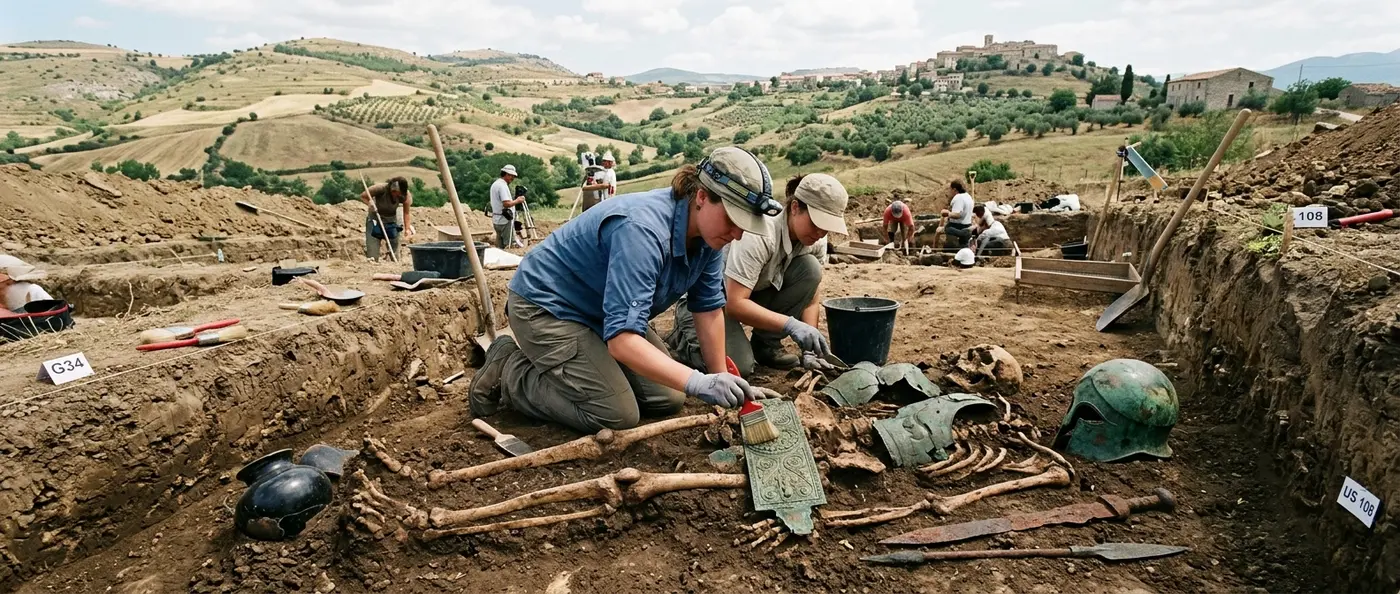
Recent excavations at a former tobacco factory in Pontecagnano uncovered part of an ancient cemetery with 34 burials dating to the 4th and 3rd centuries BC. About half the tombs contained skeletons of children aged 2 to 10 years. Samnite cemeteries reveal valuable information about their burial practices: tombs were organized by family unit, and most were earthen pits covered with tile roofs. Grave goods included various ceramic vessels, but certain objects were gender-specific.
Men were buried with "warrior code" objects: spear points, javelins, and bronze belts — the emblematic accessories of Samnite warrior identity. Women received rings and brooches. This differentiation shows a society with strict gender roles, where warrior identity followed the dead to the grave.
💡 Children buried as warriors
The most stunning discovery: two children aged 5 to 10 years were found buried with bronze belts typical exclusively of adult male burials. Previously, a 12-year-old child with a bronze warrior belt had already been discovered at the same site. According to archaeologist Gina Tomay, the boy lived in the 4th century BC and had been buried with ceramic cups — to ensure food and wine in the afterlife.
🛡️ Armament and Military Art
The Samnites fought primarily as light infantry, exploiting their rugged mountainous terrain. They never fully adopted the phalanx or heavy equipment — instead preferring swift ambushes, guerrilla movements, and exploitation of narrow passes and gorges. Their weapons included spears, javelins, short swords, linen or leather armor, and small round shields. The bronze belt — the most recognizable symbol — wasn't merely decorative. It was practical: protecting the abdominal area during battle.
The Roman army owes much to the Samnites. It's no coincidence that the Roman legion evolved dramatically during the Samnite Wars: the transition from phalanx to maniple — a flexible system of small units — is believed to have emerged precisely as a response to Samnite guerrilla warfare. Livy explicitly states that the Romans copied elements of Samnite equipment — particularly the oval scutum (shield), which replaced the round Greek clipeus.
Bronze Belt
The symbol of the Samnite warrior. Finds show they were heavy, decorated with relief motifs. Found exclusively in male burials — except for the recent child discoveries.
Mountain Cavalry
Though primarily foot warriors, certain Samnite forces used cavalry in open terrain. Their horsemen were especially honored in burial ceremonies.
Legio Linteata
The "Linen Legion" — elite warriors of the Samnite federation who swore oaths in sacred ceremony under linen cloth. Livy describes the sacrifice and oath of victory or death.
📜 The Tabula Agnonensis and Samnite Culture
The longest and most important inscription in the Samnite (Oscan) dialect is the Tabula Agnonensis — a small bronze tablet written in complete Oscan alphabet. The tablet records dedications to deities and reveals aspects of Samnite religious life that would otherwise be completely unknown. The Samnites worshipped deities corresponding to Roman gods, but with local names and rituals: Mefitis (goddess of toxic vapors), Kerres (corresponding to Ceres), and Mamers (corresponding to Mars) are revealed through archaeological finds.
Religion was deeply connected to war. Pre-battle ceremonies, sacred warrior groups, and the belief that death in battle ensured honor in the afterlife — all these explain why even children were buried with military equipment. Burial didn't reflect only what the deceased was, but what they could become — the ideal warrior who didn't live to fulfill their destiny.
🏛️ From Resistance to Extinction
After the three wars, the Samnites submitted but didn't disappear. They helped Pyrrhus of Epirus (280-275 BC) and Hannibal (218-201 BC) against Rome. In 90 BC they fought in the Social War — a rebellion of Italian peoples demanding Roman citizenship. Their last great struggle came in the civil war against Lucius Cornelius Sulla: the Battle of the Colline Gate (82 BC) marked the end. Sulla destroyed Samnite cities, slaughtered prisoners, and declared that Rome would never rest while Samnites existed. The population was decimated, land seized, cities abandoned.
Yet Samnite legacy survived in archaeological layers. In 2004, archaeologists in Pompeii discovered remains of a temple wall built by Samnites — a reminder that Pompeii was a Samnite city before becoming Roman. In Herculaneum, the "House of the Samnite" — a 2nd century BC mansion with an atrium of Ionic columns — is one of the oldest buildings discovered in the ancient city.
⚖️ Samnites vs Romans: Military Comparison
🔬 What the Tombs Tell Us Today
Excavations at Pontecagnano continue, with public and private construction projects constantly revealing new tombs. The Superintendency of Archaeology of Salerno and Avellino plans to announce new discoveries once research is completed. Samnite tombs are valuable because they offset a significant absence: the Samnites left no literature, historiography, or philosophical texts. What we know about them comes from Roman sources (which were hostile) and archaeological finds.
Grave goods reveal trade relationships: Greek ceramics alongside local vessels, Phoenician jewelry alongside Etruscan brooches. Campania was a crossroads of civilizations, and the Samnites — despite their reputation as isolated mountain warriors — operated within a rich network of exchanges. Bronze objects show exceptional metallurgical expertise — a legacy, possibly, from the Villanovan culture that preceded them in the region.
The question of why children were buried with warrior equipment remains open. One interpretation is that the objects reflected "the man these children could have become" — a practice also known in 6th-century Anglo-Saxon burials in Britain, where boys were buried with belts and military equipment. Another possibility: the children belonged to aristocratic warrior families, and the belt signified social position, not actual military service.
💡 Why were children buried with warrior belts?
In societies where warrior identity was the highest honor, burying a boy with adult warrior equipment may have meant the family was declaring what the deceased didn't live to achieve — a life dedicated to battle. It was a statement of future identity, a promise of social position that death prematurely canceled.
🏺 Samnite Legacy in Modern Archaeology
Archaeological research on the Samnites has accelerated in recent decades. For centuries, their history was filtered through a Roman prism — they were the "barbarians" fighting "civilization." Today, archaeologists recognize a complex society with religious ceremonies, trade networks, sophisticated metallurgy, and burial practices expressing deep beliefs about life, death, and honor. Finds at Pontecagnano, Pompeii, and Herculaneum give voice to a people Rome tried to erase.
The bronze belts now displayed in museum cases once encircled the waists of children who died before they could wield spears. Promises of families who believed that even premature death couldn't cancel a warrior identity. When martial prowess defined social worth, even a child's grave proclaimed warrior status.