🏛️ Ptolemais: Greece's Gateway to Africa
Ptolemais wasn't just another Mediterranean port. Founded in the 3rd century BCE as one of five cities in the Cyrenaican Pentapolis, it carried the name of the dynasty that ruled Egypt after Alexander the Great carved up the known world. This wasn't coincidence — it was strategy.
The city's position on Libya's Mediterranean coast made it the perfect waystation for ships traveling between Alexandria and the western territories. Merchants and sailors crossing these sea routes carried more than cargo. They transported Greek language, culture, and traditions into the heart of North Africa, creating a cultural melting pot that would influence the region for centuries.
The shipwrecks discovered here tell the story of this intense maritime activity. Through their study, archaeologists are reconstructing the image of a cosmopolitan city that served as a bridge between the Hellenistic East and the Roman West — a crucial link in the chain that bound the ancient Mediterranean together.
Naval Technology
Ptolemaic ships featured advanced navigation systems and could carry massive cargo loads across vast distances with remarkable precision.
Port Infrastructure
Ptolemais boasted one of the era's most sophisticated harbors, with docks, warehouses, and shipyards that serviced the entire fleet.
Trade Network
The city served as a maritime trade hub, connecting Egypt with Greece, Rome, and North Africa in a web of commerce.
⚓ The Wrecks Reveal Their Secrets
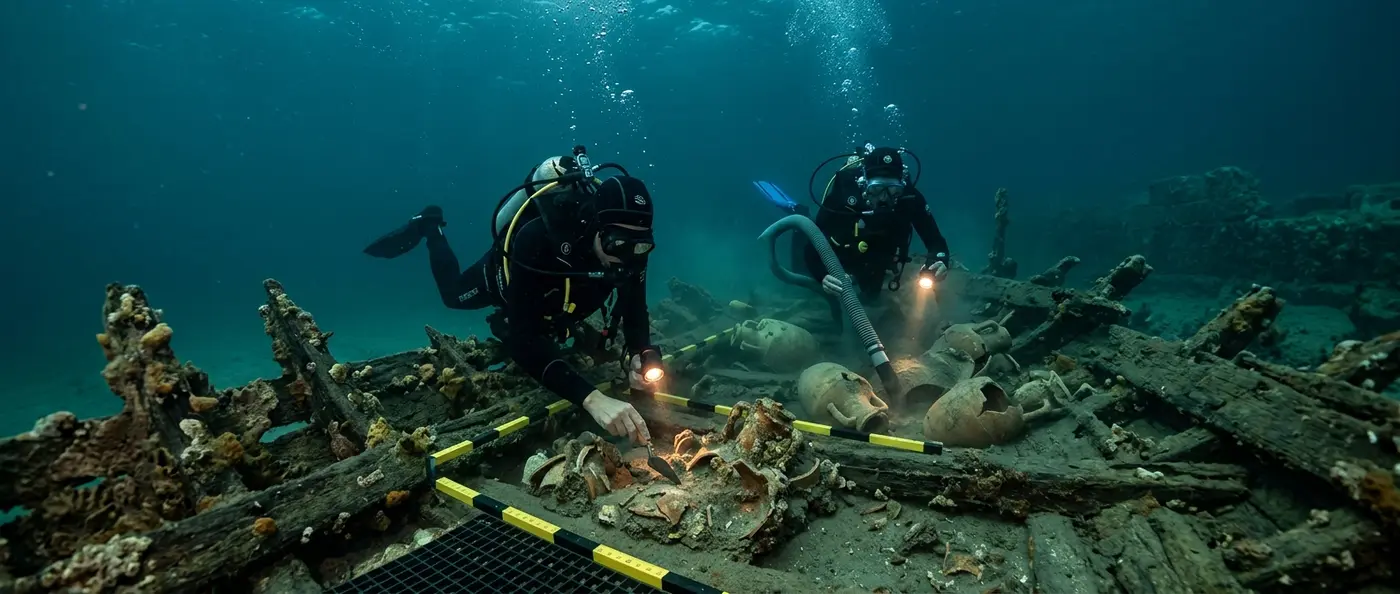
Underwater archaeological surveys off Ptolemais have uncovered at least five shipwrecks dating from the 3rd century BCE to the 1st century CE. Each wreck preserves intact information about navigation, trade, and daily life from antiquity.
The most spectacular find is a 35-meter merchant vessel that sank around 200 BCE. This ship carried cargo that reads like a shopping list from across the Mediterranean: thousands of wine amphoras from Rhodes and Kos, Attic pottery, and bronze objects from Cyprus. The cargo's diversity shows Ptolemais had developed extensive trade networks.
Another significant wreck, dating to the 1st century BCE, contained an unusual cargo: hundreds of marble statues and architectural elements. Archaeologists believe the ship was transporting decorative elements for a temple or public building in Ptolemais, underscoring the city's importance as a cultural center where Greek artistic traditions took root in African soil.
🏺 The Amphora Cargo: A Window into Ancient Trade
The amphoras discovered in these wrecks contain detailed information about ancient commerce. Each amphora bore seals indicating its origin and contents. Through studying these seals, researchers have identified products from various regions of the Hellenistic world.
Wine from Rhodes and Kos was particularly prized in antiquity. The amphoras containing it bore characteristic seals with the producer's name and production year. One wreck contained over 2,000 such amphoras, indicating the ship carried cargo worth hundreds of thousands of modern euros.
Beyond wine, the ships transported olive oil from Attica, honey from Thasos, and garum (fermented fish sauce) from North Africa. This product diversity reflects the dietary habits and culinary preferences of Ptolemais residents, who blended Greek and local traditions in their daily lives.
💡 Did You Know?
Ancient sailors used specially sealed amphoras with internal resin coating for wine transport. The resin not only waterproofed the amphora but gave the wine a distinctive flavor that led to the creation of retsina — a tradition that survives in Greece today.
🔱 Ptolemaic Naval Technology
Study of these wrecks has revealed crucial information about the evolution of shipbuilding technology during the Ptolemaic period. The ships that sank off Ptolemais represent various vessel types, from small coastal craft to large merchant ships capable of transoceanic voyages.
The largest wreck, measuring 35 meters long and 9 meters wide, featured advanced characteristics for its time. Its construction included a double hull for greater strength and safety, while a twin-rudder steering system at the stern allowed better control in difficult weather conditions.
Particularly interesting is the discovery of a smaller vessel that appears to have been a "thalamegos" — a luxury craft used for transporting officials and dignitaries. The ship featured a decorated cabin at its center and spaces for comfortable passenger accommodation, indicating Ptolemais's importance as an administrative center where comfort mattered as much as cargo capacity.
⚓ Ptolemaic Ship Characteristics
🗺️ Eastern Mediterranean Sea Routes
The wrecks' positions and cargo analysis have helped researchers reconstruct the sea routes ships followed during this period. Ptolemais sat at a critical point in the network connecting Alexandria with cities in Greece and Asia Minor.
Ships departing from Alexandria typically followed the coast westward, making stops at ports like Paraetonium (modern Mersa Matruh) and Apollonia (port of Cyrene) before reaching Ptolemais. From there, they could either continue toward the Greater Syrtis and Carthage or turn north toward Crete and mainland Greece.
Navigation on these routes required deep knowledge of local conditions. Sailors had to understand prevailing winds, sea currents, and hidden reefs. The Ptolemais wrecks testify that even the most experienced mariners could fall victim to the region's unpredictable weather conditions.
🏛️ The Cultural Legacy of the Wrecks
Beyond their economic and technological significance, the Ptolemais wrecks serve as witnesses to the cultural exchange that characterized the Hellenistic world. Objects found on the ships reflect a blend of Greek, Egyptian, and local Libyan influences.
Among the most intriguing finds is a collection of small figurines depicting deities from various traditions. Representations of Isis and Serapis, deities widely worshipped in Ptolemaic Egypt, were found alongside figurines of Poseidon and Aphrodite, protectors of seafaring in Greek tradition.
Numerous personal objects belonging to sailors and passengers were also discovered: jewelry, coins, seals, and even musical instruments. These objects show the daily lives of people who traveled the ancient seas — their hopes, fears, and beliefs spanning centuries.
Egyptian Influences
Figurines of Isis and Serapis, hieroglyphic inscriptions, and Egyptian amulets were found in many of the wrecks.
Greek Traditions
Pottery with mythological scenes, coins with Greek inscriptions, and dedications to Greek deities.
💀 Mysteries of the Deep
Despite extensive research, many mysteries remain unsolved regarding the Ptolemais wrecks. The most enigmatic is the concentration of so many shipwrecks in a relatively small area. While weather conditions and reefs can explain some accidents, the number of wrecks suggests other factors may be involved.
One theory archaeologists are examining is that some ships may have been deliberately sunk as part of religious ceremonies. The discovery of a ship containing almost exclusively ritual objects strengthens this hypothesis. The vessel may have been part of a "navigatio" — a sacred voyage in honor of some deity.
Another mystery concerns a wreck that appears to contain an unusually large number of weapons and armor. Researchers speculate it may have been a ship transporting mercenaries or military equipment during one of the many conflicts that characterized the late Hellenistic period.
«Each wreck preserves moments from the past. At Ptolemais, we can study not one but many such glimpses of history.»
🔬 Modern Research Techniques
Study of the Ptolemais wrecks has benefited significantly from advances in underwater archaeology. Modern techniques allow researchers to explore and document wrecks with unprecedented precision while minimizing destruction of sensitive archaeological layers.
The use of remotely operated underwater vehicles (ROVs) has enabled exploration of wrecks at depths that are dangerous or inaccessible to divers. ROVs equipped with high-resolution cameras can create detailed three-dimensional maps of the wrecks.
Meanwhile, DNA analysis of organic remains found in amphoras has revealed information about their exact contents. In some cases, scientists managed to identify the specific grape varieties used to produce wine 2,000 years ago.
🌊 Significance for Modern Research
The Ptolemais wrecks aren't just archaeological curiosities. They're invaluable sources of information for understanding the economic and cultural history of the Mediterranean. Through their study, researchers can reconstruct trade networks, technological developments, and cultural exchanges that shaped the ancient world.
The wrecks also offer unique information about the region's climate history. Analysis of sediments covering the wrecks can reveal changes in sea level, ocean currents, and weather conditions over the past two millennia.
Ongoing research at Ptolemais promises to reveal even more secrets. Each new discovery helps us understand the people who lived, worked, and traveled these ancient seas. The Ptolemais wrecks show that the Mediterranean connected civilizations and peoples across time.