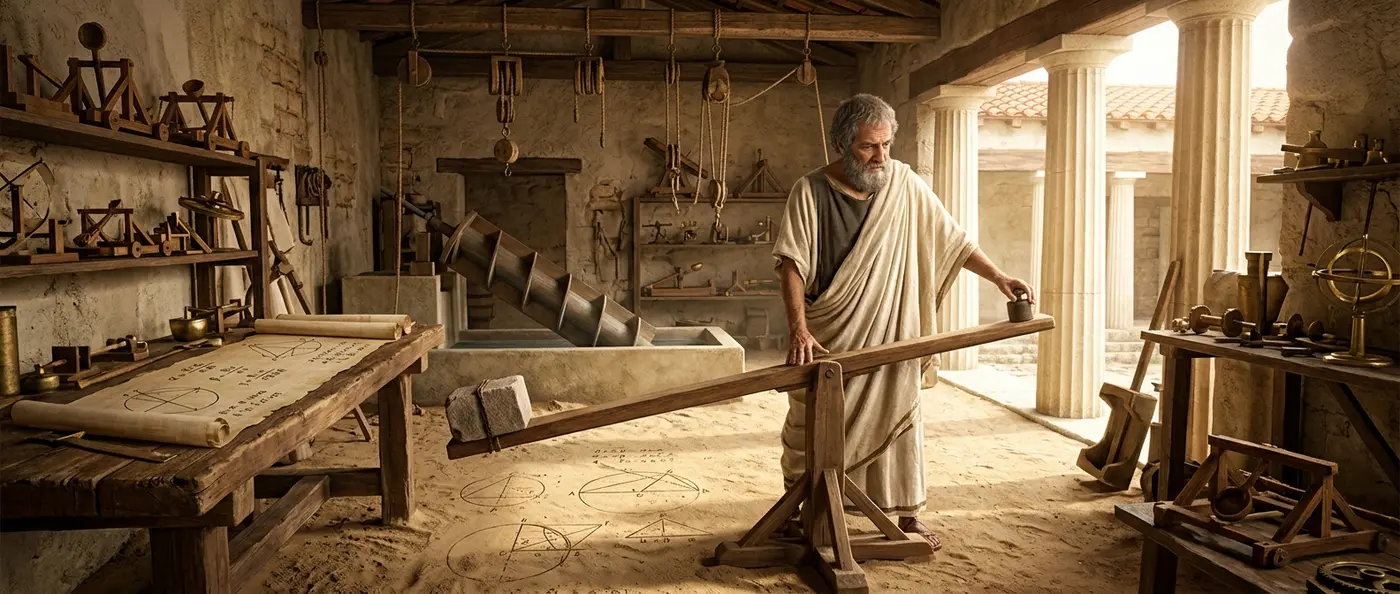
In a room filled with strange machines and mathematical calculations, a man suddenly leaps from his bath and runs through the streets shouting "Eureka!" This image of Archimedes has stuck with us for over two thousand years. The real man behind the legend was even more extraordinary than the myth.
📖 Read more: Ancient Greek Colonies: The Greater Greece Revolution
🏛️ Life of the Great Syracusan
Archimedes was born around 287 BC in Syracuse, Sicily, the most important Greek city-state on the island. His father, Phidias, was an astronomer, and young Archimedes continued the family tradition in the sciences. According to Plutarch, Archimedes had family ties to King Hiero II of Syracuse, which secured him access to the city's highest circles.
As a young man, he likely traveled to Alexandria, Egypt, the greatest center of learning of the time. There he appears to have met and collaborated with mathematicians who followed Euclid, such as Conon of Samos and Eratosthenes of Cyrene. These connections would prove crucial to his later breakthroughs.
He returned to Syracuse where he spent most of his life. His close relationship with King Hiero II allowed him to dedicate himself to research and inventions. He published his works in the form of letters to the leading mathematicians of the time, a practice that ensured the wide dissemination of his ideas throughout the ancient world.
📜 Mathematical Achievements That Changed the World
Archimedes' mathematical work represents a milestone in the history of science. In his work "On the Sphere and Cylinder," he proved that the surface area of a sphere with radius r is 4πr² and that the volume of a sphere inscribed in a cylinder is two-thirds the volume of the cylinder. He was so proud of this discovery that he requested the related diagram be carved on his tomb.
In "Measurement of a Circle," he calculated the value of π using a method that wouldn't be improved upon for centuries. He proved that π lies between 3 10/71 and 3 1/7, an approximation that remained the best for centuries. His method, known as the "method of exhaustion," was a precursor to the integral calculus that would be developed nearly two millennia later.
His work "On Floating Bodies" contains the first scientific description of how objects behave when floating in water. Here he formulated the famous Archimedes' principle: any body immersed in fluid experiences buoyancy equal to the weight of the fluid it displaces. This principle became fundamental to hydrostatics and shipbuilding.
When the Romans besieged Syracuse in 213 BC, Archimedes took charge of the city's defense with his inventions. He constructed war machines so effective they delayed the city's fall for nearly two years. Ancient sources speak of giant cranes that grabbed Roman ships and lifted them from the water before dropping them to sink.
One of his most famous inventions is the Archimedes screw, a device that uses a helical screw inside a tube to lift water from a lower to a higher level. This invention is still used today in many applications, from irrigation to industry.
According to tradition, he also constructed two "spheres" that Roman general Marcellus took with him to Rome after the city's capture. One was a celestial map and the other a mechanical device that represented the movements of the Sun, Moon, and planets. These devices are considered precursors to the Antikythera mechanism.
Archimedes Screw
Revolutionary water-lifting device still used today in various forms in agriculture and industry.
War Machines
Catapults and cranes that protected Syracuse from Roman invasion for nearly two years.
Planetarium
Mechanical representation of celestial movements, precursor to modern planetariums.
💡 Archimedes' Principle and "Eureka!"
The most famous story about Archimedes relates to his discovery of the principle of buoyancy. King Hiero had commissioned a golden crown but suspected the goldsmith had mixed silver with the gold. He asked Archimedes to find a way to test the metal's purity without destroying the crown.
As Archimedes entered his bath, he noticed the water overflowing. He realized that the volume of water displaced was equal to the volume of his submerged body. This gave him the solution: he could measure the crown's volume by immersing it in water and compare it with the volume of equal weight of pure gold.
📖 Read more: Pythagoras: How Numbers Rewrote Philosophy
The story says he was so excited that he jumped from the bath and ran naked through the streets shouting "Eureka!" (I found it!). While the naked sprint through Syracuse may be embellished, the method was real. For the first time, someone could measure the volume of any irregular object.
🔬 Did You Know?
Archimedes had such low regard for his practical inventions compared to pure mathematics that, according to Plutarch, he left no written work about them. He considered mathematics superior to mechanical applications!
⚔️ The Tragic Death of a Genius
In the fall of 212 or spring of 211 BC, Syracuse finally fell to the Romans under general Marcus Claudius Marcellus. Despite Marcellus's orders to protect Archimedes, the great scientist was killed during the city's sacking.
There are various versions of his death. The most famous relates that a Roman soldier found him drawing geometric figures in the sand. When the soldier asked him to follow, Archimedes refused, saying "Do not disturb my circles." The enraged soldier killed him on the spot.
Marcellus deeply regretted Archimedes' death, whom he admired for his genius. He ensured he was buried with honors, and on his tomb was carved, according to the deceased's wish, the diagram of a sphere inscribed in a cylinder - the achievement he was most proud of.
Nine of Archimedes' works survive today. They formed the mathematical backbone for nearly everything that followed. His methods prepared the ground for integral calculus that would be developed by Newton and Leibniz nearly 2000 years later.
During the Scientific Revolution, Galileo and Newton pored over Archimedes' texts. They found in his work the marriage of abstract mathematics and physical experiment that would define modern science.
Today, Archimedes' principles and methods continue to be taught in every university worldwide. From fluid mechanics to integral calculus, from shipbuilding to astrophysics, the spirit of the great Syracusan continues to guide human thought in the search for truth.
📊 Archimedes' Impact on Science
🏺 The Man Behind the Myth
Beyond his scientific achievements, Archimedes was a man with deep passions and peculiarities. His contemporaries described him as someone who could become completely lost in his thoughts, forgetting to eat or sleep when working on a problem.
His devotion to pure science was absolute. Although his practical inventions made him famous and saved his homeland, he considered them inferior to his mathematical achievements. This attitude reflects the spirit of ancient Greek science, which placed theoretical knowledge above practical application.
Archimedes remains the eternal symbol of human curiosity and the power of the mind to understand and change the world. From 3rd century BC Syracuse to modern research centers, his name continues to inspire those who seek truth through science and mathematics.