📖 Read more: Assyrians: History's Most Terrifying Empire
🏛️ Sennacherib's Palace at Nineveh
Sennacherib ruled Assyria from 705/704 to 681 BCE, transforming Nineveh into the empire's glittering capital. His new palace, called "Shanina-la-ishu" (meaning "Without Rival"), sprawled across acres, its walls lined with hundreds of carved relief panels.
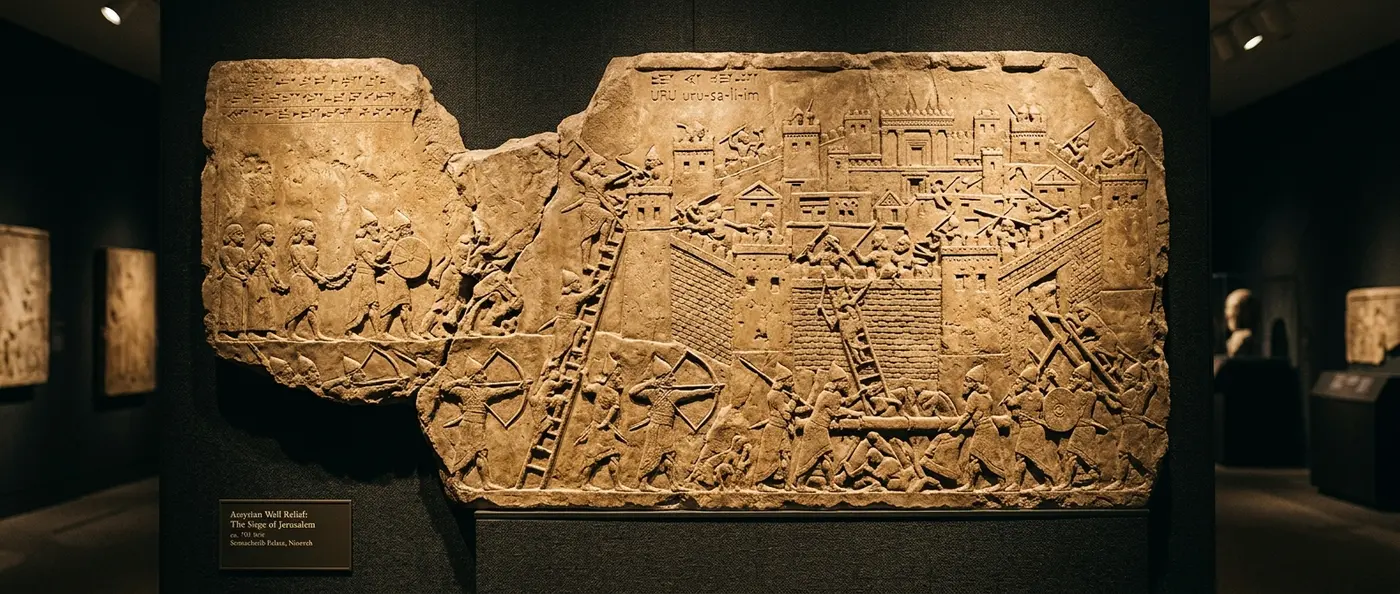
The palace walls blazed with detailed scenes depicting the king's military campaigns, conquests, and triumphs. Among these panels, one stood out: the depiction of Jerusalem's siege in 701 BCE, when Sennacherib attacked the kingdom of Judah.
Nineveh sat on the banks of the Tigris River in modern-day Iraq. Under Sennacherib, it became the Assyrian Empire's capital. The king expanded the city, building an inner wall nearly 13 kilometers long and an outer wall that still stands today, built from massive stone blocks.
⚔️ The Campaign Against Judah
In 701 BCE, rebellion erupted across Palestine with Egyptian backing. Sennacherib responded immediately, leading his army against the rebel cities. This campaign left an unusually rich historical record, recorded in both Assyrian sources and the Old Testament.
According to Assyrian inscriptions and biblical narrative (2 Kings 18:13-19:36), Sennacherib captured many fortified cities in the kingdom of Judah. Jerusalem, under King Hezekiah, was besieged but ultimately escaped destruction by paying heavy tribute.
Here's the twist: while Assyrian sources mention the siege and tribute, they don't claim to have captured the city. This gap in the Assyrian record has puzzled historians for decades.
🗿 The Mysterious Relief
Among the many reliefs decorating Sennacherib's palace, one reportedly depicted Jerusalem's siege. Unfortunately, this specific relief has been destroyed, leaving behind only descriptions and references from earlier scholars who saw it.
If the relief truly showed Jerusalem, it would be the oldest known visual representation of the holy city. This would have enormous significance for understanding the city's architecture and fortifications during the First Temple period.
Assyrian reliefs were famous for their accuracy and detail. Artists faithfully depicted the architectural features of conquered cities, including walls, gates, and important buildings.
Relief Technique
Assyrian reliefs were carved in soft limestone with exceptional detail, depicting scenes of war, hunting, and ceremonies in realistic style.
Historical Documentation
The reliefs functioned as visual chronicles of royal achievements, complementing written inscriptions with detailed images.
Propaganda
The scenes also served propaganda purposes, projecting the power and invincible nature of the Assyrian army.
📜 Archaeological Significance
The possible existence of an ancient depiction of Jerusalem from 701 BCE would have immense value for archaeologists and historians. It could provide information about the city's topography, size, fortifications, and perhaps even the location of Solomon's Temple.
Modern researchers have other Assyrian reliefs from the same period depicting the siege of Lachish, another important city in the kingdom of Judah. These reliefs, now displayed in the British Museum, show Assyrian battering rams, archers, and defenders hurling stones from the walls.
Comparing the Lachish reliefs with the supposed Jerusalem depiction could reveal significant differences in the fortification and architecture of the two cities.
💡 Did You Know?
Assyrian palaces were decorated with thousands of square meters of relief panels. Sennacherib's palace at Nineveh alone is estimated to have had over 3,000 meters of reliefs covering the walls of its 70 rooms.
🔬 Modern Reconstruction Efforts
Despite losing the original relief, modern researchers attempt to reconstruct its possible appearance using various sources. They use old descriptions, 19th-century drawings, and comparisons with other surviving Assyrian reliefs.
Digital reconstruction technology allows archaeologists to create virtual models of how the lost relief might have looked. These efforts draw on decades of studying how Assyrian artists depicted cities, walls, and siege warfare.
Excavations in Jerusalem have revealed sections of ancient walls dating to Hezekiah's time. These archaeological finds can be compared with possible depictions in the lost relief to verify its accuracy.
🏺 The Legacy of Assyrian Reliefs
Assyrian reliefs constitute one of the most important sources of information about ancient Near Eastern history. They provide unique visual testimony for events we would otherwise know only from written sources.
Assyrian art profoundly influenced later civilizations in the region. Babylonians, Persians, and even Greeks borrowed elements from the Assyrian tradition in depicting historical events.
Today, surviving Assyrian reliefs are housed in museums worldwide, with the largest collections at the British Museum in London, the Louvre in Paris, and the Pergamon Museum in Berlin. These artworks continue to inspire and educate, offering a window into a world that vanished millennia ago.
⚔️ Assyrian Sieges in Judah
🗺️ Jerusalem's Strategic Importance
8th-century BCE Jerusalem wasn't just another city in the kingdom of Judah. Its position atop hills, surrounded by deep valleys, made it a natural fortress. As a religious center housing Solomon's Temple, it held enormous symbolic significance for the people of Judah.
Hezekiah had significantly strengthened the city's fortifications before the Assyrian invasion. He built a new wall enclosing the western districts and created the famous Siloam tunnel to ensure water supply during siege.
These preparations proved crucial when the Assyrian army reached the city walls. Unlike other cities that fell quickly, Jerusalem held out, ultimately forcing Sennacherib to accept tribute payment instead of capturing the city.
📚 The End of an Era
Sennacherib was assassinated in 681 BCE by two of his sons, according to both Assyrian sources and the Bible. Nineveh, his magnificent capital, was utterly destroyed in 612 BCE by an alliance of Babylonians and Medes.
With Nineveh's destruction, many palace reliefs were lost, possibly including the one depicting Jerusalem. However, the discovery of the city's ruins in the 19th century brought to light thousands of reliefs and inscriptions that allow us to reconstruct the history of this once-mighty empire.
The lost Jerusalem relief may be gone forever. Perhaps someday, in some remote corner of a museum or in a new excavation, a fragment will be found that gives us the first visual image of the holy city from the First Temple period. Until then, we can only imagine how Assyrian artists rendered the city that resisted their all-powerful army.