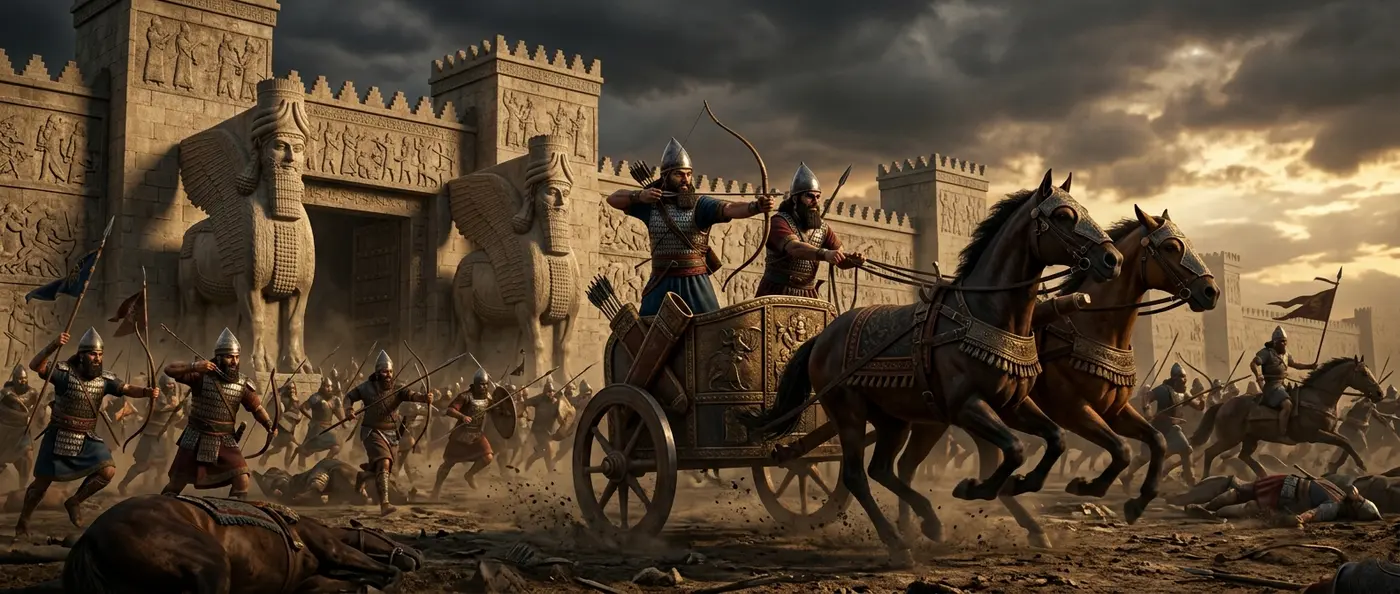
Buried in the British Museum's archives, among thousands of clay tablets from Nineveh, lie testimonies to one of humanity's most terrifying armies. The Assyrians weren't just conquerors — they were the pioneers of organized terror as a weapon of war. Their methods would make even history's most brutal warriors shudder.
🗿 Rise of the Terror Empire
The Assyrian Empire started as a small city-state in northern Mesopotamia around 2500 BCE, but transformed into a war machine that dominated the Middle East for nearly 300 years. The Neo-Assyrian period (911-609 BCE) marked their peak, when their army became the most advanced and terrifying military force of its time.
Assyrians didn't just conquer territory — they created a system of terror that paralyzed enemies before battles even began. Wall reliefs from the palaces of Nineveh and Nimrud depict their methods with chilling detail: prisoners impaled alive, skinned, or blinded en masse. These images weren't artistic expression — they were propaganda, designed to terrorize anyone thinking of resistance.
In 701 BCE, when King Sennacherib campaigned against Judah, his forces systematically destroyed every city in their path. Archaeological finds from Jerusalem reveal buildings reduced to rubble, with foundation stones deliberately placed atop the debris — a clear message about "who really rules," as archaeologists note.
⚔️ The War Machine That Changed Combat
Assyrians weren't just violent — they revolutionized warfare. They developed history's first truly professional army, with specialized units, systematic training, and advanced equipment. They were the first to use iron weapons and armor en masse, giving them enormous advantages over enemies still using bronze.
Their innovation didn't stop there. Assyrians developed the first effective siege engines — mobile towers, battering rams, and catapults that could topple even the strongest walls. Their engineers built ramps from earth and stone to reach wall tops, while specialized sapper units undermined fortification foundations.
But perhaps their most terrifying innovation was psychological warfare. Assyrians understood that fear could be more powerful than any weapon. When they conquered a city, they selected specific leaders and officials for public execution using the most barbaric methods. Remaining inhabitants were left alive to spread terror stories to neighboring cities.
🏛️ Nineveh: Capital of Terror and Knowledge
Paradoxically, the same empire that built power on terror also created the ancient world's greatest library. King Ashurbanipal (669-631 BCE), known for battlefield cruelty and lion-hunting skills, was also a passionate knowledge collector.
His Nineveh library contained over 30,000 cuneiform clay tablets, including the oldest known literary work — the Epic of Gilgamesh. When British archaeologists discovered the library in the 19th century, they found rooms filled with shattered tablets covering floors a foot deep. The tablets contained medical knowledge, mathematics, astronomy, divination, and diplomatic correspondence.
Ashurbanipal didn't just collect knowledge — he plundered it. During campaigns against Babylon, his forces seized not only treasures but entire libraries. Babylonian scribes were captured and forced to work in Nineveh, copying and translating ancient texts. This way, Nineveh became Mesopotamia's intellectual center, concentrating millennia of knowledge in one place.
The Library of Nineveh
Over 30,000 clay tablets with knowledge from across Mesopotamia, including the Epic of Gilgamesh and medical texts.
Cuneiform Writing
Assyrians perfected the writing system, with characters so small they required magnifying glasses to read.
Learning Center
Specialized scholars (ummânu) dealt with magic, divination, astronomy, and therapeutic medicine.
💀 Methods That Shocked the Ancient World
Assyrians developed an entire "menu" of punishments and executions, each designed for maximum psychological impact. Royal inscriptions proudly describe how their enemies suffered. King Ashurnasirpal II (883-859 BCE) was particularly notorious for his cruelty, boasting that he "skinned nobles alive and covered walls with their hides."
Mass population deportation was another tactic Assyrians perfected. Entire cities were emptied and inhabitants relocated to other empire regions, breaking homeland ties and making rebellion nearly impossible. An estimated millions of people were forcibly moved during Assyrian rule.
However, Assyrians weren't just destroyers. Their administrative system was exceptionally organized, with provinces, governors, and an extensive road network enabling rapid troop and information movement. They developed one of the first postal systems, with horse-changing stations every 30 kilometers along royal roads.
🔥 The Execution Rock of Nineveh
At Nineveh's Tsarevets fortress stood the "Execution Rock" — a steep cliff where condemned prisoners were thrown into the void. Archaeologists have found bones at the rock's base, evidence of harsh Assyrian justice.
🗺️ The Empire's Extent
At its peak, the Assyrian Empire stretched from Egypt to the Persian Gulf and from Cyprus to Iran's mountains. It was the first truly "global" empire, controlling trade routes, resources, and populations across a vast geographical area. Assyrian kings called themselves "Kings of the Universe" and "Kings of the Four Corners of the World."
In 612 BCE, a Babylonian-Median alliance attacked Nineveh. The city that had spread so much terror fell after a three-month siege. The conquerors burned palaces and libraries, but ironically, the fire that destroyed the city baked the clay tablets, preserving them for future archaeologists. Thus, the knowledge Assyrians gathered through violence survived their fall.
🏺 Legacy of Terror and Knowledge
Assyrians left a dual legacy — on one hand, they perfected terror as a dominance tool; on the other, they preserved and concentrated millennia of knowledge. Their military innovations influenced all subsequent empires, from Persians to Romans. Their provincial administrative system with central control became the template for future empires.
Today, archaeologists continue discovering Assyrian evidence. In 2016, ISIS destroyed the Temple of Nabu at Nimrud, erasing another piece of this ancient heritage. Nevertheless, thousands of tablets from Nineveh's library remain untranslated in museum basements, waiting to reveal their secrets.
Assyrians remind us that power based solely on terror is ephemeral. The empire that seemed invincible for three centuries collapsed within years when enemies united against it. But the knowledge they gathered — even violently — survived, providing invaluable information about ancient Mesopotamian civilizations.
📊 Comparison with Other Ancient Empires
📜 Lessons from the Fall
The Assyrian rise and fall reveals how empires collapse. Despite military superiority and sophisticated administration, excessive reliance on terror created enemies everywhere. When leadership weaknesses appeared, subject peoples and neighboring powers united forces.
The end came quickly and violently. Within a generation, the empire that dominated the Middle East vanished. Their cities were abandoned, palaces burned, and people scattered. The Bible references Nineveh as an example of punished wickedness, while ancient Greek historians described Assyrians as the epitome of tyranny.
Today, as archaeologists continue deciphering thousands of tablets from Nineveh, we learn more about this complex civilization. Beyond warfare, Assyrians excelled at administration, scholarship, and construction. The empire that terrorized the ancient world for three centuries vanished in a single generation, leaving behind only clay tablets and stone reliefs.