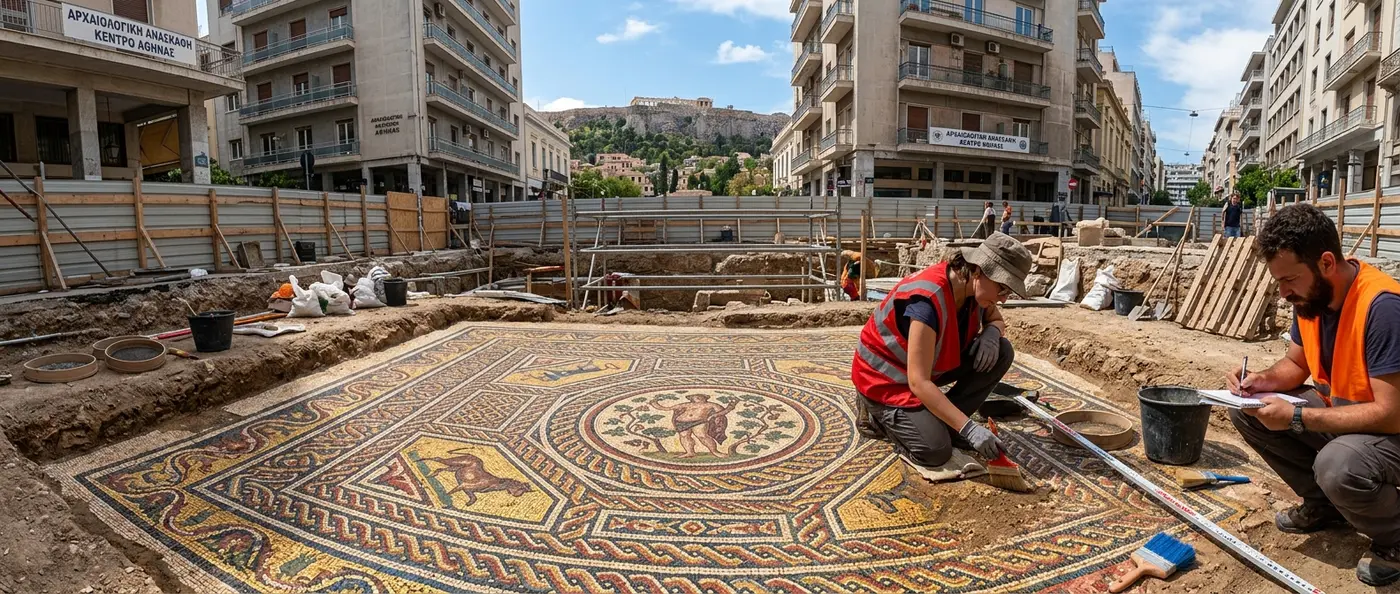
A backhoe hit stone at 11.5 feet down. What construction workers thought was bedrock turned out to be 2,400-year-old art. The random dig for an underground parking garage in central Athens uncovered a breathtaking 4th century BC mosaic in January 2026, revealing an unknown Classical-era building complete with symposium halls and intricate satyr scenes that archaeologists are calling one of the finest preserved examples of ancient Greek mosaic work ever found in Attica.
🏛️ The Moment Everything Stopped
January 15, 2026. Workers digging foundations for a new underground parking space near Plaka struck what looked like a flat stone surface 3.5 meters down. The foreman called a halt. Good thing — that "stone" was actually thousands of carefully arranged pebbles covering 45 square meters of pristine ancient floor.
The Athens Antiquities Authority took control within hours. What emerged over the next few days was an entire mosaic floor, so well-preserved that individual pebbles still held their original positions after nearly two and a half millennia. Dr. Maria Papadopoulou, the archaeologist leading the excavation, calls it one of the best-preserved examples of late Classical mosaic art found in Attica.
The mosaic depicts scenes from mythology and daily life, centered around two satyrs in dancing and musical poses. The construction technique — using small river pebbles of different colors — echoes the famous mosaics of Eretria and Pella, suggesting communication and technical exchange between ancient Greek cities that historians are now scrambling to map.
🎨 The Art of Ancient Pebbles
The Athens mosaic follows the pebble floor technique that dominated 4th century BC Greece. Unlike later Roman mosaics that used cut cubes (tesserae), ancient Greek craftsmen hand-selected natural pebbles from rivers and beaches, sorting them by color and size like a painter organizing a palette.
The central scene shows two satyrs — mythical creatures linked to Dionysus, god of wine and ecstasy. The younger satyr plays a flute while the older one, sporting a full beard, dances in rapture. The detail work is staggering. Pebbles were placed to create shadows and give volume to the bodies, turning flat stone into three-dimensional art.
Around the central scene, an intricate geometric pattern of meanders and anthemia frames the composition. The color scheme includes white from Parian marble, black from volcanic stone, red and ochre from local rock, plus shades of gray and brown. Each pebble was chosen not just for color but for how light would hit its surface.
🏺 The Building and Its Purpose
Excavations revealed that the mosaic belonged to a large symposium hall, part of a luxurious private residence. Along three sides of the room, archaeologists found raised platforms where couches were placed for symposium participants. This layout is classic for an andron — a men-only room where symposiums took place.
Symposiums were the social heartbeat of wealthy Athenian life. In these gatherings, men drank wine mixed with water, debated politics and philosophy, listened to music, and watched dance performances. The choice of satyrs as the central theme wasn't random — they symbolized the ecstasy and liberation that accompanied these gatherings.
Architectural Elements
The room measured 7.5 x 6 meters, with an entrance from the east side. Surviving wall sections show traces of red and black paint, indicating rich decoration throughout.
Symposium Finds
Fragments of cups, kraters, and other symposium vessels were discovered. An almost intact kantharos with a Dionysus scene confirms the space's connection to wine god worship.
Dating Evidence
Coins found in the destruction layer date to the late 4th century BC, providing a terminus ante quem for the building's use.
🔬 Analysis Techniques and Conservation
The mosaic study uses cutting-edge non-destructive methods. The conservation team employs portable X-ray fluorescence spectroscopy (pXRF) to determine the exact composition and origin of the pebbles. Initial results show white pebbles came from Pentelic and Parian marble, while colored ones originated from various Attica locations.
Preserving the mosaic in situ presents unique challenges. The Ministry of Culture decided to modify the parking garage plans to incorporate a visitable archaeological space. A specialized humidity and temperature control system will be installed to protect the mosaic.
The cleaning and conservation process will take at least 18 months. Each pebble gets cleaned individually with lasers, while the substrate gets reinforced with special mortars compatible with ancient materials. Meanwhile, detailed digital documentation proceeds with 3D scanning and photogrammetry.
⚖️ Comparison with Other Period Mosaics
The new Athens find joins a series of important 4th century BC mosaics discovered across the Greek world. Comparing them reveals fascinating details about the art form's evolution and spread.
🏛️ Greek Mosaics 4th cent. BC
The Athens mosaic shares many elements with the Eretria example, particularly in satyr themes. But the Athens execution is more sophisticated, with smaller pebbles allowing greater detail. This suggests mosaic art continued evolving throughout the 4th century, reaching new levels of refinement.
🗿 Significance for Understanding Ancient Athens
This discovery fills crucial gaps in our understanding of Classical Athens private architecture. Until now, most knowledge came from public buildings and temples. The new mosaic offers a rare glimpse into how wealthy Athenian citizens actually lived.
The building's location, near the ancient Agora but outside the classical city walls, suggests Athens expanded southward during the 4th century BC. This aligns with historical sources describing economic prosperity and population growth after the city's mid-century reconstruction.
💡 Why This Matters
The Athens mosaic is the first so well-preserved example from the city itself. While we knew about luxurious residences from written sources, this is our first clear view of the wealth and artistic sophistication that characterized these homes.
Following the discovery, four neighboring plots around the Acropolis were placed under archaeological control. Archaeologists believe many more surprises hide beneath Athens' modern urban fabric. Systematic surveys are already planned for adjacent plots where construction projects are scheduled.
🌍 International Impact and Future Plans
Fifteen international specialists have visited the site since February. Experts from Oxford University and the German Archaeological Institute have already examined the space. An international collaboration is planned to study construction techniques and compare with other Mediterranean mosaics.
The Ministry of Culture announced an ambitious plan to create an underground archaeological museum on the site. Visitors will see the mosaic in its original position, while digital reconstructions will recreate an ancient symposium. Project completion is scheduled for 2028.
The discovery is expected to boost tourism in the area. The Athens Municipality plans to create an archaeological route connecting the new find with other area monuments, creating a walk through Classical Athens.
As work continues, new elements constantly emerge. A section of a second room with fresco traces was recently discovered, suggesting the entire residence was richly decorated. New finds show the house had at least four rooms with rich decoration, bringing us closer to the people who walked these spaces 2,400 years ago.