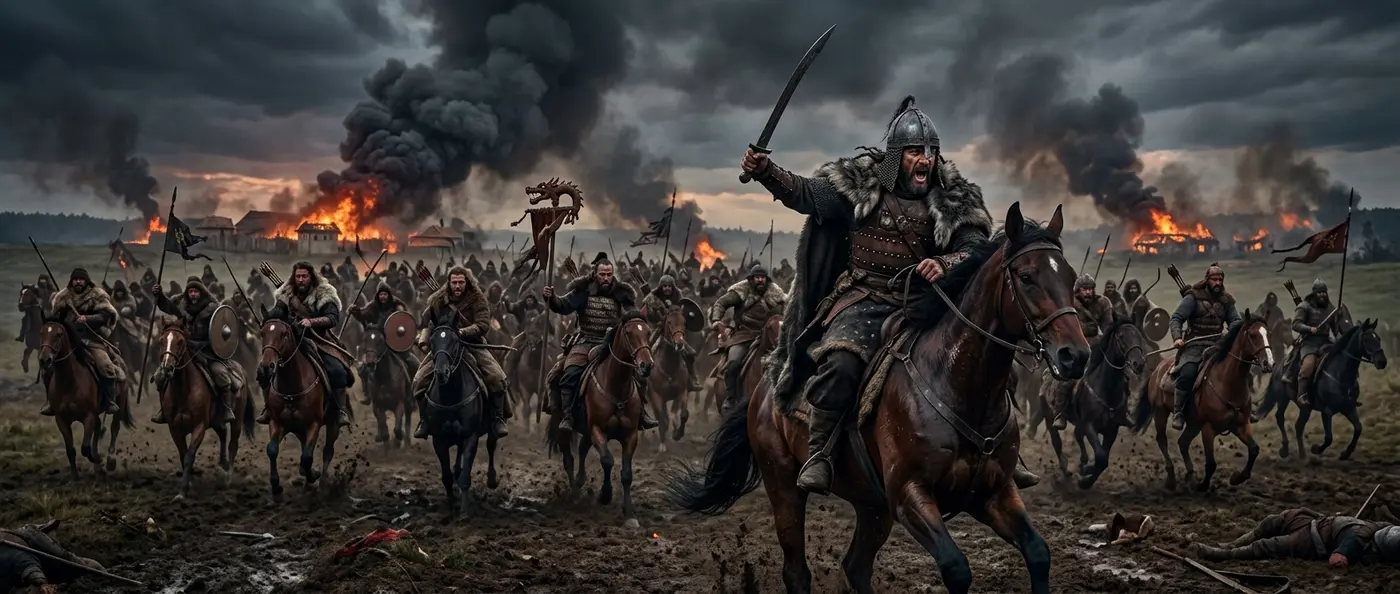
🏹 The King Who Terrorized Two Empires
Attila seized the Hun throne in 434 AD alongside his older brother Bleda. The empire they inherited stretched from the Alps and Baltic Sea in the west to somewhere near the Caspian Sea in the east. Their first known act as co-rulers was negotiating a peace treaty with the Eastern Roman Empire at the city of Margus (modern Požarevac).
The treaty terms revealed the Huns' power and Rome's weakness. The Romans agreed to double their annual subsidies and pay 700 pounds (300 kilograms) of gold each year. This wasn't tribute in name, but that's exactly what it was — protection money.
In 445 AD, Attila murdered his brother and became sole ruler of the Huns. From that moment, he governed as an absolute monarch, expanding his empire and intensifying pressure on Rome. Roman historians described him as a short man with an imposing presence, large head, small eyes, and sparse beard. Despite his small frame, his presence commanded absolute authority.
⚔️ Terror Campaigns in the Balkans
In 441 AD, while Eastern Roman forces were busy in the West and on eastern frontiers, Attila unleashed a devastating attack on the Danube frontier. He captured and destroyed major cities, including Singidunum (modern Belgrade). The Romans managed to arrange a truce for 442, recalling their forces from the West.
But in 443, Attila resumed his assault. He began by capturing and destroying cities along the Danube, then pushed inland toward Naissus (Niš) and Serdica (Sofia), which he completely destroyed. Next, he turned toward Constantinople, captured Philippopolis, and defeated the main Eastern Roman forces in a series of battles.
His second major attack on the Eastern Roman Empire came in 447 AD. This campaign was planned on an even larger scale than the 441-443 offensive, with the main thrust directed at the provinces of Lower Scythia and Moesia in southeastern Europe. He devastated the Balkan provinces and pushed south into Greece, stopping only at Thermopylae.
🗺️ The Gallic Invasion and the Battle of the Catalaunian Plains
Attila's next major campaign was his invasion of Gaul in 451 AD. Until then, he seemed to maintain friendly relations with the Roman general Aetius, the real ruler of the West at that time. His motives for the Gallic campaign aren't clearly recorded, but one catalyst was Honoria, sister of Emperor Valentinian III.
In spring 450 AD, Honoria sent her ring to Attila, asking him to save her from an arranged marriage. Attila claimed Honoria as his wife and demanded half the Western Empire as her dowry. When his demand was rejected, he launched his invasion of Gaul.
Honoria's Ring
The emperor's sister sent her ring to Attila as a plea for help, giving him the excuse to claim half the Western Empire as dowry.
The Roman-Visigoth Alliance
Aetius managed to ally with Visigoth king Theodoric I to jointly face the Hun threat — enemies becoming allies against a greater enemy.
The Siege of Orléans
Attila nearly captured Aurelianum (Orléans) before the allies arrived. The Huns had already entered the city when they were forced to withdraw.
The decisive clash was the Battle of the Catalaunian Plains in 451 AD. Many legends surround this campaign and the battle that followed. What's certain is that Attila nearly managed to capture Aurelianum (Orléans) before the allies arrived. The Huns had already gained a foothold inside the city when Aetius and Theodoric forced them to withdraw.
The battle that followed was one of antiquity's bloodiest. Visigoth king Theodoric was killed in the fighting, but the allies managed to halt Attila's advance. For the first time, the "Scourge of God" had been stopped. However, Attila wasn't decisively defeated and withdrew with his forces in good order.
🏛️ The Italian Invasion and the Legend of Pope Leo
In 452 AD, Attila turned toward Italy. He crossed the Alps and destroyed Aquileia, one of northern Italy's most important cities. He then proceeded to destroy other cities including Padua, Verona, and Milan. Terror spread throughout the Italian peninsula as the Hun army headed toward Rome.
Here we encounter one of the most famous legends surrounding Attila. According to tradition, Pope Leo I met Attila near the Mincio River and persuaded him not to attack Rome. Historians believe more practical reasons led to Attila's withdrawal: epidemics in his army, lack of supplies, and the threat of a Roman army from Constantinople.
💡 Myth vs Reality
While legend says Pope Leo persuaded Attila through divine intervention, historians believe Attila withdrew due to disease, food shortages, and the threat of Roman reinforcements from the East. He also likely received a substantial amount of gold in exchange for his departure.
👑 Death of the Conqueror
In 453 AD, Attila died suddenly on the night of his wedding to a young woman named Ildico. The circumstances of his death remain mysterious. According to historian Priscus, who visited Attila's court in 449 AD, the Hun king died from hemorrhaging after excessive alcohol consumption at the wedding feast.
Other sources suggest murder, perhaps by his bride or conspirators. Regardless of the cause, his death marked the end of the Hun empire. His sons couldn't maintain the empire's unity, which soon dissolved under pressure from internal conflicts and rebellions by subject peoples.
⚔️ Attila's Legacy
🗿 Attila in Mythology and Literature
After his death, Attila became a legendary figure appearing in many European traditions. In the German epic "Nibelungenlied," he appears as Etzel, a noble and generous king — very different from his historical image. In Icelandic sagas, he appears as Atli, a greedy and cruel ruler.
These contrasting portrayals show how different peoples remembered him. To the Romans, he was the "Scourge of God," a barbarian destroyer of civilization. To the peoples who followed him, he was a charismatic leader who led them to unprecedented greatness. Priscus, who met him personally, described him as a man simple in his habits, eating from wooden plates while his guests ate from gold and silver vessels.
🔬 The Archaeological Search for His Tomb
The location of Attila's tomb remains unknown. According to Jordanes, a 6th-century historian, Attila was secretly buried in a triple coffin — iron, silver, and gold. The workers who dug the tomb were killed to prevent them from revealing its location, and a river was diverted over the grave.
Archaeologists and treasure hunters have searched for the tomb for centuries, mainly in the area of modern Hungary. Despite numerous theories and investigations, the tomb remains undiscovered.
The search for Attila's tomb continues to captivate imaginations. Some believe it lies beneath the Tisza River in Hungary, others argue it's buried somewhere in the vast steppes. Finding it would reveal new details about Hun burial practices and their material culture.
💭 Impact on European History
Attila's impact on European history extends far beyond his brief reign. His campaigns accelerated the decline of the Western Roman Empire, which collapsed definitively just 23 years after his death. The Hun threat forced various Germanic tribes to migrate westward, creating a domino effect of population movements that changed Europe's demographic map.
The need to confront Attila led to unprecedented alliances between Romans and barbarians, like the one with the Visigoths at the Battle of the Catalaunian Plains. These alliances laid the groundwork for future cooperation and eventual integration of Germanic tribes into the Roman system, shaping medieval Europe.
Attila remains one of history's most controversial figures. Was he a ruthless conqueror who destroyed countless cities and caused massive casualties? Or was he a capable leader who united various nomadic peoples and created one of his era's greatest empires? The truth, as often happens, lies somewhere in between. Attila was a product of his times, a period of violent changes and population movements that shaped modern Europe.