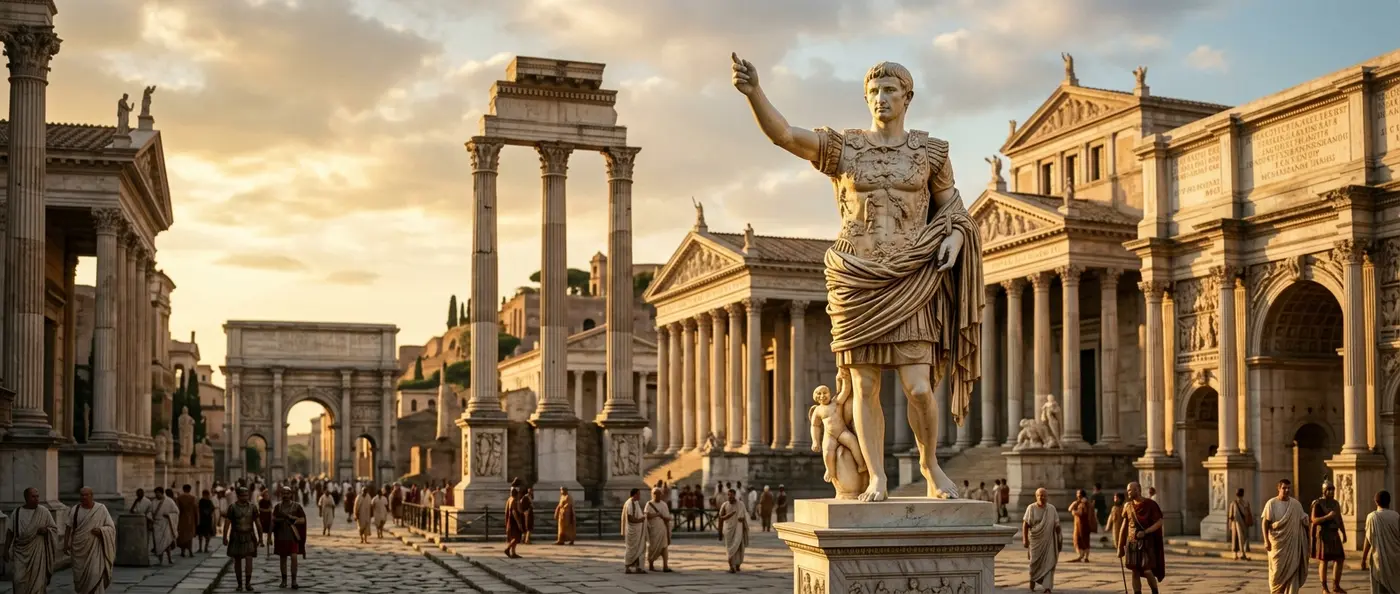
A teenager named Gaius Octavius stood by the Tiber River, watching his world collapse. The Roman Republic was bleeding to death from civil wars. Decades later, that same young man would become Augustus — the architect who rebuilt Rome into an empire that would dominate the world for four centuries. He didn't just change Rome. He rewrote the blueprint of Western civilization.
🏛️ From Octavius to Augustus
Nobody planned for Augustus to rule the world. Born in 63 BC as Gaius Octavius, he was Julius Caesar's great-nephew — close enough to matter, distant enough to stay alive. Then Caesar died on the Ides of March, 44 BC. Nineteen-year-old Octavius suddenly found himself heir to Rome's most powerful man. And Rome's most dangerous inheritance.
The path from teenage Octavius to Emperor Augustus reads like a political thriller. After Caesar's assassination, Octavius formed the Second Triumvirate with Mark Antony and Marcus Lepidus. They carved up the Roman world like a pizza, each taking their slice. The alliance worked — until it didn't. Personal ambitions have a way of destroying partnerships, especially when the prize is global domination.
The final showdown came at Actium in 31 BC. Octavius crushed Antony and Cleopatra in a naval battle that decided the fate of two continents. Antony's suicide left Octavius as the undisputed master of Rome. In 27 BC, the Senate awarded him the title "Augustus" — the revered one. The Roman Empire had officially begun.
⚔️ The Great Transformation
Augustus wasn't just another conqueror with a sword. He was a systems architect with a vision. "I found Rome brick and left it marble," he boasted. True enough — but the real transformation went deeper than construction projects. He rebuilt the DNA of Roman government.
His administrative overhaul created a bureaucratic machine that would hum efficiently for centuries. Augustus divided provinces between imperial and senatorial control, created a professional civil service, and established regular taxation that guaranteed steady state revenue. No more financial crises every time a general needed to pay his troops.
The military reforms were equally revolutionary. Augustus created the first professional standing army in Roman history — soldiers with steady pay, retirement benefits, and 25-year service terms. He stationed legions strategically along frontiers, creating a defensive system that protected the empire from external threats. Meanwhile, the Praetorian Guard kept order in Rome and protected the emperor from internal enemies.
📜 The Julian Laws and Social Engineering
Augustus had opinions about Roman bedrooms. Strong ones. In 18 BC, he passed the Julian Laws — legislation that tried to regulate the private lives of Roman citizens. These weren't suggestions. They were imperial commands backed by serious penalties.
The laws criminalized adultery for the first time, transforming it from a private family matter into a public offense. They offered incentives for marriage and childbearing, giving special privileges to families with three or more children. The irony? Augustus's own daughter Julia became a victim of these laws when she was convicted of adultery and exiled to the remote island of Pandateria (modern Ventotene).
According to Suetonius, Augustus was so controlling that he insisted on teaching his heirs to imitate even his handwriting style. This obsession with micromanagement reveals a leader who wanted to shape not just Rome's present, but its future character down to the smallest details.
Legal Reforms
Established laws governing marriage, adultery, and inheritance. Created a legal framework that influenced jurisprudence for centuries.
Economic Stability
Introduced stable currency and reorganized taxation, creating economic prosperity that lasted for decades across the empire.
Pax Romana
Inaugurated a period of peace and stability that allowed culture and commerce to flourish throughout the empire.
🏺 Art and Culture in the Augustan Age
Augustus's reign coincided with a golden age of Roman literature and art. Poets like Virgil, Horace, and Ovid flourished under his patronage, creating works that are still read and admired today. Virgil's Aeneid, celebrating Rome's mythical origins, became the empire's national epic — required reading for educated Romans.
In architecture, Augustus transformed Rome into a city worthy of its imperial status. The Forum of Augustus, the Mausoleum of Augustus, and the Ara Pacis (Altar of Peace) were just some of the monuments constructed during his reign. These buildings weren't just impressive — they were propaganda tools that projected the power and legitimacy of the new regime.
Augustan art combined Greek elegance with Roman practicality. Statues depicted the emperor as youthful and idealistic, even as he aged, projecting an image of eternal strength and stability. Every public artwork reinforced the message: Augustus had brought order from chaos.
💡 The Secret of Success
Augustus held power for 45 years because he gave Romans the illusion that the Republic had been restored. He kept republican institutions but drained them of real power, concentrating all meaningful authority in his own hands.
🌍 Expansion and Organization of the Empire
During his reign, Augustus significantly expanded Rome's borders. Egypt was annexed in 30 BC, bringing enormous wealth to the imperial treasury. Campaigns in Germany, Spain, and the Balkans extended Roman dominion to new territories, pushing the empire's boundaries to their greatest extent.
But Augustus wasn't just a conqueror. He understood that maintaining such a vast empire required effective administration. He created a system of provincial governance that balanced central authority with local autonomy. Provincial governors were carefully selected and regularly monitored to prevent corruption and abuse of power.
The road network Augustus developed became the arteries of the empire, enabling rapid troop movement and fostering trade development. The postal system (cursus publicus) he established allowed efficient communication between Rome and the most remote provinces. Information could travel from Britain to Syria faster than ever before in human history.
👑 The Imperial Cult
One of Augustus's most significant innovations was the introduction of emperor worship. While careful not to appear as a living god in Rome itself, he allowed and encouraged his worship in the eastern provinces, where deification of rulers had a long tradition.
After his death in 14 AD, the Senate officially declared him a god, and his worship spread throughout the empire. Temples dedicated to "Divine Augustus" (Divus Augustus) were built in every major city, creating a religious bond that united the diverse peoples of the empire under one spiritual umbrella.
This religious dimension of imperial power became a fundamental element of the Roman political system. Augustus's successors continued and expanded this practice, creating a system where political and religious authority were inseparable. The emperor wasn't just a ruler — he was a divine intermediary between heaven and earth.
⚔️ Rome Before and After Augustus
🗿 The Legacy of Augustus
When Augustus died on August 19, 14 AD, he left behind an empire that would dominate the Western world for the next four centuries. The governmental system he created proved remarkably resilient, surviving incompetent and tyrannical successors who should have destroyed it.
His influence extends far beyond politics. The month of August bears his name. The legal system he helped shape became the foundation of modern European law. The idea of a unified state spanning multiple peoples and cultures inspired countless later leaders, from Charlemagne to Napoleon to the architects of the European Union.
Perhaps Augustus's greatest legacy is proof that a capable leader can transform chaos into order, division into unity. He convinced Romans to abandon their republic while maintaining the illusion that he had restored it. This political genius, combined with his administrative competence, makes him one of the most influential leaders in human history.
Today, two millennia later, historians continue to study and debate the Augustan age. Was he a savior who brought peace and prosperity, or a dictator who destroyed Roman freedom? The answer, as often happens in history, is both. Augustus was a man of his time who shaped the world according to his vision — a vision that forever changed the course of Western civilization.