🗿 The Kingdom That Connected Three Continents
The Kingdom of Axum wasn't just another African empire. Between the 1st and 8th centuries CE, it controlled the economic lifeline between Rome and India. Gold, ivory, frankincense, and myrrh flowed through Axumite ports on the Red Sea, generating wealth that funded some of humanity's most audacious architectural projects.
Axum's rulers minted their own currency in gold, silver, and bronze — a rare practice in sub-Saharan Africa. These coins, inscribed in Greek and Ge'ez, circulated from Alexandria to the Arabian Peninsula. The kingdom's strategic position at the crossroads of Africa, Asia, and Europe transformed it into an economic superpower that rivaled Rome and Persia.
This wasn't merely a trading post. Axum became a cultural melting pot where African traditions merged with Hellenistic influences, where Christianity encountered ancient beliefs, where Mediterranean architecture fused with African artistry. This unique synthesis produced monuments of unmatched grandeur — the towering obelisks that still pierce the Ethiopian sky.
⚒️ Engineering Miracles in Stone
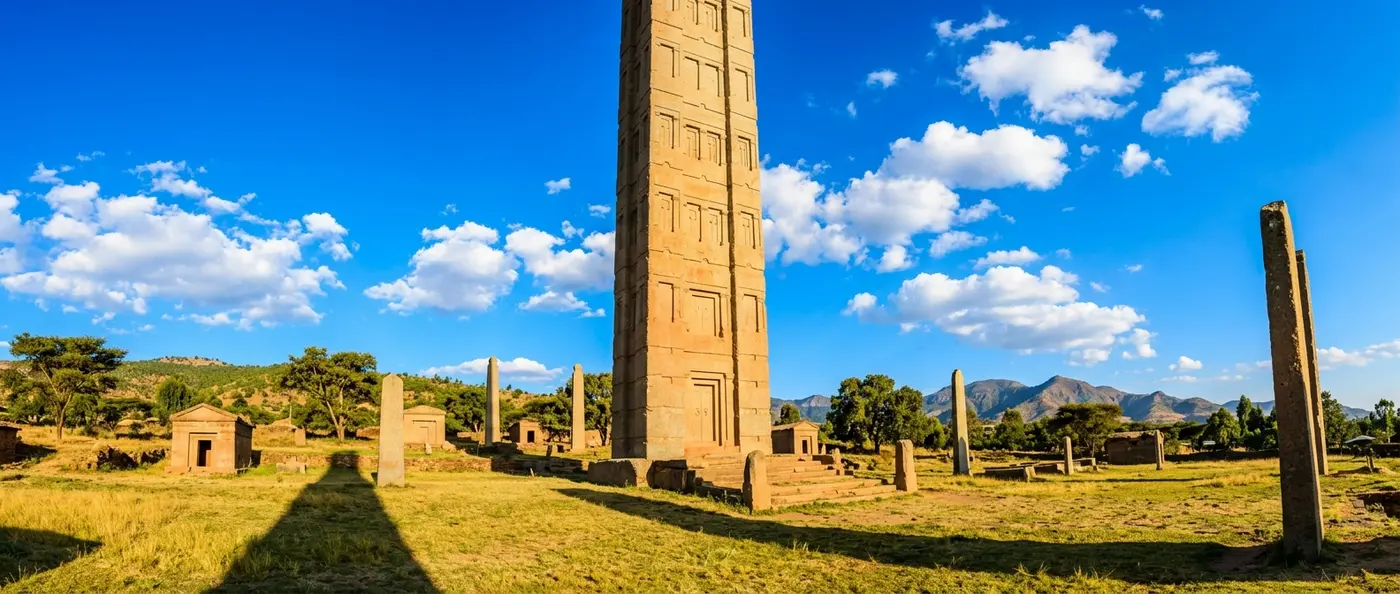
The obelisks of Axum represent one of ancient engineering's greatest puzzles. The tallest standing monument reaches 23 meters and weighs roughly 160 tons. Every obelisk was carved from a single granite block — a technical achievement that challenges modern understanding.
What makes Axum's obelisks unique isn't just their size. It's their breathtaking detail. Each surface is carved to resemble multi-story buildings, complete with false doors, windows, and even wooden beams. Every "floor" differs from the others, creating the illusion of stone skyscrapers frozen in time.
The granite came from quarries several kilometers away. Moving these monoliths would have required hundreds, perhaps thousands of workers, plus engineering techniques that remain partially mysterious. No contemporary records explain the process. No similar monuments exist elsewhere in Africa from this period.
The obelisks served as tomb markers for Axumite royalty, projecting both political authority and religious significance across the kingdom. Underground burial chambers beneath the obelisks contained the dead alongside rich grave goods that testified to the kingdom's far-reaching trade networks.
The largest obelisk ever attempted at Axum never stood upright. At 33 meters long and an estimated 520 tons, it remains broken on the ground where it fell during transport or erection. Had it been successfully raised, it would have been the tallest monolithic monument in the ancient world — taller than any Egyptian obelisk, taller than the Colossus of Rhodes.
Colossal Dimensions
The tallest standing obelisk reaches 23 meters, while the largest ever attempted stretches 33 meters in length.
Massive Weight
From 160 tons for medium obelisks to 520 tons for the largest — all carved from single granite blocks.
Architectural Illusion
Each obelisk features carved "doors" and "windows" that create the impression of multi-story buildings.
💎 Treasures Beneath the Earth
Below and around the obelisks, archaeologists have uncovered an extensive network of underground tombs. These burial chambers, known as the "catacombs of Axum," reveal the wealth and power of the kingdom's ruling class.
The tombs are carved into bedrock and consist of multiple chambers. Inside, excavators have found gold and silver jewelry, ceramics from distant lands, glass objects from Syria and Egypt, and Roman coins. These artifacts document Axum's extensive trade relationships across the ancient world.
Among the most remarkable discoveries are the so-called "thrones of Axum" — large stone slabs with carved symbols believed to have been used in coronation ceremonies. These thrones, positioned near the obelisks, underscore the connection between royal power and monumental construction.
🔍 The Ark Mystery
Ethiopian tradition claims the Ark of the Covenant is housed in the Church of Our Lady Mary of Zion in Axum. While no archaeological evidence supports this belief, it has made Axum a sacred pilgrimage site for millions of Ethiopian Christians.
⛪ From Obelisks to Christianity
Axum became one of the world's first kingdoms to officially adopt Christianity, around 330 CE under King Ezana. This transition fundamentally changed the kingdom's character and its monuments.
After Christianization, obelisk construction gradually ceased. Churches began rising instead, many built with stones from earlier monuments. Yet the obelisks weren't destroyed. They remained standing, silent witnesses to a vanished era.
The Church of Our Lady Mary of Zion, built in the 4th century and reconstructed several times since, became Axum's new religious center. Today, thousands of pilgrims visit the city annually, combining religious devotion with admiration for the ancient monuments.
Axum's decline began in the 7th century CE. The rise of Islam and Arab control over maritime trade routes isolated the kingdom from its traditional trading partners. Gradually, the center of Ethiopian power shifted southward.
Despite its decline as a political and economic center, Axum retained its religious and symbolic significance. Ethiopian kings continued to be crowned in the city until the 20th century, acknowledging its connection to the glorious past.
Today, Axum's obelisks are recognized as a UNESCO World Heritage Site. They serve not only as tourist attractions but as symbols of Ethiopian identity. The return of an obelisk from Italy in 2005, taken during the Italian occupation of the 1930s, was celebrated with national festivities.
🏺 Comparison with Other Monumental Works
🔬 Modern Research and Discoveries
Archaeological research at Axum continues to reveal new insights about this enigmatic civilization. Recent excavations have uncovered additional tombs, residential remains, and evidence of the kingdom's extensive trade network.
Modern technologies like ground-penetrating radar and satellite imaging have revealed that ancient Axum was much larger than previously believed. Beneath the modern city lie countless secrets waiting to be discovered.
One of the most intriguing questions occupying researchers is the precise method of obelisk construction and erection. Experimental archaeological studies attempt to recreate ancient techniques, but the mystery remains unsolved. How did ancient craftsmen transport hundreds of tons of granite without modern machinery? How did they manage to erect these colossi vertically with such precision?
The obelisks of Axum remain one of the most impressive achievements of human creativity and technical skill. They stand as proof that Africa was always home to great civilizations, capable of creating monuments that endure through time and continue to inspire awe millennia later.