🏛️ Nebuchadnezzar II's Babylon
Nebuchadnezzar II ruled from 605 to 561 BCE. He transformed Babylon into the ancient world's most magnificent city. His name, from the Akkadian Nabu-kudurri-uṣur, meant "O Nabu, protect my heir" — and protect it he did, turning his inheritance into an empire that stretched from the Persian Gulf to the Mediterranean.
The son of Nabopolassar, founder of the Chaldean Empire, Nebuchadnezzar cut his teeth on warfare early. At 607/606 BCE, still crown prince, he led armies alongside his father through the mountains north of Assyria. His military genius showed at the Battle of Carchemish in 605 BCE, where he crushed the Egyptian army and secured control of all Syria.
When his father died on August 16, 605 BCE, Nebuchadnezzar raced back to Babylon and claimed the throne within three weeks. The speed with which he consolidated power and returned to Syria reflected his iron grip on the empire. This wasn't just succession — it was a masterclass in ancient power politics.
🌿 The Garden Myth
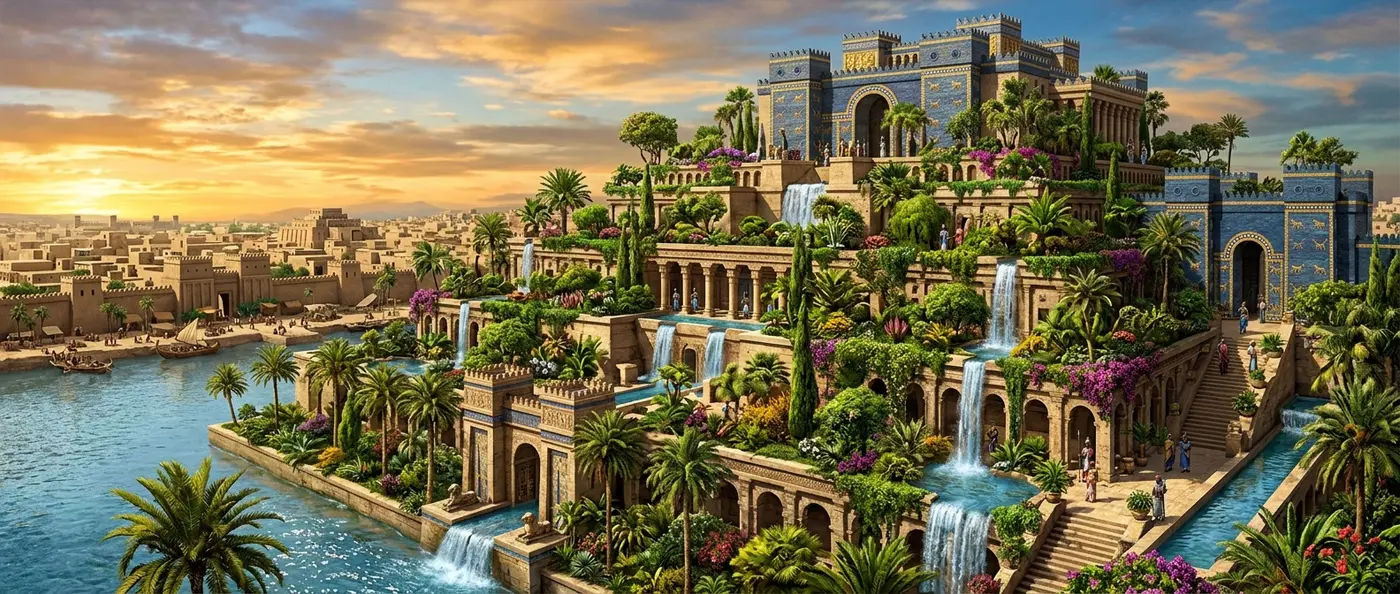
The story sounds perfect. Too perfect. Nebuchadnezzar's wife, homesick for the green mountains of Media, pined for her homeland in the dusty plains of Mesopotamia. So the king built her a mountain. An artificial one, covered in cascading terraces of trees, shrubs, and flowers from across the known world.
Ancient writers described the gardens as a series of stepped terraces rising like a green pyramid above the city. Water lifted from the Euphrates through an elaborate system of pumps nourished this hanging paradise. The engineering alone would have been revolutionary — a feat of hydraulics that wouldn't be matched for centuries.
But here's the problem: nobody who actually lived in Babylon wrote about them. The detailed descriptions come from Greek and Roman historians who visited centuries later, if they visited at all. Herodotus, who toured Babylon around 450 BCE, mentions the city's walls, gates, and temples. No gardens.
🔍 The Archaeological Void
Archaeologists have mapped Babylon's ruins extensively. They've found Nebuchadnezzar's throne room with its glazed brick lions. They've uncovered the Ishtar Gate's brilliant blue tiles. They've traced the Processional Way where New Year festivals paraded through the city. But the Hanging Gardens? Nothing.
Archaeologists have searched extensively. German archaeologist Robert Koldewey spent 18 years excavating Babylon starting in 1899. He found a vaulted building near the Southern Palace that he hoped might be the gardens' foundation. The structure had thick walls and an unusual well system. But no evidence of the elaborate terraces or irrigation described in ancient texts.
Modern excavations have been even more thorough. Every major building Nebuchadnezzar constructed has been identified and mapped. The double walls surrounding the city. The hanging gardens of the palace. The ziggurat Etemenanki — the biblical Tower of Babel. All confirmed by archaeology. Except the gardens.
💡 Why no traces?
Some researchers argue the gardens could have been completely destroyed by time and Euphrates floods. Others suggest they might have been in a different location than archaeologists expected, or even in a different city entirely — like Nineveh.
⚔️ Military Campaigns and Babylonian Power
Nebuchadnezzar wasn't just a builder — he was a conqueror. From June to December 604 BCE, he campaigned through Syria and Palestine, receiving submission from local states including Judah and capturing the city of Ashkelon. With Greek mercenaries in his armies, further campaigns followed to extend Babylonian control over Palestine for the next three years.
In 597 BCE, Nebuchadnezzar captured Jerusalem on March 16, deporting King Jehoiachin to Babylon. The siege of Jerusalem ended with its capture in 587/586 BCE and the deportation of prominent citizens, with further deportation in 582 BCE. He followed the methods of his Assyrian predecessors — rule through fear and forced relocation.
Each conquest filled Babylon's treasury. Tribute flowed into Babylon from conquered territories. Skilled craftsmen were relocated to beautify the capital. The wealth that funded Nebuchadnezzar's building projects came from the systematic exploitation of his empire.
Fortification Works
Built double walls around Babylon with towers every 18 meters. The famous Ishtar Gate was decorated with sculpted lions and dragons in glazed brick.
Temples and Palaces
Renovated Marduk's temple and built the famous palace with 600 rooms, decorated with polychrome tiles showing hunting scenes and mythical creatures.
Hydraulic Engineering
Created an extensive network of canals for irrigation and navigation, connecting the Tigris with the Euphrates through artificial waterways.
🏺 Babylonian Culture and Daily Life
Nebuchadnezzar's Babylon was a cosmopolitan metropolis. The Babylonians and Assyrians of 2105-540 BCE developed sophisticated versions of Sumerian and Akkadian dress styles. Two basic garments existed for both sexes: the tunic and the shawl, cut from single pieces of cloth.
The tunic reached the knee or ankle, had short sleeves and a round neckline. Over it they draped one or more shawls of different proportions and sizes, all generally fringed. Wool was the most commonly used material, in bright or vivid colors. Decoration was rich, with geometric patterns in embroidery or printing.
Hair care was crucial for both men and women. Hair was grown long and carefully shaped into curls, with false hair added if needed. Perfumes, oils, and black dye were used on hair. Men cultivated long, carefully groomed beards with curls. Elaborate grooming signaled wealth and position.
🔬 Modern Theories and Research
Contemporary researchers have proposed several theories for the Hanging Gardens mystery. One suggests the gardens weren't in Babylon at all but in Nineveh, the Assyrian capital. Reliefs found there show gardens with irrigation systems that match ancient descriptions.
Dr. Stephanie Dalley of Oxford University argues that the gardens were built by the Assyrian king Sennacherib in Nineveh around 700 BCE. Her evidence includes cuneiform texts describing Sennacherib's palace gardens and an aqueduct system that brought water from mountain springs 50 miles away. The confusion, she suggests, arose because "Babylon" was sometimes used to refer to the entire Mesopotamian region.
Another theory proposes the gardens were real but completely destroyed. Babylon suffered multiple catastrophes after Nebuchadnezzar's death, including floods and wars. Organic materials from the gardens would have decomposed entirely over time, leaving no archaeological trace.
📊 Theories About the Hanging Gardens
🗿 Nebuchadnezzar's Legacy
Whether the Hanging Gardens existed or not, Nebuchadnezzar's legacy is undeniable. He transformed Babylon into the world's largest city of its time. His constructions, from the Ishtar Gate to the Tower of Babel (Etemenanki), impressed visitors for centuries.
Nebuchadnezzar died around 561 BCE and was succeeded by his son Amel-Marduk. The empire he left behind was the Middle East's dominant power, though it didn't survive long after his death. In 539 BCE, Babylon fell to the Persians under Cyrus the Great.
The paradox endures. Nebuchadnezzar built monuments that lasted millennia. His walls, gates, and palaces still rise from Mesopotamian sand. Yet the one structure that captured imaginations most completely — the Hanging Gardens — remains a ghost. The most celebrated wonder may have existed only in imagination.
Today, the question of the Hanging Gardens remains open. Were they a real architectural achievement lost to time? A misinterpretation of ancient texts? Or maybe a myth that grew with each retelling? We may never know for certain. What we do know is that the idea of the Hanging Gardens continues to fascinate us, just as it fascinated the ancients who first described them.