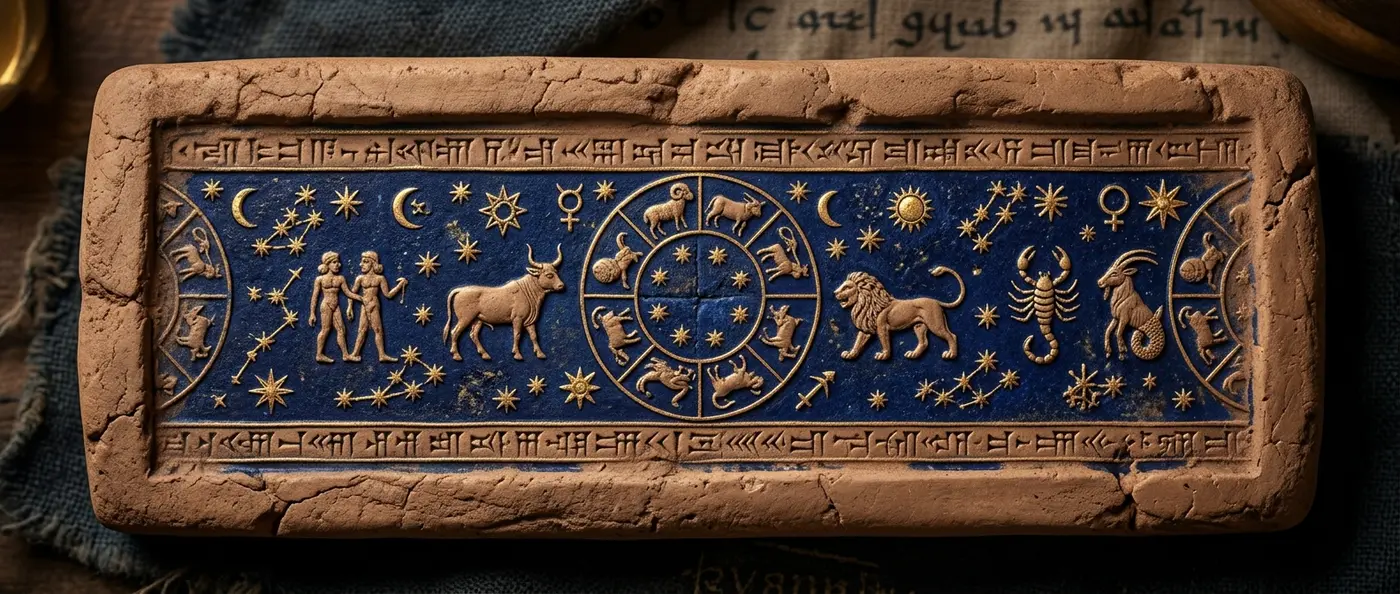
Every time you check your horoscope or wonder if you're compatible with that Scorpio, you're using a system born in the brick temples of ancient Babylon 2,500 years ago. Babylonian priest-astronomers, watching the night sky from their towering ziggurats, created the first organized astrological system that would reshape how humanity sees the cosmos. What started as flood prediction would eventually become your daily horoscope.
🌙 Astrology's Birth in Mesopotamia
Mesopotamia — the land between the Tigris and Euphrates rivers — birthed many human achievements. Around 2300 BCE, Babylonians began systematically recording celestial movements. What began as seasonal prediction for agriculture evolved into an intricate system for interpreting the future.
Babylonian priest-astronomers observed the sky from tall ziggurats, pyramid-shaped temples rising above their cities. They recorded planetary positions, lunar phases, and eclipses with meticulous precision. These observations were carved into clay tablets using cuneiform script, creating humanity's first astronomical archives.
Their greatest breakthrough came around the 5th century BCE: dividing the ecliptic — the Sun's apparent path across the sky — into 12 equal segments of 30 degrees each. Each segment linked to a constellation, creating the zodiacal circle we know today. This innovation revolutionized sky interpretation and gave birth to modern astrology.
⭐ The 12 Signs and Their Babylonian Roots
The zodiac names we use today are Greek translations of original Babylonian terms. Babylonians named each constellation after their mythology or natural phenomena they observed during that time of year.
Aries got its name because its period coincided with lambing season. Taurus connected to the sacred bull of god Marduk. Gemini represented twin gods Lugalgirra and Meslamtaea. Each sign carried its own story and symbolism in Babylonian cosmology.
Babylonians believed gods communicated with humans through celestial signs. Planetary positions in various zodiac signs were interpreted as messages about the king's and kingdom's future. This practice, called "omina," was state secret of the highest importance.
📜 Clay Tablets and Astrological Texts
Thousands of clay tablets containing astronomical and astrological information have been discovered in ancient Mesopotamian cities. The most famous come from Ashurbanipal's library in Nineveh, dating to the 7th century BCE. These tablets contain detailed planetary motion calculations and eclipse predictions that proved remarkably precise.
One of the most significant texts is "Enuma Anu Enlil," a collection of about 70 tablets containing thousands of omens. Each omen connects a celestial phenomenon with a future prediction. For example: "If the Moon is visible on the 30th day, there will be a good harvest."
Babylonians also developed the first personal horoscopes around the 5th century BCE. The oldest surviving horoscope dates to April 29, 410 BCE, describing planetary positions at a child's birth. This practice marked the transition from state astrology to personal astrology.
Cuneiform Writing
Astrological observations were recorded using the world's oldest writing system, carving symbols into soft clay that was then fired for preservation.
Mathematical Precision
Babylonians used the sexagesimal system (base 60) for calculations, which survives today in our time measurements of 60 seconds and 60 minutes.
Lunar Calendar
The Babylonian calendar was based on lunar phases, with 12 months of 29-30 days and an additional month every three years to stay synchronized.
🔮 From Babylon to the World
Babylonian astrology didn't stay confined to Mesopotamia. After Alexander the Great conquered Babylon in 331 BCE, astrological knowledge spread throughout the Hellenistic world. Greek astronomers like Hipparchus and Ptolemy incorporated Babylonian methods into their own systems.
Greeks added their own philosophical interpretation, connecting zodiac signs with the four elements (fire, earth, air, water) and developing the concept of "houses" in horoscopes. From there, astrology traveled to Rome, India, the Arab world, and eventually throughout Europe.
A system created to predict floods and harvests in ancient Mesopotamia now generates billions in revenue through apps, books, and consultations. Today, millions worldwide read their horoscopes using essentially the same system Babylonians invented 2,500 years ago.
🌟 Did You Know?
The Capricorn symbol — half goat, half fish — comes from the Babylonian god Ea, depicted in this form as the god of wisdom and waters. Babylonians called him "Suhur-Mas," meaning "goat-fish."
🏛️ The Legacy of Babylonian Astrology
Babylonian astrology's influence extends far beyond horoscopes. The 360-degree circle system, dividing hours into 60 minutes and minutes into 60 seconds — all stem from the Babylonian sexagesimal system used for astronomical calculations.
Modern astronomers recognize the Babylonians' massive contribution to their science. The systematic observations they maintained for centuries enabled discoveries like the precession of the equinoxes. Even though astrology is no longer considered science, Babylon's astronomical legacy remains fundamental.
In our modern era, astrology experiences a renaissance, especially among younger generations. Smartphone apps, websites, and social media have made astrological information more accessible than ever. All based on the system ancient Babylonians invented, tapping into the same human impulse that drove ancient priests to climb ziggurats and scan the heavens.
📊 Babylonian vs Modern Astrology
🌌 The Future of Ancient Wisdom
As archaeologists continue discovering and deciphering Babylonian tablets, we learn more about their astrological system's complexity. Recent discoveries reveal Babylonians had developed methods for calculating Jupiter's orbit that foreshadowed integral calculus, 14 centuries before its official discovery.
The story of Babylonian astrology reminds us that human curiosity about the sky is as old as civilization itself. From Mesopotamian ziggurats to modern telescopes, we continue looking up, seeking answers to eternal questions about our place in the universe.
Next time you read your horoscope, remember you're participating in a tradition that began millennia ago on the banks of the Tigris and Euphrates. Babylonians couldn't have imagined smartphones and the internet, but their system for understanding the sky continues to accompany us, proving that some human needs are truly timeless.