⚔️ The Road to War
The Battle of Actium wasn't just naval combat. It was the bloody climax of a political chess game that started with Julius Caesar's assassination in 44 BC. After Caesar's death, three men carved up Roman power: Octavian (Caesar's nephew and adopted son), Mark Antony (Caesar's trusted lieutenant), and Marcus Aemilius Lepidus.
This alliance called itself the Second Triumvirate, claiming to "restore the Republic." The three men ruled as absolute dictators. They executed and seized the property of roughly 3,000 patricians, including the great philosopher Cicero. Blood flowed through Rome's streets as the triumvirs eliminated their enemies.
Lepidus gradually lost power, leaving Antony and Octavian to face each other across the Mediterranean. Antony controlled Rome's eastern provinces. Octavian dominated the west. War between them was now certain.
💑 Antony and Cleopatra: The Alliance That Shocked Rome
In 41 BC, Antony summoned Cleopatra to meet him in Tarsus, in modern-day Turkey. Egypt's last pharaoh arrived in spectacular fashion, sailing up the river on a golden barge dressed as the goddess Aphrodite. As art historian Diana E. E. Kleiner notes, "Cleopatra invested in her sea voyages with carefully chosen costumes, divine associations, expensive fabrics and jewelry, music, and exotic perfumes."
The strategy worked. Antony was instantly captivated and began a passionate affair, moving to Alexandria. This wasn't just romance. Cleopatra needed Antony to restore the old borders of the Ptolemaic kingdom. Antony needed Egypt's wealth for his military campaigns.
In 34 BC, Antony staged a ceremony in Alexandria where he proclaimed Cleopatra "Queen of Kings" and her son Caesarion (whom Antony recognized as Julius Caesar's son) "King of Kings." The three children he'd fathered with Cleopatra also received royal titles. Roman territories were handed out like party favors to Egyptian royalty.
🗡️ The Declaration of War
In Rome, Octavian weaponized these actions for a brutal propaganda campaign. In 33 BC, he obtained a document allegedly containing Antony's will, deposited with the Vestal Virgins. According to this will, Antony left vast territories to Cleopatra and their children and requested burial in Alexandria.
The revelation sparked outrage in Rome. Octavian accused Antony of planning to move the empire's capital to Alexandria. When Antony officially divorced Octavia (Octavian's sister), the break became final. Octavian declared war — not against Antony, but against Cleopatra, a clever move that let him avoid charges of starting civil war.
Antony's Will
The document allegedly leaving Roman territories to Cleopatra and requesting burial in Egypt caused scandal in Rome and gave Octavian his pretext for war.
Divorce from Octavia
The formal dissolution of Antony's marriage to Octavian's sister marked the definitive break in personal bonds between the two men.
Donations of Alexandria
The 34 BC ceremony where Antony distributed kingdoms to Cleopatra's children was seen by Romans as betrayal of imperial interests.
⚓ Preparing for Battle
Antony established his headquarters successively in Ephesus, Athens, and Patras, concentrating his main fleet in the Ambracian Gulf in northwestern Greece. More than 200 members of the Roman Senate followed him, showing he still had significant support.
Antony's fleet consisted of 500 ships, many of them massive warships with towers and catapults. He commanded 70,000 infantry. Octavian fielded 400 smaller but more maneuverable ships and 80,000 troops.
In the summer of 31 BC, Octavian's admiral Marcus Vipsanius Agrippa managed to cross the Ionian Sea and capture strategic points along the Greek coast. This cut Antony's supply lines from Egypt through the Peloponnese.
🏛️ The Strategic Mistake
Cleopatra's insistence on remaining at Antony's headquarters caused resentment among many Roman supporters. Many began defecting to Octavian, weakening Antony's position before the battle even began.
🌊 The Naval Battle of Actium
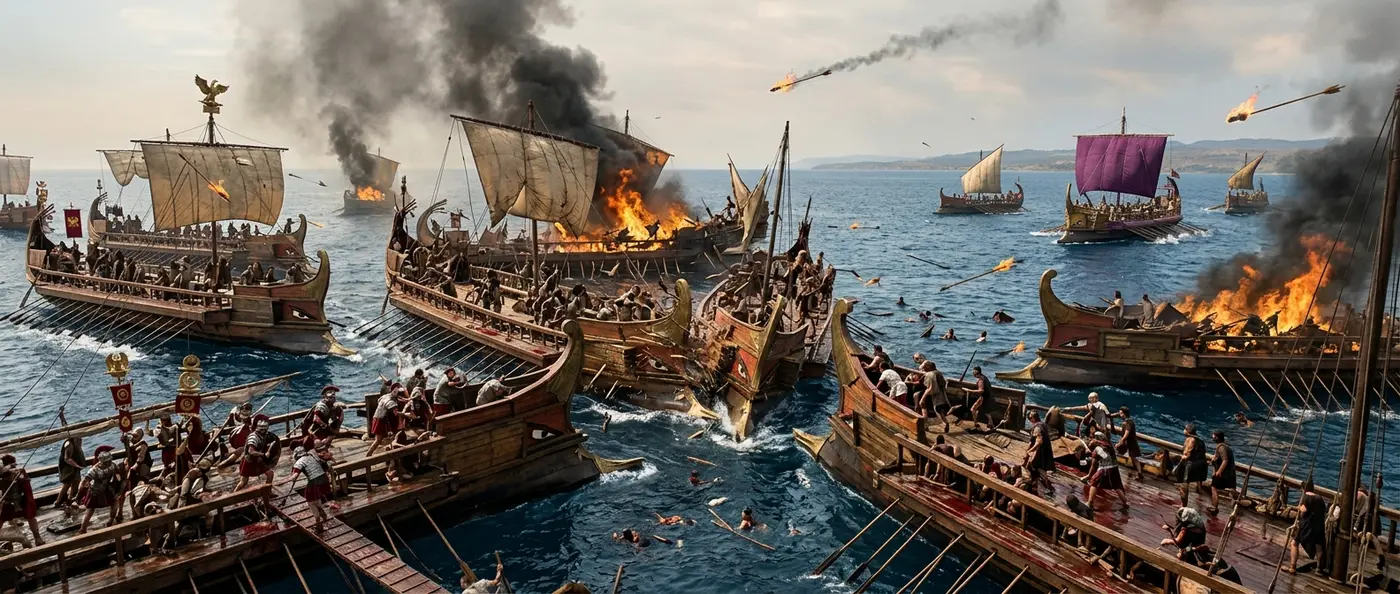
On September 2, 31 BC, Antony decided to fight a naval battle outside the Ambracian Gulf, near Cape Actium. He deployed his ships facing west, with Cleopatra's squadron (60 Egyptian ships) positioned behind the main battle line.
The battle began with both fleets trying to outflank each other. Agrippa's smaller, more agile ships had the advantage over Antony's heavy vessels. As the battle progressed, Octavian's fleet was clearly gaining ground.
At the battle's turning point, Cleopatra made a fateful decision. Cleopatra, seeing the battle's direction, made the decision to break through the line with her 60 ships and sail for Egypt. Antony, watching her flee, abandoned his flagship and followed her with a few vessels.
Without their commanders, the remaining forces crumbled. Antony's fleet surrendered to Octavian, and a week later his land forces also capitulated.
⚔️ Forces at Actium
💀 The Tragic End
After defeat at Actium, Antony and Cleopatra fled to Alexandria. For nearly a year they tried to organize their defense, but Octavian's forces were too strong. In the summer of 30 BC, Octavian arrived in Egypt with his forces.
Cleopatra fortified herself in her royal mausoleum and sent word to Antony that she planned to commit suicide. Antony, believing his beloved was dead, fell on his sword. Mortally wounded, he was carried to Cleopatra and died in her arms.
Cleopatra tried to negotiate with Octavian, but when she realized he intended to take her captive to Rome to parade her as a trophy, she decided to kill herself. Though legend says she died from a snake bite, historians believe she likely used poison.
🏛️ Consequences for the Ancient World
Octavian's victory at Actium marked the end of the Roman Republic and the beginning of the Roman Empire. In 27 BC, the Senate granted him the title Augustus, making him Rome's first emperor.
For Egypt, defeat meant the end of nearly three millennia of independent existence. The land of the pharaohs became a Roman province, and its vast wealth was used to fund Roman expansion.
The Battle of Actium also determined the cultural orientation of the Mediterranean. Octavian's victory ensured that Roman-Italian politics would dominate the entire empire. Antony's vision of Greco-Roman cooperation wouldn't be tested again until Constantine's era, three centuries later.
End of the Republic
The Roman Republic founded in 501 BC came to an end. Octavian became Augustus, Rome's first emperor.
End of Ptolemaic Dynasty
After nearly 300 years of rule, the Greek Ptolemaic dynasty lost control of Egypt, which became a Roman province.
📚 Historical Legacy
The story of Antony and Cleopatra has inspired countless works of art, from Shakespeare's play to modern films. But behind the romance lies harsh political reality.
Antony was a capable general and charismatic leader, but he lacked Octavian's cold effectiveness. Cleopatra, far from the femme fatale often portrayed, was a shrewd politician who tried to preserve her country's independence in a world dominated by Rome.
Actium remains one of the most decisive battles in world history. In a single day, the Mediterranean's future changed forever. Democracy gave way to empire, and the ancient world entered a new era that would last for the next five centuries.