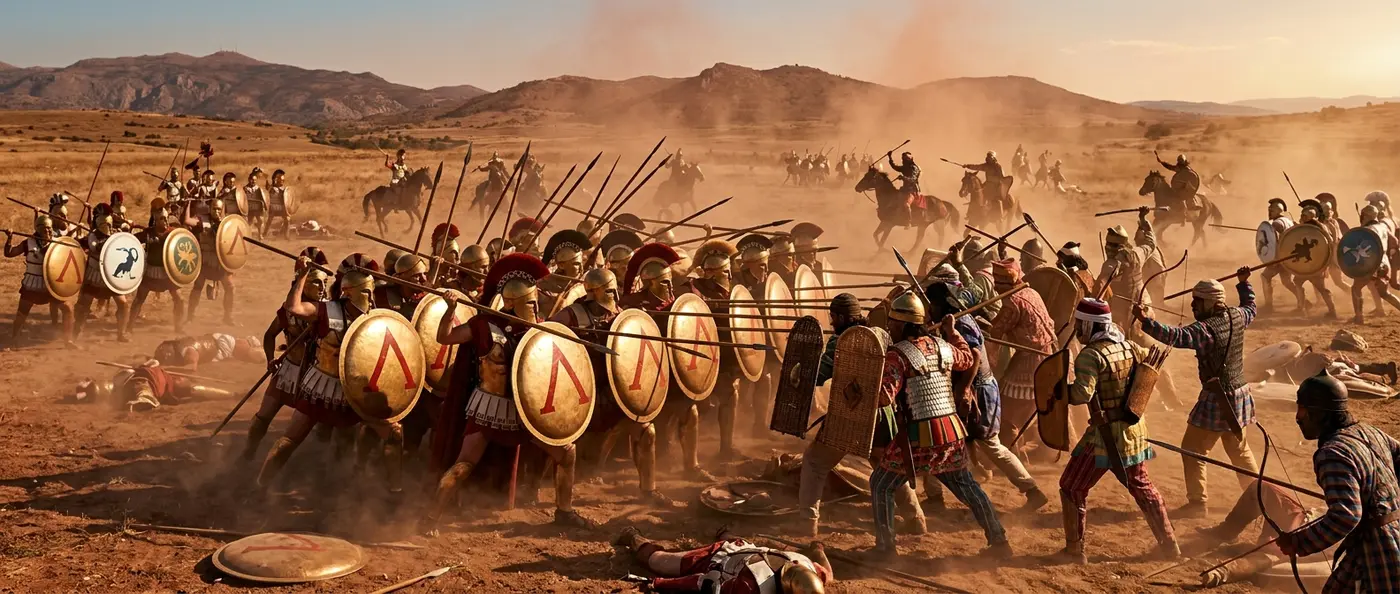
Blood soaked the Boeotian plains on July 479 BC. Tens of thousands of Greeks and Persians clashed in a battle that would decide whether Western civilization survived or died. The Battle of Plataea wasn't just another skirmish in the Persian Wars — it was the final act of a drama that began with Xerxes' invasion and would end with Persia's threat permanently erased from Greek soil.
🏛️ The Stage Set for War
After the catastrophic defeat of his fleet at Salamis in 480 BC, Xerxes fled Greece with most of his army. But he left behind something dangerous: General Mardonius with a massive force to finish what the invasion had started. Mardonius, a veteran commander and son-in-law of Darius, had one job — crush the Greeks once and for all.
The Persian force that stayed was still terrifying. Sources put Mardonius's strength at around 100,000 men, including allies from Boeotia and other Greek cities that had sided with Persia. Against them, the Greeks managed to scrape together about 40,000 hoplites under Spartan regent Pausanias.
Plataea wasn't chosen by accident. The town sat on the border between Attica and Boeotia, offering strategic advantages to both sides. Mardonius had set up his base there, exploiting his alliance with Thebes and control of the surrounding territory.
⚔️ The Forces That Collided
The Greek alliance brought together 31 city-states. Sparta provided 5,000 hoplites plus 5,000 perioeci, while Athens contributed 8,000 men. Corinth, Sicyon, and Tegea added significant numbers. Each city had its own reasons to fight, but all united against the common threat.
The Persian army drew from across the empire. Beyond Persians and Medes, it included Bactrians, Indians, Sacae, and other peoples from across the empire's vast territories. Their cavalry was particularly excellent and gave them a major advantage on open ground.
🗺️ The Strategic Chess Match
Pausanias initially positioned his forces on hills near the Persian camp. This gave him defensive advantage and made Persian cavalry charges difficult. Mardonius, meanwhile, tried to lure the Greeks into open terrain where his horsemen could operate freely.
For several days, both armies waited. Neither side wanted to make the first move. Persian cavalry conducted raids on Greek supply lines and managed to block some of the water sources the Greeks used. The pressure mounted on the Greek forces.
Persian Cavalry
The Persian light cavalry excelled at hit-and-run tactics. Their horsemen carried bows and javelins, striking fast and withdrawing before the heavily armored Greeks could react.
Greek Phalanx
The dense formation of hoplites with their long shields and spears was nearly impenetrable in direct combat. Spartan discipline and training were legendary.
Battlefield Geography
The terrain around Plataea mixed hills and plains. Greeks tried to exploit the hills while Persians preferred open ground.
🌅 The Critical Night and Dawn of Battle
Under pressure from Persian raids and with supply problems mounting, Pausanias decided on a nighttime movement to new positions near the Asopus River. The maneuver went wrong. When dawn broke, the Greek force was scattered and disorganized.
The Athenians had concentrated on the left wing, the Spartans on the right, and a small mixed force in the center near Plataea itself. Mardonius saw his opportunity. He ordered a general attack, believing he could crush the Greeks while they were still scattered.
The Persian assault began with a rain of arrows from their archers. Thousands of arrows darkened the sky as the Persians tried to break Greek lines from a distance. The Spartans under Pausanias endured the bombardment stoically, waiting for the right moment to counterattack.
💡 Mardonius's Fatal Mistake
Mardonius's decision to attack when the Greeks appeared disorganized proved fatal. What looked like weakness gave the Greeks the close-quarters battle they wanted, where hoplite superiority was decisive.
⚔️ The Battle's Climax
As the Persians closed in, the Greeks finally got the signal to attack. The Spartans, with their famous discipline, advanced in perfect formation against the Persians. The clash that followed was violent and bloody. The hoplites' long spears proved superior to the Persians' shorter weapons in hand-to-hand combat.
At the battle's peak, Mardonius himself, mounted on his white horse and surrounded by his 1,000 elite bodyguards, personally led the charge against the Spartans. The fighting around the Persian general was fierce, but eventually a Spartan named Aeimnestus managed to strike him down with a stone to the head.
🏃 The Collapse and Pursuit
Mardonius's death marked the beginning of the end for the Persian army. Without their commander, the Persians lost cohesion and began to retreat. What started as an organized withdrawal quickly became a rout. The Greeks, seeing the enemy flee, began a merciless pursuit.
Thousands of Persians were slaughtered during the retreat or in their camp. According to sources, of the 100,000 Persians, about 30,000 died, while Greek losses were only 2,000 men. The remnants of the Persian army retreated north to Thessaly and from there returned to Asia.
⚖️ Casualty Comparison
🏛️ The Victory's Consequences
The victory at Plataea, combined with the naval victory at Mycale around the same time, marked the definitive end of the Persian threat to mainland Greece. The Persians never again attempted to invade Greece. The battle proved that the Greek way of war — heavily armed hoplites in disciplined phalanx formation — was superior to Persian methods in direct confrontation.
For the Greeks, the victory had enormous psychological significance. It proved that when united, they could defeat even the era's most powerful empire. This confidence sparked classical Greece's golden age, with Athens rising to create the art and philosophy that still shapes our world.
The battle also had important military implications. It showed the importance of leadership — Mardonius's death destroyed Persian army cohesion. It also highlighted the value of discipline and training over numerical superiority.
🗿 The Battle's Memory
The Greeks honored their victory in various ways. At Delphi they dedicated a golden tripod supported by a bronze column shaped like three intertwined serpents. This column survives today in Constantinople, where Constantine the Great moved it. The names of the 31 cities that fought at Plataea are carved on it.
The Plataeans, whose city had been destroyed by the Persians, rebuilt with help from their allies. Every year they held the Eleutheria, a festival honoring the battle's dead. Their city became sacred and inviolate, a symbol of Greek freedom.
Pausanias, despite his great victory, met a tragic end. He was later accused of treason and died of starvation while seeking sanctuary in a temple. But Plataea's legacy lived on — proof that even the mightiest empire could bleed and break on Greek spears.