📖 Read more: Roman Mosaics: Art That Survived 2,000 Years
🏛️ The Christian Basilicas of Berat
Berat wasn't just another Roman outpost. Positioned along the Osum River and near the ancient Via Egnatia, this central Albanian city became a crucial hub for Christianity's spread through the Balkans. Between the 4th and 6th centuries AD, builders erected over a dozen basilicas across the rocky terrain — a construction boom that transformed the landscape in just two centuries.
These weren't simple prayer halls. The basilicas served as community centers where early Christians gathered for worship, education, and social activities. Their architecture followed the classic three-nave design with narthex, central nave, and semicircular eastern apse. But what set Berat's churches apart was their floors.
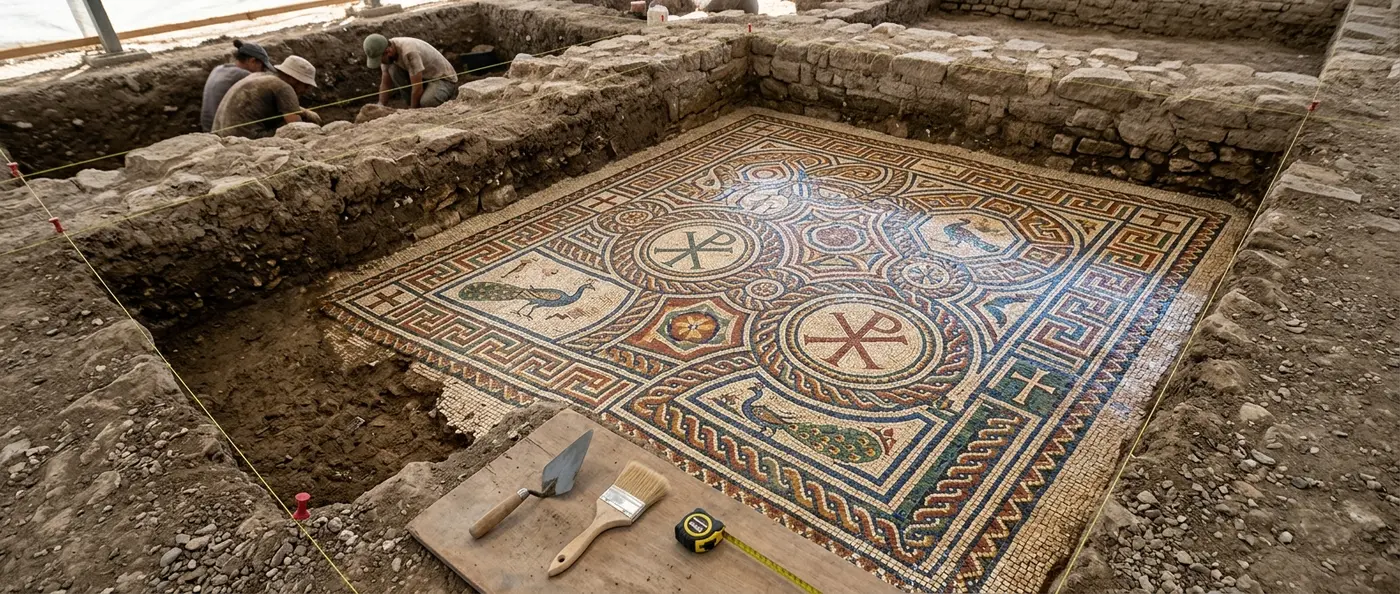
While most early Christian sites reserved mosaics for the altar area, Berat's basilicas carpeted their entire floors with intricate stonework. Worshippers walked across seas of geometric patterns, Christian symbols, and local Illyrian motifs that created a visual symphony underfoot. Each footfall crossed another piece of the sacred narrative.
🎨 The Art of Stone Storytelling
Berat's mosaics represent a unique fusion of Byzantine tradition and local craftsmanship. The artisans who created them used thousands of tiny tesserae cut from local limestone, marble, and ceramic materials. The result: complex geometric patterns, plant motifs, and Christian symbols embedded in limestone and marble.
The construction technique required extreme precision. Craftsmen first prepared the substrate with successive layers of mortar. They sketched designs with charcoal or red ochre. Then came the painstaking work — placing each tessera one by one, following predetermined patterns with mathematical precision.
White, black, red, and ochre dominate the color palette, creating stark contrasts that emphasize geometric shapes. The most fascinating elements combine Christian crosses with traditional Illyrian symbols like the double axe and solar wheel. These hybrid designs capture the gradual transition from paganism to Christianity in visual form.
⛪ Sacred Symbols in Stone
Every mosaic element carried deep symbolic weight. Crosses appeared in countless variations — Greek, Latin, and equal-armed — representing salvation and eternal life. Circular patterns evoked God's eternity, while squares represented the material world and nature's four elements.
The "Solomon's knot" motif appears frequently — a complex geometric pattern symbolizing the unbreakable unity between divine and human. This design, found in multiple Berat basilicas, reveals strong Eastern Christian influence in the region.
Crosses
Greek, Latin, and equal-armed crosses in various forms, often inscribed within circles or squares.
Doves
Symbols of the Holy Spirit and peace, typically depicted in pairs around chalices.
Fish
Christianity's oldest symbol, representing Christ and the faithful.
🔬 Recent Archaeological Breakthroughs
The 2019 excavation uncovered a nearly intact mosaic floor covering 450 square meters. This find preserved rare Greek inscriptions naming donors and construction dates — direct evidence of how these early Christian communities organized and funded their buildings.
Modern technology has revealed details invisible to the naked eye. Photogrammetry and spectroscopic analysis uncovered that certain tesserae had been coated with thin gold leaf, creating dazzling optical effects when light struck them. The craftsmen possessed advanced knowledge of optical effects and light manipulation.
Analysis of the mortars revealed a special composition containing crushed ceramics and volcanic ash — similar to the Romans' famous opus caementicium. This explains the mosaics' extraordinary durability across fifteen centuries of Balkan weather.
💡 Did You Know?
Berat's mosaics contain over 2 million individual tesserae. Placed end to end, they would stretch approximately 15 kilometers!
🏺 Balkan Connections
Berat's mosaics aren't isolated masterpieces. They're part of a broader network of early Christian monuments spanning the entire Balkans. Similar mosaics have been found at Stobi in North Macedonia, Philippopolis in Bulgaria, and Salona in Croatia — evidence of shared artistic workshops or at least close contact between craftsmen.
The similarities in patterns and techniques suggest traveling teams of artisans moved from city to city, carrying not just technical knowledge but also design templates. This explains why we find nearly identical motifs in locations hundreds of kilometers apart.
Yet Berat's mosaics maintain their own distinct identity. The incorporation of local Illyrian symbols like the double axe and solar wheel distinguishes them from counterparts elsewhere, highlighting the creative synthesis between Christian and pre-Christian traditions.
🛡️ Conservation Challenges
Preserving these treasures faces serious obstacles. Weather exposure, humidity, and human activity threaten their integrity. Many mosaics have suffered damage from erosion, ground subsidence, and pollution.
Albanian authorities, working with international organizations like UNESCO, have launched an ambitious conservation program. The project includes substrate stabilization, specialized laser cleaning of tesserae, and protective coatings that allow the mosaics to "breathe" without moisture exposure.
Digital documentation runs parallel to physical conservation. 3D scanning and photogrammetry create detailed digital copies ensuring that even if originals suffer damage, knowledge of them will survive for future generations.
📊 Balkan Mosaic Comparison
🌟 Modern Research Impact
Berat's mosaics offer invaluable insights into Christianity's Balkan expansion. Through pattern and inscription analysis, researchers reconstruct early Christian communities' social structures, economic activities, and cultural contacts.
Material and construction technique analysis contributes to understanding technological evolution and period trade networks. The presence of imported materials — marble from Proconnesus and glass from Syria — proves Berat was integrated into a vast exchange network spanning the entire Mediterranean.
The mosaics also provide crucial sources for religious art studies. The transition from purely geometric 4th-century motifs to more complex 6th-century representations reflects changes in theological thought and Christian iconography evolution.
Today, as Albania opens to tourism, Berat's mosaics gain new dimensions. They attract thousands of visitors who come to admire these early Christian art masterpieces. Simultaneously, they function as bridges connecting past and present, reminding us of the Balkans' deep historical and cultural heritage.