Inside the tomb of noblewoman Hatnefer, archaeologists discovered a golden scarab inscribed with texts from the Book of the Dead. This artifact, dating to around 1473 BCE, shows ancient Egyptians preparing for their afterlife journey with magical texts and spells to protect them from underworld dangers.
📜 What Was the Book of the Dead
The Book of the Dead wasn't a book at all. Known in ancient Egypt as "The Chapters of Coming Forth by Day," it was a collection of roughly 200 magical spells. German Egyptologist Karl Richard Lepsius systematized these texts in 1842, giving them the title we know today.
These texts functioned as magical "roadmaps" for the dead. They appeared on papyrus rolls, mummy wrappings, tomb walls, sarcophagi, and burial objects. Each copy was unique — some were lavishly illustrated and expensive, while others looked mass-produced with blank spaces where the deceased's name would be filled in.
The earliest known version appeared in Queen Mentuhotep's sarcophagus from the 13th Dynasty (1633-1552 BCE). Initially reserved for royalty, it gradually became accessible to anyone with enough money to buy a copy.
🗿 Hatnefer's Golden Scarab
One of the most striking examples of the Book of the Dead was found in Hatnefer's tomb at Thebes (modern Luxor). The scarab, carved from serpentinite — a greenish-gray metamorphic rock — measures about 6.6 centimeters long. It was set in gold and hung from a braided gold chain 77.5 centimeters long.
Hatnefer's name was inscribed over previously erased text. The amulet wasn't originally made for her — even nobles "recycled" precious objects for their afterlife journey.
Hatnefer died at about 60 and was buried with bronze and silver mirrors, cosmetics, and wooden chests filled with high-quality linen fabrics — signs of her power and wealth.
⚖️ The Weighing of the Heart
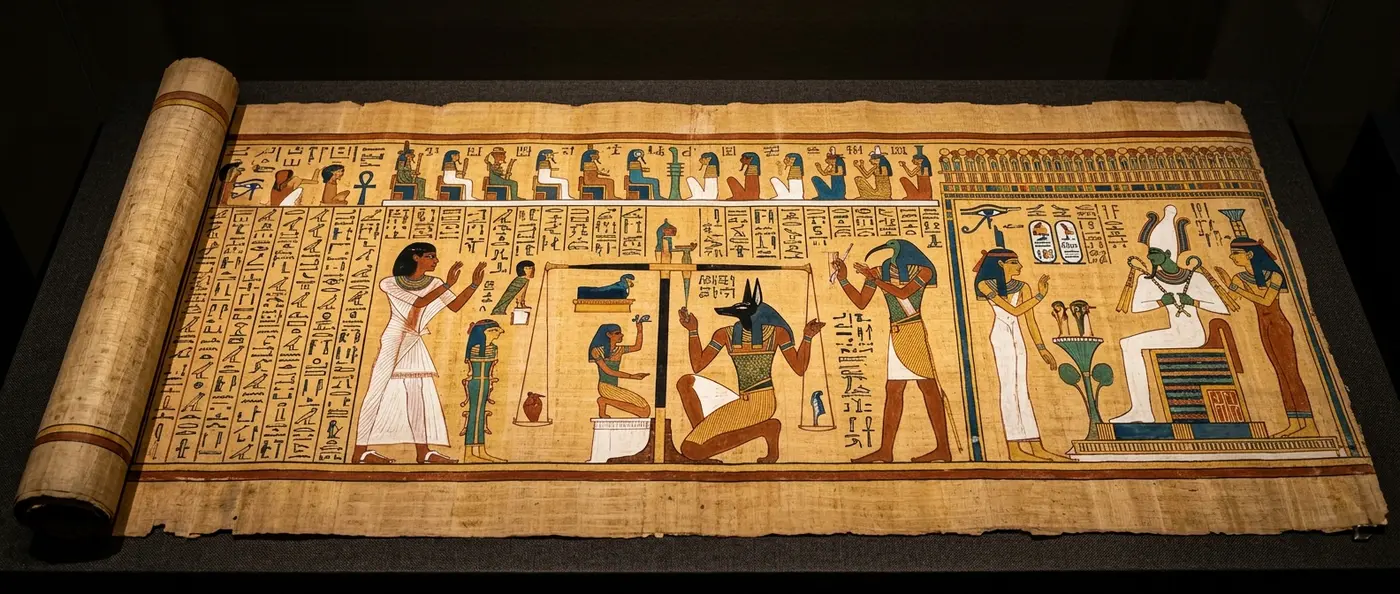
The most critical moment of the underworld journey was the trial in the Hall of Two Truths. There, the deceased had to stand before 42 judges led by Osiris, god of the underworld. Chapter 125 of the Book of the Dead includes an extensive list of sins the deceased had to deny committing.
💀 The Negative Confession
"I have not killed people... I have not stolen the property of the gods... I have not made anyone cry... I have not profiteered with grain... I have not committed adultery... I have not caused terror... I have not slaughtered sacred cattle..."
The trial's climax came next: the weighing of the heart. Anubis, the jackal-headed god, held a scale. On one side sat an ostrich feather, symbol of truth from the goddess Maat. On the other was placed the deceased's heart, which embodied all their life's actions.
For ancient Egyptians, the heart was the most important organ — considered the seat of intelligence and memory. Egyptians crafted special amulets, "heart scarabs," placed over the heart before mummification to protect this crucial moment.
Balance = Paradise
If the heart and feather balanced, the deceased passed the test and the path to paradise opened.
Heavy Heart = Damnation
Those with hearts heavy with sin faced horrific punishments, like eating their own excrement for eternity.
🚢 The Underground Journey with Ra
Egyptians believed the deceased would begin an underground journey following the path of the sun god Ra. After sunset in the west, Ra traveled beneath the world in a boat to return to his starting point in the east. During this journey, the deceased, aboard Ra's boat, had to face terrible creatures.
The most terrifying was Apep, a giant serpent that tried to stop Ra's boat and bring chaos to the world. Chapter 7 of the Book of the Dead offered protection: "I will not be idle for you, I will not be weak for you, your poison will not enter my limbs, for my limbs are the limbs of Atum."
After passing Apep, the dead reached a labyrinth protected by a series of gates. To pass through each one, they had to recite specific text and call out the gate's name. If they offered the correct prayer, the gate would say: "Pass, you are pure."
🏺 Peter Dornan's Translation
Peter Dornan, former curator of Egyptian art at the Metropolitan Museum, translated the cuneiform text on Hatnefer's scarab. The translation reveals the deceased's desperate plea to her heart not to betray her during the trial:
«Heart of my mother, heart of my mother, heart of my being, do not rise up against me as a witness; do not oppose me in the court; do not make objections against me before the keeper of the scale. You are my bodily ka, a Khnum who has enlivened my limbs...»
The text continues with the plea that the heart not invent lies against her before the god, reminding that the moment of reckoning has arrived. The desperate tone of these words shows how deeply Egyptians believed in the power of magical texts.
🎨 The Papyrus of Ani
At nearly 24 meters long, the Papyrus of Ani is the most complete surviving version of the Book of the Dead. Created around 1275 BCE for Ani, royal scribe of Thebes, and his wife Tutu, priestess of Amun. It was acquired in Luxor in 1888 by Wallis Budge, who published a translation in 1895.
The papyrus contains detailed illustrations depicting Ani's journey through the underworld. Vivid scenes show his heart being weighed, his encounters with various deities, and his final arrival at paradise's fields. Each image is accompanied by hieroglyphic texts explaining the spells and prayers.
📊 Book of the Dead Editions
🔮 Evolution of the Texts
The oldest parts of the Book of the Dead come from the Pyramid Texts, dating from the Old Kingdom as early as 2300 BCE. These ancient texts were exclusively for royal family use and were carved into pyramid walls.
During the Middle Kingdom, texts began appearing in non-royal sarcophagi, known as Coffin Texts. By the New Kingdom (roughly 1539-1075 BCE), access to the Book of the Dead had broadened. Anyone with sufficient money could acquire a copy.
Excerpts from the Book of the Dead were recited by priests during funeral ceremonies at the tomb. This was followed by a series of rituals to prepare the deceased, including the "opening of the mouth" ceremony, where ritual tools were applied to the deceased's image on the sarcophagus to reactivate their senses.
⚡ The Power of Words
For ancient Egyptians, words had real power. Chapter 9 expresses the hope of resurrection: "I have opened every path that is in heaven and that is on earth, for I am the beloved son of my father Osiris. I am noble, I am a spirit, I am equipped; O all you gods and all you spirits, prepare a path for me."
Chapter 53 eloquently summarizes an ancient Egyptian's deepest fears when contemplating their fate for eternity. One of the eternal punishments was the prospect of eating one's own excrement: "I detest what is detestable. I will not eat excrement, I will not drink urine, I will not walk head-down."
🌟 Paradise's Rewards
For the righteous, the path to paradise opened. The virtuous could look forward to the Fields of Ialu — a place of eternal spring where grain grew taller than a person and life was filled with happiness and abundance.
The Book of the Dead remains one of the most important texts for understanding ancient Egyptian religion and worldview. Through its pages, we see not only a people's beliefs about the afterlife, but also their hopes, fears, and deepest desires for eternal life and vindication.