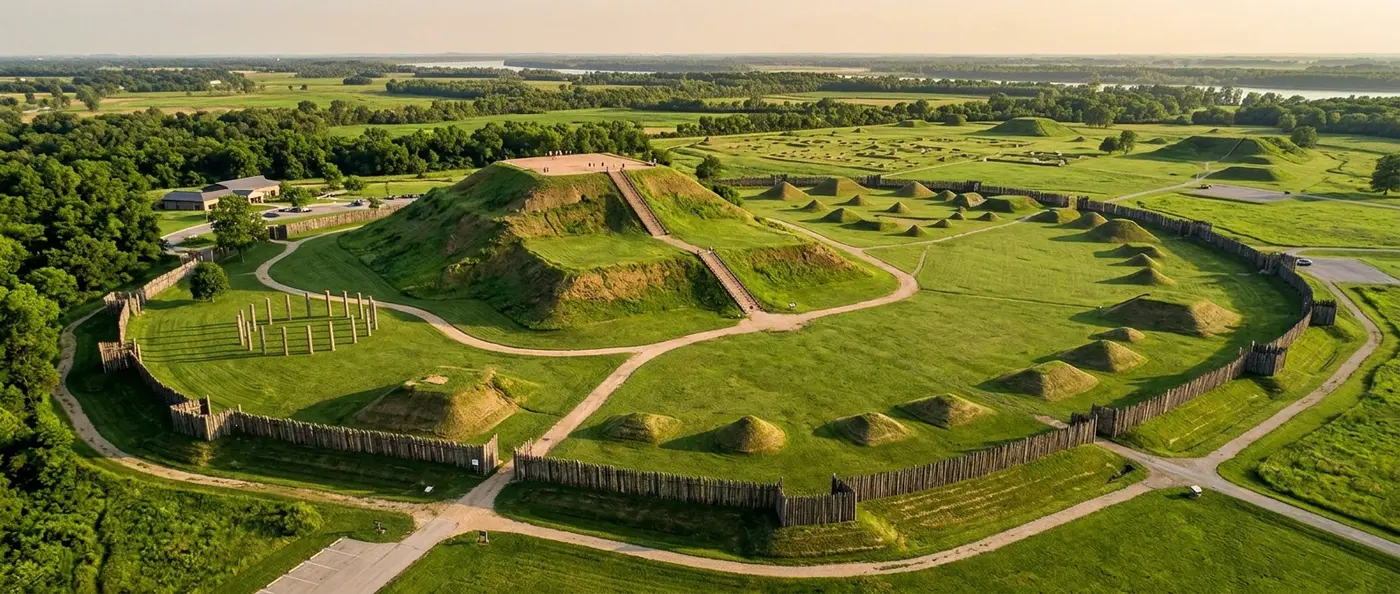
🏛️ The Mississippi Metropolis
Cahokia wasn't just a city. It was the beating heart of an empire that influenced millions of square kilometers across North America. Between 1050 and 1200 CE, this urban center exploded in size, reaching a peak population of 20,000 residents. One-third of those people were immigrants who traveled hundreds of miles, drawn by the city's reputation and wealth.
The city's reach stretched from the Gulf Coast to the Great Plains. Products, ideas, and people from Cahokia traveled thousands of kilometers, creating the most extensive trade and cultural exchange network North America had ever seen. Copper from Lake Superior, shells from the Gulf of Mexico, obsidian from the Rocky Mountains — all flowed through Cahokia's markets.
The urban landscape dominated the Mississippi floodplain. Massive earthen mounds rose from the floodplain, the largest reaching 100 feet high. Temples, palaces, and elite residences crowned these artificial hills, while below, neighborhoods of common citizens sprawled around plazas, markets, and workshops. The city covered 16 square kilometers — larger than many European cities of the same era.
🗿 The Sacred Posts of Cahokia
Giant wooden posts dominated Cahokia's central plazas. These weren't decorative monuments — they were axis mundi, physical connections between the upper, middle, and lower worlds according to the residents' religious beliefs. The posts served as cosmic anchors, marking sacred spaces where earth touched sky.
In 2024, archaeologists from the University of Arizona and University of Illinois traced the largest post ever found at Cahokia to its exact origins. The "Mitchell Post" — a massive red cedar trunk — was cut in 1124 CE and hauled at least 180 kilometers to reach the city. The precision of this dating came from a breakthrough technique: detecting cosmic radiation signatures in tree rings from specific solar storms.
The post weighed between 4 and 5 tons and originally stood 60 feet tall. Moving it required either river transport or dragging across ancient trails — a logistical feat that demonstrates the enormous resources Cahokia's leaders could mobilize. The effort invested in transporting this single post shows these monuments anchored the city's spiritual life.
💡 The Dating Revolution
Scientists used cosmic radiation traces in tree rings to pinpoint exactly when the Mitchell Post was cut. Solar storms leave distinctive signatures in wood that occurred in specific years, allowing researchers to date the tree's felling with unprecedented accuracy — down to the exact year.
⚔️ Social Structure and Daily Life
Cahokia pulsed with activity. The city organized around massive plazas where ceremonies, markets, and public gatherings took place. Residents lived in wooden houses clustered into neighborhoods, each with its own character and function. Archaeological evidence reveals a complex society with distinct social classes and specialized occupations.
Master craftspeople produced pottery, flint tools, shell jewelry, and copper ornaments that traveled across North America. Their workshops lined the city's streets, filling the air with smoke from kilns and the sound of hammering stone. The quality of Cahokian goods was so renowned that imitations appeared in settlements hundreds of miles away.
Diet centered on the "Three Sisters" — corn, beans, and squash — supplemented by deer hunting, fishing in the Mississippi, and gathering wild nuts and fruits from surrounding forests. Advanced agricultural techniques and storage systems ensured food security even during droughts.
Crafts & Trade
Specialized artisans produced goods exported across North America. Cahokian pottery, tools, jewelry, and ceremonial objects have been found at archaeological sites thousands of kilometers away, proving the city's vast commercial reach.
Agriculture & Food
Intensive corn cultivation supported the large population. Advanced irrigation and storage techniques ensured food security during lean years. The agricultural surplus freed thousands to pursue specialized crafts and construction projects.
Religion & Ceremony
The massive posts and pyramid-shaped mounds indicate intense religious activity. Ceremonies connecting heaven and earth took place regularly in the central plazas, reinforcing the city's role as a sacred center.
🌅 Rise of an Empire
Cahokia's explosive growth in the late 11th century wasn't accidental. It coincided with a period of climate stability and increased rainfall that boosted agriculture. Simultaneously, innovations in corn cultivation allowed surplus food production on an unprecedented scale.
Cahokia's growth depended on more than farming. It was a center of religious and political power. The city's leaders could mobilize massive human resources for grand projects — constructing the giant mounds, transporting sacred posts, and organizing the complex ceremonies that bound the community together.
The city acted as a magnet for people across North America. Archaeological evidence shows that people from different ethnicities and cultures coexisted in Cahokia, bringing their own traditions and expertise. This mix of peoples made Cahokia a laboratory for new ideas and technologies.
📊 Cahokia in Context
🗺️ The Network of Influence
Cahokia's influence extended far beyond the city limits. Archaeological excavations have revealed dozens of smaller cities and settlements that followed Cahokia's model — central plazas, earthen mounds, and sacred posts. These satellite communities formed a network spanning the continent's interior.
This network followed North America's great rivers — the Mississippi, Missouri, Ohio, and their tributaries. Rivers served as communication and trade arteries, enabling rapid movement of people and goods across vast distances. A canoe could travel from Cahokia to the Gulf of Mexico in weeks, carrying news, trade goods, and cultural innovations.
Cahokian products have been found from the Gulf Coast to the Great Lakes, from the Great Plains to the Appalachian Mountains. Conversely, exotic materials like Lake Superior copper, Gulf Coast shells, and Rocky Mountain obsidian flowed into Cahokia, making it a truly international hub.
💀 Decline and the Mystery of Abandonment
After 1200 CE, Cahokia began to decline. Archaeologists have identified several changes during this period: increased droughts, shifts in trade goods, transformation of public spaces, and cessation of new mound construction. The city that had thrived for two centuries was slowly dying.
One telling sign of decline was the end of new sacred post installations. After 1200, no new posts were erected in the city. Existing posts like the Mitchell Post were likely removed between 1150 and 1175 as natural decay made them dangerous. The removal of these cosmic anchors may have symbolized the city's spiritual decline.
By 1400, Cahokia was completely abandoned. The reasons remain unknown. Climate change? Resource depletion? Social conflict? Disease? All these theories have been proposed, but none definitively proven. Why Cahokia died remains unanswered.
🔍 Theories for Abandonment
Researchers examine multiple factors that may have contributed to Cahokia's abandonment: prolonged drought, deforestation from timber harvesting, social tensions from inequality, or even changes in religious beliefs that stripped the city of its sacred character.
🔬 Modern Discoveries and New Technologies
Modern archaeological techniques continue revealing new information about Cahokia. Radiocarbon dating, strontium isotope analysis, and ancient DNA studies allow scientists to reconstruct life in the ancient city with unprecedented accuracy.
The recent Mitchell Post study exemplifies these advances. Using strontium isotope analysis, researchers pinpointed the tree's origin to southern Illinois, over 180 kilometers from Cahokia. This proves the residents' ability to organize large-scale transportation operations across vast distances.
The detection of cosmic radiation in tree rings enabled precise dating to a specific year — a technique only recently applied to archaeology. These techniques show pre-Columbian North America was far more connected than anyone realized.
🌎 Cahokia's Legacy
Though abandoned 600 years ago, Cahokia's influence persists. Many traditions and practices developed there survived among descendant populations and spread to other indigenous groups across North America. The city's innovations in agriculture, architecture, and social organization left lasting marks on the continent.
Today, Cahokia is a UNESCO World Heritage Site attracting thousands of visitors annually. The massive earthen mounds stand as witnesses to a civilization that created one of the world's largest cities of its era without wheels, draft animals, or metal tools. The achievement seems almost impossible, yet the evidence rises from the Illinois prairie.
Cahokia's story reminds us that pre-Columbian American civilizations were far more complex and advanced than commonly believed. They created great cities, organized sophisticated societies, and influenced vast geographical regions — achievements that deserve our admiration and study. The mystery of their disappearance only adds to their fascination, leaving us to wonder what other secrets lie buried beneath North America's soil.