🏛️ From Trading Post to Superpower
Carthage was founded by Phoenicians from Tyre around 814 BC in modern-day Tunisia, on a strategic peninsula in the Gulf of Tunis. The location commanded the Mediterranean's busiest shipping lane: a protected harbor with direct access to the Sicilian straits, where every east-west trade route had to pass. The city didn't start as a military power. It began as a commercial hub, earning massive wealth from Spanish silver mines, purple dye from murex shells, and a network of colonies stretching from Sardinia to the Balearic Islands.
But wealth needs protection. Gradually, Carthage developed a naval fleet to guard sea routes, and a land army to defend its commercial interests from local tribes and competitors — mainly Sicilian tyrants and later Rome.
⚔️ The Mercenary Army
Carthage's army was unique in the ancient world. Only a small portion — the famous Sacred Band — consisted of citizens. These were 2,500 to 3,000 heavily armed infantry, recognizable by their white shields. The elite. The main bulk of the army? Mercenaries. Paid local allies from Libya and Tunisia. Professional warriors from Greece, Iberia, southern Italy, Gaul.
The Numidian cavalry from North Africa's interior rode without saddles or bridles, controlling their horses with voice and leg pressure alone — a mobility that could shatter enemy flanks in minutes. Hannibal used them devastatingly against the Romans in battle after battle.
To avoid the risk of mercenary rebellion, Carthage kept all senior command positions in citizen hands. This wasn't always enough — in the Mercenary War (241-237 BC), unpaid mercenaries turned against Carthage itself in a bloody civil conflict.
🐘 War Elephants: Ancient Tanks
Carthage's most distinctive weapon was war elephants — North African forest elephants, about 2.5 meters tall (smaller than Indian elephants). They were armored on the head, trunk, and sides. Blades or spears were attached to their tusks. They were controlled by the mahout — their driver — and sometimes carried a second rider armed with bow or javelins.
Horses bolted at their trumpet-like calls, and infantry broke ranks rather than face the tusks. Wounded elephants, however, became uncontrollable — trampling friend and foe alike. When enemy forces trained against them (as Roman Scipio did at Zama), their effectiveness dropped dramatically.
💡 The Battle of Zama (202 BC)
Roman general Scipio Africanus formed "corridors" in his infantry, letting Hannibal's 80 elephants pass through harmlessly. The elephants, disoriented by trumpets, turned back and created chaos in Carthage's line. It was the final major battle of the Second Punic War.
🚢 The Invincible Fleet
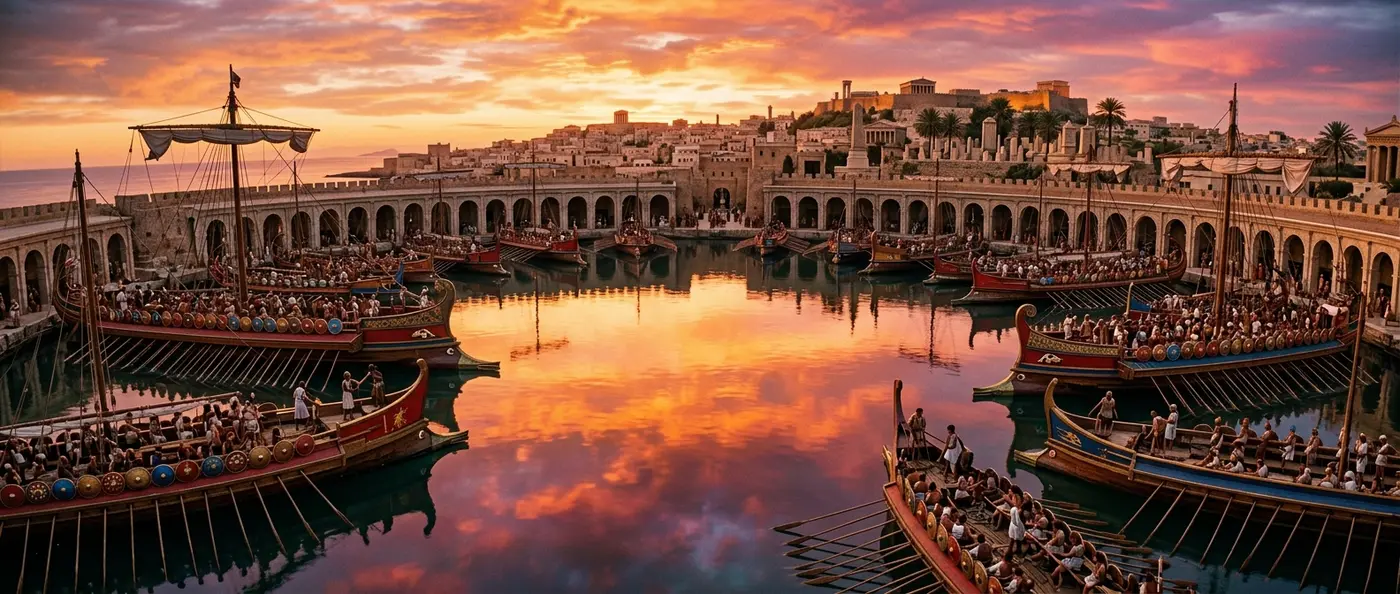
While Carthage hired its soldiers, it built its own ships. According to Polybius, in 256 BC Carthage had 350 warships. Ships were built industrially — their parts were numbered, like assembly kits, designed for rapid mass production.
The fleet consisted mainly of quinqueremes — massive warships with 300 rowers in five rows per vertical line. Bronze ram at the bow below the waterline, catapults on deck, and a full marine contingent. Even during the initial confrontation with Rome, Carthaginians considered naval defeat unthinkable — so much so that at Mylae (260 BC) they didn't even bother forming battle formation. They lost.
Diekplous
The "breakthrough" tactic — a line of ships pushes through a weak point in the enemy formation, ramming ships from behind. Core strategy of the Carthaginian navy.
Periplous
The encircling movement — ships move around the flanks of the enemy line, hitting vulnerable sides and sterns. Countered by formation close to coastline.
Ram & Boarding
The main objective: the bronze ram struck enemy ship sides. If ramming failed, marines armed with spear, javelin and sword boarded the enemy deck.
🗡️ The Barca Family: Strategic Genius
Carthaginian generals were elected for the duration of a specific war, usually from dominant families. After each battle or war, they faced a tribunal evaluating their decisions. The lightest penalty for failure was a heavy fine. The heaviest? Crucifixion. Several generals committed suicide to avoid it. The result: Carthaginian commanders chose safe defeats over risky victories. In contrast, Roman generals had one-year terms — this pushed them toward aggressive strategy, since they had no time for slow victories.
The Barca family stands out. Hamilcar Barca landed in Spain in 237 BC with 25,000 soldiers, locally recruited up to 50,000, including 100 elephants, and rebuilt Carthage's wealth through silver mines. His son Hannibal (247-183 BC) went further — he identified with Hercules-Melqart, creating a personal mythology that inspired both Carthaginians and Greek mercenaries. Hannibal claimed the god Melqart had appeared in a dream, ordering him to invade Italy — a story that convinced Greek mercenaries they served divine will, not just Carthaginian gold.
🏹 Land Warfare Equipment and Tactics
The Carthaginian army used varied equipment, depending on each unit's origin. There was no uniform — each ethnic group fought with their own weapons. Most followed the Greek hoplite model: heavy armor, large shield, spear and sword. There were also slingers (mainly Balearic, famous for their accuracy) and archers. Until the 3rd century BC, war chariots were used, but gradually abandoned in favor of cavalry.
Siege equipment was essential in Sicily, where cities were well-fortified. Carthaginians quickly copied Hellenistic inventions: catapults for stones and incendiary projectiles, battering rams, mobile siege towers, tunnel excavation. Carthage itself was equipped with siege machinery for defense.
In land battles, after initial light cavalry skirmishes, the army attacked frontally with heavy infantry in phalanx — like the Greeks for centuries. But Hannibal showed flexibility: after the Battle of Lake Trasimene (217 BC), he possibly adopted the Roman maniple system — smaller, more flexible units instead of the immobile phalanx.
🔥 Four Victories That Terrified Rome
In the Second Punic War (218-201 BC), Hannibal crossed the Alps with elephants — an undertaking considered impossible — and descended into Italy. What followed were four consecutive victories that shook the Roman world: River Ticinus (November 218), Trebia (December 218), Lake Trasimene (June 217), and Cannae (August 216).
At Cannae, Hannibal achieved something theoretically impossible: he encircled and annihilated an entire Roman army, killing 50,000-70,000 Romans in one day. It was the worst defeat in Roman history. But Rome didn't surrender. It drew on endless reserves — something Carthage, dependent on mercenaries, couldn't do.
Before the wars with Rome, Carthage already had centuries of military experience. From 580 BC it fought in Sicily against Greek colonies. In 255 BC, during the First Punic War (264-241 BC), Spartan mercenary Xanthippus reorganized the Carthaginian army near Tunis. He combined 100 war elephants with 12,000 infantry and 4,000 cavalry — destroyed two Roman legions, killing 12,000 Romans with losses of only 800 Carthaginians. He even captured Roman general Regulus.
⚖️ Carthage vs Rome: Military Models
💀 The Fall: Carthago Delenda Est
The third and final confrontation, the Third Punic War (149-146 BC), was a siege to the death. Cato the Elder in the Roman Senate ended every speech — whatever the topic — with the phrase "Carthago delenda est" (Carthage must be destroyed). Rome sent 80,000 infantry and 4,000 cavalry. After a long siege, Scipio Aemilianus captured the city. Buildings were demolished, the population sold into slavery, the land officially cursed. A 700-year-old city was literally erased from the map.
Carthage's military machine — heterogeneous mercenaries, sometimes disloyal, command confusion, over-reliance on elephants and heavy infantry — ultimately couldn't withstand Rome's relentless mechanism. But it would be wrong to view Carthage only through the lens of defeat. For 600 years, the city without citizen-soldiers managed to dominate an entire sea, conquer territories on three continents, produce generals like Hannibal — still studied in military academies — and terrify Rome like no one else ever did. That says something about the power of money, strategy — and a world-class navy.