📖 Read more: 5,000-Year-Old Rock Art Reveals Saudi Arabia's Hidden Past
🏛️ The Discovery That Rewrote History
In the early 1960s, archaeologists working Turkey's Anatolian plateau unearthed something that would rewrite the timeline of human civilization. At Çatalhöyük, near modern-day Konya, they uncovered a Neolithic settlement with pottery dating to roughly 9,000 BCE — thousands of years before Egypt's pyramids or Mesopotamia's ziggurats.
Age was only part of the shock. Çatalhöyük represents the first known example of a densely populated urban community, with an estimated peak population reaching 8,000 residents. To put that in perspective: this happened when most humans on the planet still lived as nomadic hunter-gatherers.
The excavations revealed occupation layers spanning from 7,500 to 5,700 BCE, making Çatalhöyük not just a flash in prehistoric time but a community that thrived for nearly two millennia. The finds include sophisticated pottery, obsidian tools, and stunning wall paintings that reveal a civilization with rich spiritual life.
🏺 The Pottery Revolution
Çatalhöyük's ceramics mark a critical turning point in human technology. The earliest samples, dating around 9,000 BCE, are handmade and soft-fired, but already show signs of technical evolution. By 6,500 BCE, the settlement's potters had developed more advanced techniques involving hard firing and burnishing, creating superior-quality vessels.
Evolution continued with red slip coatings and molded decorative elements. These weren't just aesthetic choices. Improved ceramics enabled better food storage, more efficient cooking, and liquid transport — all critical for sustaining a permanent, densely populated community.
The timing makes Çatalhöyük's pottery revolutionary. It predates the potter's wheel in Mesopotamia by centuries (around 3,000 BCE). Çatalhöyük's craftsmen created their works entirely by hand, using techniques like coiling and pinching, achieving impressive symmetry and uniformity.
🗿 Architecture Without Streets
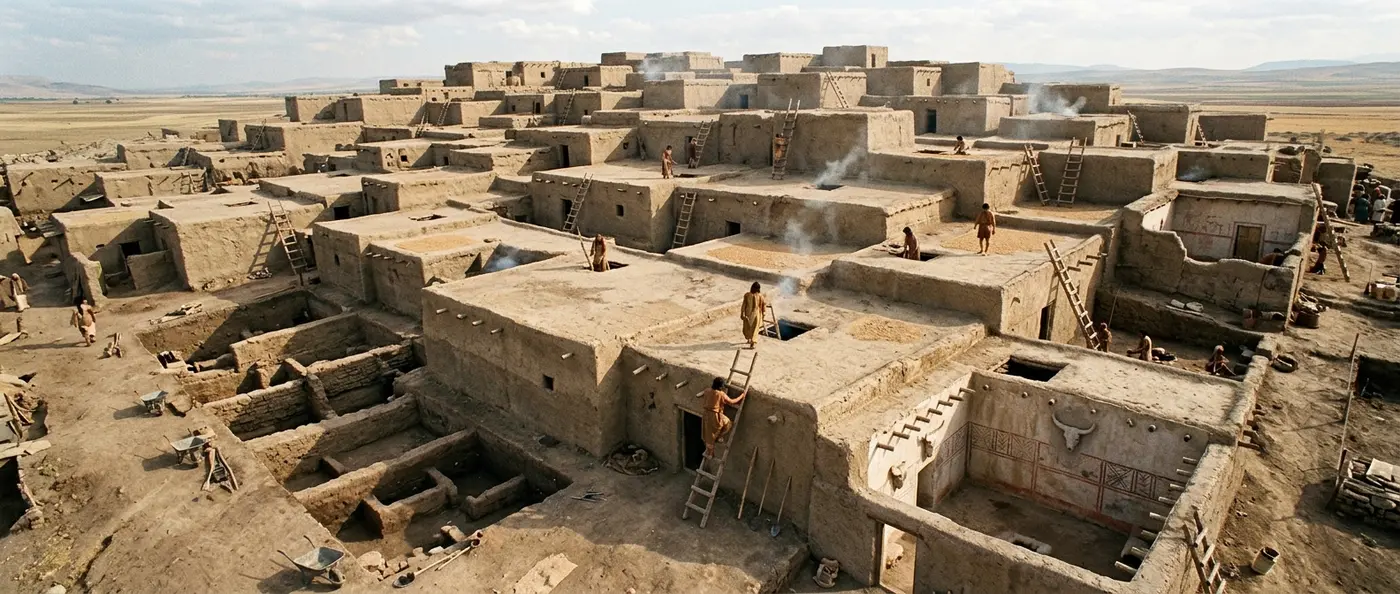
The settlement's architecture defied every rule of ancient city planning. Unlike every other known ancient city, there were no streets or pathways between buildings. Houses were built side by side like honeycomb cells, sharing walls, creating a continuous urban landscape.
Entry to each house came through roof openings, with wooden ladders leading inside. Rooftops functioned as public spaces — where social life happened, meetings occurred, even movement from one part of the settlement to another. Think prehistoric rooftop gardens, except these were the main circulation routes.
Each house followed similar layouts: a central room with hearth, benches along walls serving as beds and seats, and smaller storage areas. Floors were packed earth covered with lime plaster that was regularly renewed. Walls were mud brick, often decorated with striking murals.
House Structure
Rectangular homes 25-30 sq meters with roof entry, central hearth, and built-in clay furniture.
Wall Paintings
Murals featuring bulls, leopards, and vultures, often in red and black paint over white backgrounds.
Burial Customs
The dead were buried beneath house floors, often in fetal position with grave goods.
💀 The Dead Beneath Our Feet
One of Çatalhöyük's most unusual features was burying the dead beneath house floors. Archaeologists have discovered hundreds of skeletons interred directly under living spaces, particularly beneath platforms that served as beds.
The process was complex. Bodies were likely first exposed to vultures or other scavengers to remove flesh — explaining the numerous vulture depictions in wall paintings. Then bones were collected and buried in fetal positions. Grave goods accompanied the dead: obsidian and shell jewelry, tools, even mirrors made from polished obsidian.
This practice suggests deep connections between living and dead. Ancestors literally remained part of the house, perhaps offering protection or maintaining family continuity. In some cases, skulls were removed and covered with plaster to recreate facial features — an early form of portraiture preserving the deceased's memory.
🔬 DNA Reveals
Recent genetic analyses showed that individuals buried together in one house weren't always biological relatives. This suggests Çatalhöyük "families" may have been based on social bonds rather than blood relations.
📖 Read more: Indus Valley: Lost Cities Reveal 4,500-Year-Old Secrets
🌾 From Hunters to Farmers
Çatalhöyük represents a critical stage in the transition from nomadic hunter-gatherer life to permanent agricultural settlement. Residents cultivated wheat, barley, and legumes while domesticating sheep, goats, and later cattle. However, hunting remained important — particularly wild boar and deer.
The settlement's location wasn't random. It sat near fertile plains suitable for agriculture and animal husbandry, with access to water from the Çarşamba River. The area was also rich in obsidian — volcanic glass extremely valuable for making tools and weapons. Obsidian from Çatalhöyük has been found at archaeological sites hundreds of miles away, indicating extensive trade networks.
Residents' diet was remarkably diverse. Beyond cultivated grains and legumes, they consumed fruits like apples and almonds, plus wild greens. Animals provided not just meat but milk, cheese, and hides. Bone analysis shows the diet was generally healthy, though there were signs of periodic shortages.
🔱 Religion and Rituals
Çatalhöyük's spiritual life was rich and complex. There were no separate temples — each house appears to have functioned as sacred space. Wall paintings often depict bulls with massive horns, leopards, and vultures. Actual bull skulls with horns were embedded in walls, creating impressive "shrines."
Female figures held special positions in religious life. Numerous figurines depict corpulent women, often seated, interpreted as fertility or mother goddesses. The most famous shows a woman giving birth while seated on a throne flanked by leopards.
Rituals likely involved using wall paintings and figurines in ceremonies related to fertility, death, and rebirth. The periodic renewal of murals — some have up to 120 paint layers — suggests repeated ritual acts. Perhaps each new layer marked a new cycle, a fresh beginning.
⚖️ Çatalhöyük vs Other Ancient Settlements
🏹 Daily Life in the First City
Life in Çatalhöyük was remarkably egalitarian. There's no evidence of palaces, large public buildings, or houses that stand out in size or wealth. All dwellings had similar dimensions and equipment. This lack of social stratification is stunning for such a large settlement.
Women and men appear to have had similar roles. Skeletal analysis shows both sexes had comparable levels of physical stress and nutrition. Women participated in agricultural work and likely hunting, while men engaged in domestic activities like cooking and childcare.
Children grew up in a stimulus-rich environment. Small clay figurines and animals have been found that likely served as toys. Education happened through participation in daily activities — children learned to make tools, farm, cook, and participate in rituals by observing and mimicking adults.
Residents' health was generally good, though challenges existed. Dental analysis shows wear from consuming hard foods and sand in flour. Fall injuries were common — probably inevitable when daily movement happened across rooftops. Still, many reached advanced ages for the period, with some living past 60.
🗺️ The End of a World
Around 5,700 BCE, after nearly two millennia of continuous occupation, Çatalhöyük was abandoned. There's no evidence of violent destruction — residents simply left. The reasons remain mysterious. Climate change? Natural resource depletion? Social tensions in an overcrowded settlement?
Whatever happened, residents scattered, taking with them the knowledge and techniques they'd developed. Perhaps they contributed to spreading agriculture and urban life to other parts of Anatolia and beyond. Çatalhöyük remained buried and forgotten for thousands of years until 20th-century archaeologists brought it back to light.
Today, the archaeological site is a UNESCO World Heritage Monument and continues revealing its secrets. Each new excavation season brings discoveries that enrich our understanding of this extraordinary community. Çatalhöyük reminds us that our ancestors were far more creative and progressive than we often imagine.