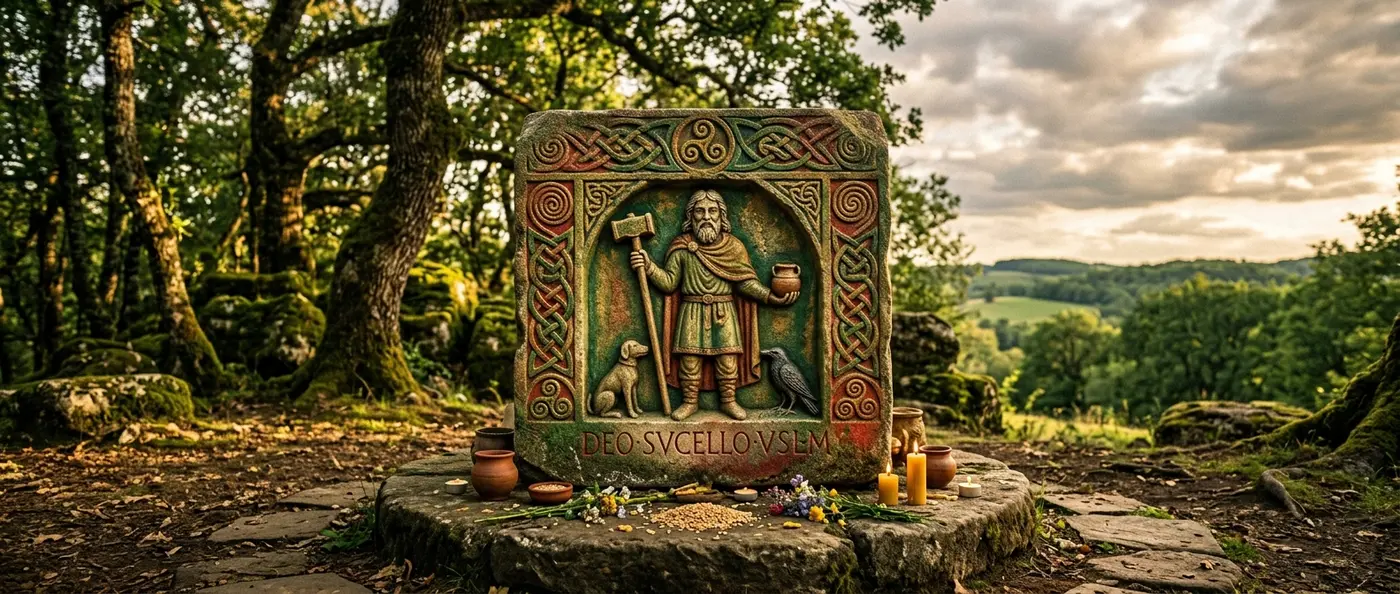
A painted altar block sits in a Burgundy laboratory, colors still vivid after 1,800 years underground. The figure depicted holds a long-handled hammer in one hand, a wine barrel in the other. A dog sits loyally at his feet. Archaeologists know they're looking at Sucellus—one of Roman Gaul's most popular gods. But here's what makes this discovery extraordinary: dozens of stone sculptures of Sucellus exist across Europe, yet no painted depiction had ever been found. Until now.
🏛️ The Discovery: Mancey's Sacred Hill
The find came from the Gallo-Roman sanctuary of Mancey in Saône-et-Loire, Burgundy, near the town of Tournus. The sanctuary crowns a forested ridge overlooking the Tournugeois landscape—a strategic position that signals this was no ordinary worship site. Systematic excavations began in 2023, but the breakthrough came during the 2025 research season, when archaeologists uncovered an extensive ritual complex active for nearly five centuries—from the late Iron Age through the final centuries of the Roman Empire.
The painted altar block emerged from the ruins of what researchers designated "Monument M3"—a temple where elite gatherings and ritual banquets took place. The temple floor was littered with thousands of ceremonial meal remnants: pig bones, poultry, fish remains, drinking cups, jewelry, coins, and votive objects. Researcher Grégory Compagnon published the findings in Le Fil d'ArAr in March 2026, calling it unique in Celtic archaeology.
🔨 Sucellus: The God with Hammer and Wine Barrel
Sucellus ranked among Roman Gaul's most widely worshipped deities—a god who combined raw power with abundance in a unique theological package. His name means "He who strikes well" or "The Good Striker," referring to his signature tool: a long-handled hammer or mallet, symbol of both creative force and death. Across Gaul—from France to Germany and Luxembourg—sculptures and inscriptions show him gripping this hammer with his right hand while his left holds a wine vessel (olla) or barrel, symbols of fertility, abundance, and protection of rural life. A dog appears frequently beside him, possibly as faithful guardian or guide for souls to the underworld—an image reminiscent of Greek mythology's Cerberus.
Alongside Sucellus often appears the goddess Nantosuelta, forming a divine couple connected to prosperity, fertility, and the natural world. Nantosuelta, whose name likely means "Shining Valley" or "Valley Sun," typically holds a scepter topped with a small house—symbol of domestic prosperity. Julius Caesar notes in his "Commentaries on the Gallic War" that the Gauls believed they descended from the god Dis Pater—the Roman god of the underworld. Modern scholars consider Sucellus likely the Gallic equivalent of this deity. In Irish mythology, his counterpart was the Dagda—the "Good God" with a magical club capable of killing nine men with one blow and reviving the dead with its other end, plus an inexhaustible cauldron of food that never empties.
Dozens of stone sculptures of Sucellus have been found across France, Germany, and Luxembourg—but painted representations are extraordinarily rare for any Celtic god. The reason is simple: paint on stone deteriorates far faster than sculpture. Time, moisture, and solar radiation erase pigments while stone relief endures for centuries. Finding ancient painting on an altar dating to the Roman period is exceptionally rare—and if the identification holds, it reveals the visual art of Celtic religious worship.