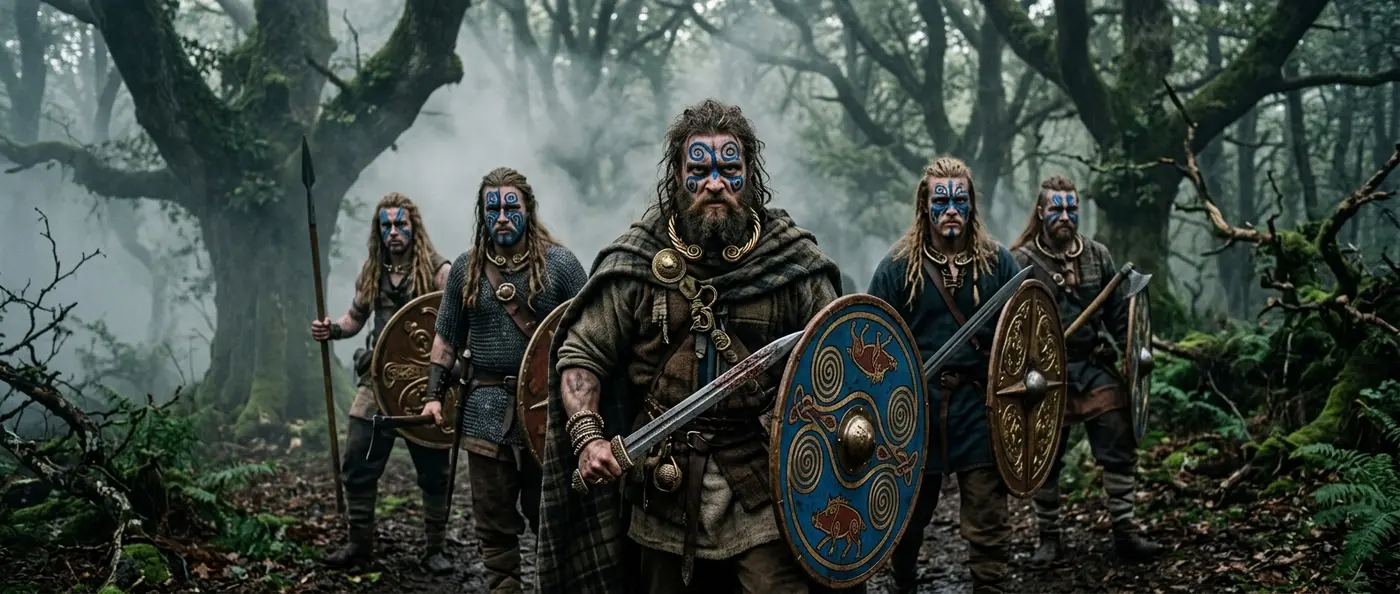
July 18, 390 BC. A horde of blonde-haired giants appeared at Rome's gates, their massive frames painted blue with woad, screaming like wild animals as they beat shields with swords. Roman soldiers, accustomed to disciplined formations and organized warfare, faced something they'd never seen: half-naked warriors who fought like demons and showed no fear of death. These were the Celts — and in seven months, they would strip Rome bare of everything worth taking.
🗡️ Who Were the Celts?
The Celts weren't a single people but a mosaic of tribes that spread from Ireland to Anatolia. Starting in the 8th century BC, they dominated much of Europe, creating a civilization that combined incredible military prowess with sophisticated art and deep spirituality.
What made the Celts so terrifying to Mediterranean peoples wasn't just their size — though ancient writers describe them as giants compared to Romans. It was how they fought. Without the rigid formations of legions, Celts attacked like a storm, with individual warriors seeking personal glory in battle.
Their society organized around powerful families and tribes, with a warrior code of honor that resembled Homeric heroes more than Rome's disciplined organization. And as recent genetic studies from Britain reveal, power in Celtic society may not have been exclusively male business.
⚔️ The Day Rome Fell
On the banks of the Allia River, just 18 kilometers from Rome, Romans faced their worst nightmare. Brennus, chieftain of the Senones Gauls, led his warriors against Roman legions. What followed wasn't a battle — it was a massacre.
The Celts used tactics Romans had never encountered. Instead of organized formations, they attacked in waves of individual warriors screaming and beating weapons to create deafening noise. Many fought naked or half-naked, covered only with blue woad dye, making them look like demons to Roman eyes.
The Roman phalanx collapsed. Survivors ran panic-stricken back to Rome, but there was no time to organize defense. For the first and last time in its history, the Eternal City fell to invaders. The Celts looted Rome for seven months, and only after paying massive ransom — 1,000 pounds of gold — did they agree to leave.
🛡️ Weapons and the Art of War
Celtic smiths forged weapons that made Roman officers jealous. The Celts were masters of iron metallurgy, creating weapons that combined deadly effectiveness with artistic beauty. Their long swords, known as spatha, later became the standard for Roman swords of the late empire.
But their most distinctive weapon was the long La Tène sword, with blades reaching 90 centimeters. Unlike the short Roman gladius designed for thrusting, the Celtic sword was a slashing weapon, ideal for the sweeping attacks they favored. Their shields were oval or hexagonal, often decorated with complex designs that had both aesthetic and magical significance.
Long La Tène Sword
60-90 cm blade, ideal for sweeping motions. Metallurgical techniques allowed flexible but durable blades.
Oval Shield
Wooden with metal reinforcement at center. Often decorated with symbols believed to offer magical protection.
Horned Helmet
Though rare in battle, horned helmets were used in ceremonies. War helmets were simple but effective.
👑 Women Warriors: The Myth That Was Truth
For centuries, stories of Celtic women warriors were considered exaggerations by Roman writers. Boudica of the Iceni, who led a revolt against Rome in 60 AD, was the most famous example. But genetic studies from Dorset, England reveal something that would have shocked Caesar himself.
According to research published in Nature, DNA analysis from 57 Celtic graves showed that Durotriges society organized around female lineages. 85% of burials belonged to relatives descended from one founding woman. Men entered the community through marriage, not the reverse.
Women didn't just influence Celtic politics — they controlled it. No coincidence that Julius Caesar noted Celtic women could marry multiple men — unthinkable in Roman society. Archaeological evidence shows women buried with weapons and precious objects, indicating high status.
💡 DNA Reveals
Mitochondrial analysis showed over 2/3 of Celts in Dorset shared the same rare maternal line (U5b1), while Y chromosome variety was high — a sign that men came from outside to marry women of the community.
🔱 The Religion of the Druids
At the heart of Celtic civilization were the Druids — priests, judges, doctors and advisors rolled into one. Their education lasted up to 20 years, as they had to memorize vast amounts of sacred texts, laws and histories. Celts deliberately avoided writing for religious matters, believing oral tradition preserved the sanctity of knowledge.
Druids conducted ceremonies in sacred groves, especially under oak trees considered holy. Mistletoe, a parasitic plant growing on oaks, was cut with golden sickles in special ceremonies and used in potions. They believed in reincarnation and the soul's passage to another body after death — a belief that explains their absolute fearlessness in battle.
But Celtic religion had dark sides. Romans recorded with horror the human sacrifices made in large straw effigies, where prisoners were locked and burned alive. While many historians question the accuracy of these accounts, archaeological finds with human bones in ritual wells suggest some form of human sacrifice did exist.
🏰 Fortress-Cities and Daily Life
The Celts weren't just warriors. They built impressive fortified cities called oppida, with populations reaching tens of thousands. Bibracte in Gaul, capital of the Aedui, covered 135 hectares with a population of about 30,000. These cities were centers of trade, crafts and administration.
Celtic metallurgy was so advanced that Romans copied many of their techniques. They made intricate jewelry using enameling techniques, creating multicolored designs that still impress today. The characteristic Celtic motif with spirals and complex knots influenced European art for centuries.
🏛️ Celtic vs Roman Cities
🌅 The Celtic Legacy
Despite their eventual submission to Rome, the Celts left an indelible mark on European history. Their language survives in Irish, Scottish Gaelic, Welsh and Breton. Place names across Europe — from Paris (from the Parisii) to Milan (Mediolanum) — recall their presence.
But perhaps their greatest legacy is their impact on Roman military art. After the disaster at Allia, Romans completely reorganized their army. They adopted elements from Celtic equipment, like chain mail and improved shields. The experience of facing Celts shaped Roman strategy for centuries to come.
Today, as new archaeological and genetic discoveries illuminate aspects of their civilization that remained hidden, the Celts emerge not simply as barbarian warriors, but as creators of a complex civilization that combined martial valor, artistic expression and — as we now learn — perhaps a more egalitarian social organization than their Roman conquerors believed.
📚 What Celtic History Teaches Us
The clash between Celts and Romans wasn't just a war between two peoples. It was the collision of two worlds, two ways of thinking about social organization. On one side, Roman order, discipline and hierarchy. On the other, Celtic freedom, individual valor and tribal solidarity.
Ultimately, Roman organization prevailed. But the victory wasn't absolute. Romans learned from the Celts, adopted their technologies and tactics. And in remote corners of the empire — Ireland, Scotland, Wales — Celtic civilization survived and evolved, preserving elements lost elsewhere.
DNA doesn't lie the way victors do. For centuries, we knew the Celts only through Roman eyes — as barbarians, uncivilized, chaotic. Today, archaeology and genetics reveal a different picture: a civilization with its own complexity, innovations and perhaps more progressive social structures than those that replaced them.
The Celts may have lost the war with Rome. But their spirit — love of freedom, appreciation of individual courage, connection with nature — profoundly influenced European consciousness. From Arthurian legends to modern Celtic revival, the warriors who once terrorized Rome continue to captivate and inspire.