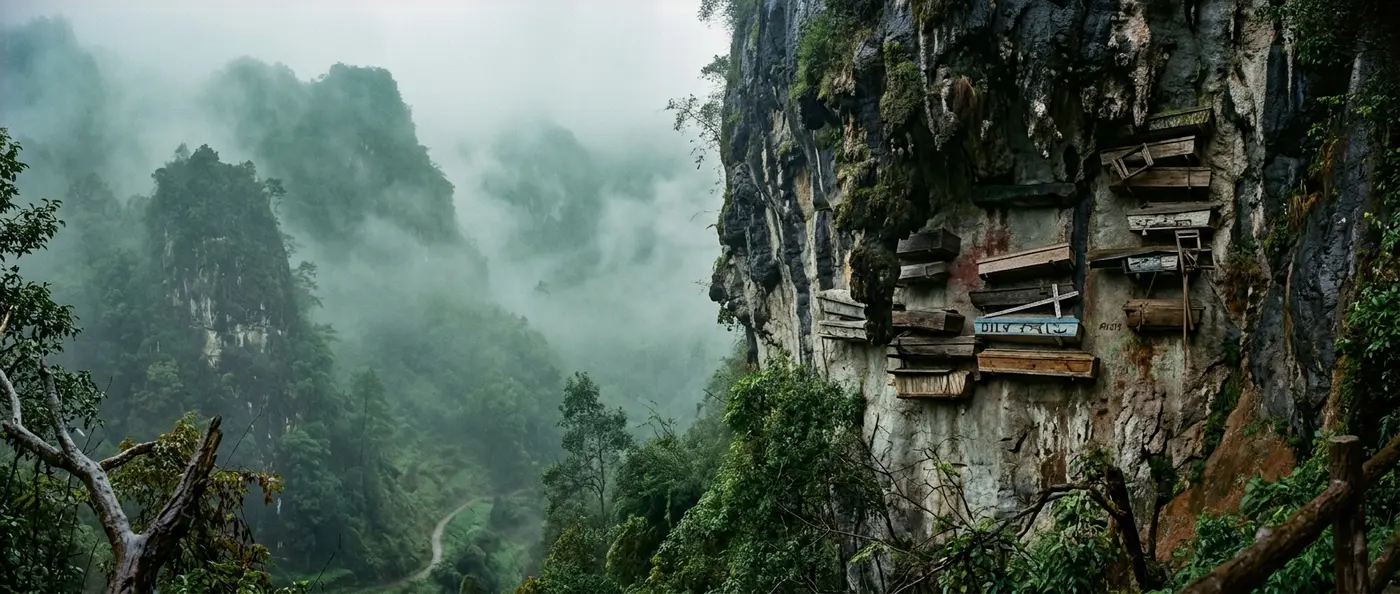
Look up at the sheer cliffs of Sagada province in the Philippines. Hundreds of wooden coffins dangle from impossible heights, suspended like ancient prayers frozen in time. The Igorot tribe has practiced this sky burial for centuries, but they're not alone. Across Asia, from China's remote mountains to Indonesia's highlands, ancient peoples defied gravity to bury their dead closer to heaven. China holds the most spectacular examples — and the deepest mysteries.
🗿 Coffins That Shouldn't Exist
China's hanging coffins are archaeological impossibilities. In the southern provinces of Sichuan, Yunnan, and Fujian, wooden coffins sit wedged into cliff faces hundreds of feet above ground. No roads. No paths. No obvious way up or down. Just massive tree-trunk coffins weighing 500 pounds each, somehow placed with surgical precision on ledges that would challenge modern rock climbers.
The practice started during the Han Dynasty (206 BC - 220 AD) and lasted over 2,000 years. The Bo people, the Gelao, and other ethnic minorities believed height brought their dead closer to the gods. The higher the coffin, the greater the honor. Simple concept. Impossible execution.
How did they do it? That's the question that keeps archaeologists awake at night. These aren't lightweight bamboo boxes. We're talking about coffins carved from entire tree trunks, positioned with millimeter accuracy on cliff faces that would make a mountain goat nervous. The engineering alone should have been beyond their capabilities. Yet there they hang, 2,000 years later, still defying explanation.
Geographic Distribution
Hanging coffins cluster in southern China's mountainous regions, primarily Sichuan, Yunnan, and Fujian provinces. Similar practices appear in the Philippines and Indonesia.
Timeline
The earliest examples date to the Han Dynasty (206 BC - 220 AD), with the practice continuing in some areas until the Ming Dynasty (1368-1644 AD).
Cultures
Multiple ethnic groups adopted this practice, including the Bo, Gelao, and other minority peoples of southern China.
🔬 DNA Cracks the Code
November 2025 changed everything. Scientists extracted ancient DNA from the hanging coffin remains and compared it to modern populations. The results, published by Arkeonews, shattered assumptions: today's Bo people are direct descendants of the ancient coffin builders. After centuries of population shifts, wars, and cultural upheaval, the bloodline survived.
The DNA didn't just confirm ancestry. It proved that bloodlines can survive what empires cannot. The modern Bo still tell stories about their ancestors who "flew with the dead to touch the sky." Those weren't myths. They were family histories passed down through 80 generations.
The genetic data exposed another truth. The ancient coffin builders weren't a single unified culture. Multiple ethnic groups independently developed hanging burial practices across southern China. Same solution, different peoples, suggesting either shared genius or trade routes that connected distant mountain peoples.
⚰️ Engineering the Impossible
Stand at the base of Gongxian's cliff faces in Sichuan province. Crane your neck up 400 feet. See that coffin wedged into what looks like a crack in the rock? Now imagine hauling it there with hemp rope and wooden pulleys. In 200 AD. Without power tools, cranes, or safety equipment.
Archaeologists have three main theories. Theory one: they built massive wooden scaffolding systems, hauled the coffins up from below, then dismantled the scaffolding. Theory two: they lowered coffins from the clifftops using rope systems. Theory three: they carved temporary footholds and ledges into the rock face, then filled them in afterward.
None fully convince. Scaffolding that tall would require engineering knowledge that supposedly didn't exist. Lowering from above means getting the coffins to the clifftops first — equally impossible. The carved foothold theory works for some sites but fails to explain coffins placed in smooth, vertical rock faces with no tool marks.
💡 Precision Engineering
Some coffins sit over 300 feet above ground in positions with no natural access routes. The precision and durability point to engineering skills that don't match what we thought these people knew.
🔱 Sacred Heights
The Bo people didn't risk their lives hauling coffins up cliff faces for fun. This was sacred work. Their cosmology placed the afterlife in the sky realm, accessible only to souls buried at great heights. The higher the burial, the faster the journey to the ancestors.
But height wasn't just about reaching heaven. It was about protection. Ground burials faced floods, wild animals, and grave robbers. Cliff burials were permanent. Untouchable. The dead would rest undisturbed until the mountains crumbled.
The burial process was communal. Entire villages participated in hauling coffins to their final resting places. The logistics became ritual. The ritual became identity. Every successful cliff burial reinforced the group's identity and demonstrated their mastery over the impossible.
🏺 Death Rituals Across Cultures
China's hanging coffins aren't unique. Sky burial appears across cultures that never contacted each other. The Igorot tribe in the Philippines still practices cliff burial today. In Indonesia, the Toraja people place coffins in cave systems carved into vertical rock faces. Each culture reached the same conclusion: the dead belong in the sky.
The Philippines offers the clearest modern parallel. According to National Geographic, the Igorot people of Sagada province continue hanging their dead on cliff faces. They believe height brings the deceased closer to ancestral spirits dwelling in the sky. Tourists flock to see the spectacle, but for the Igorot, it's living tradition, not archaeological curiosity.
🌏 Sky Burials Worldwide
Other ancient cultures chose different paths to immortality. Egyptians mummified their pharaohs and buried them in pyramid tombs. Chinese Han dynasty royalty, like Prince Liu Sheng and his wife Dou Wan, were entombed underground wearing jade burial suits. The Scythians built massive burial mounds across the steppes. Each culture's burial practices reflected their unique vision of the afterlife.
China's hanging coffins represent something different. Other cultures built tombs. These people turned mountains into graveyards. The mountains became their pyramids. The cliff faces became their tomb walls. Nature and death ritual merged into something unprecedented.
The most spectacular concentrations appear in specific regions that have become major archaeological sites. Gongxian in Sichuan province hosts hundreds of hanging coffins along the Yangtze River gorges. Here, coffins occupy natural caves and artificial niches carved directly into the rock face.
Yunnan province's Bo tombs represent some of the best-preserved examples. The coffins, made from durable hardwood, have survived over a thousand years thanks to the dry climate and protected positioning. Some still contain intact burial goods and human remains.
Fujian province also features notable hanging tomb sites, with some dating to the Tang Dynasty (618-907 AD). These tombs differ slightly in construction, with many placed on wooden platforms projecting from the cliff face rather than in carved niches.
💀 Secrets of the Dead
Each coffin preserves a life. Inside, archaeologists have found ceramic vessels, jewelry, weapons, and tools that reveal how these ancient peoples lived and what they believed about death. The grave goods suggest belief in an afterlife where the dead would need earthly possessions.
Skeletal analysis tells darker stories. Some remains show evidence of violent death — battle wounds, blunt force trauma, possible ritual sacrifice. The hanging burial wasn't always reserved for natural deaths. Some coffins contain multiple individuals, suggesting family burials or mass casualties from warfare or disease.
The wood itself provides climate data. Dendrochronological analysis of coffin timber helps date the burials more precisely and reveals information about ancient weather patterns. Tree ring data shows drought cycles, temperature fluctuations, and environmental changes that shaped these ancient societies.
DNA Analysis
Recent extraction and analysis of ancient DNA from the remains has revealed genetic continuity between ancient and modern populations in the region.
Osteological Study
Examination of skeletal remains provides information about health, diet, and living conditions of ancient populations.
🔬 Racing Against Time
The hanging coffins are dying. Climate change brings more humidity and extreme weather that accelerates wood decay. Tourism development threatens remote sites. Artifact hunters target accessible coffins. What survived 2,000 years might not survive the next 50.
Chinese authorities have implemented protection measures — surveillance systems, restricted access, armed guards at major sites. But many coffins hang in locations so remote that effective protection is impossible. The same inaccessibility that preserved them for millennia now makes them vulnerable to modern threats.
Scientists race to document everything before it's lost. Photogrammetry and laser scanning create detailed 3D models that will preserve the information for future generations. But digital preservation can't capture everything. The wood itself, the craftsmanship details, the subtle placement variations — these require physical examination that becomes more dangerous as the coffins deteriorate.
🌅 The Future of Mystery
New technologies promise to unlock more secrets. Isotope analysis can reveal where the ancient peoples lived and what they ate. Advanced imaging might show construction techniques invisible to the naked eye. Ground-penetrating radar could locate undiscovered burial sites.
Collaboration with descendant communities is crucial. The modern Bo people maintain oral traditions that complement archaeological evidence. Their stories about ancestor spirits and sky burial practices provide context that pure science cannot. These aren't just archaeological specimens — they're family graves with living cultural connections.
As technology advances and new analytical methods develop, China's hanging coffins will continue revealing their secrets. These mysterious sky tombs remain one of humanity's most compelling archaeological puzzles — proof of ancient ingenuity and spiritual beliefs that literally reached for the heavens.