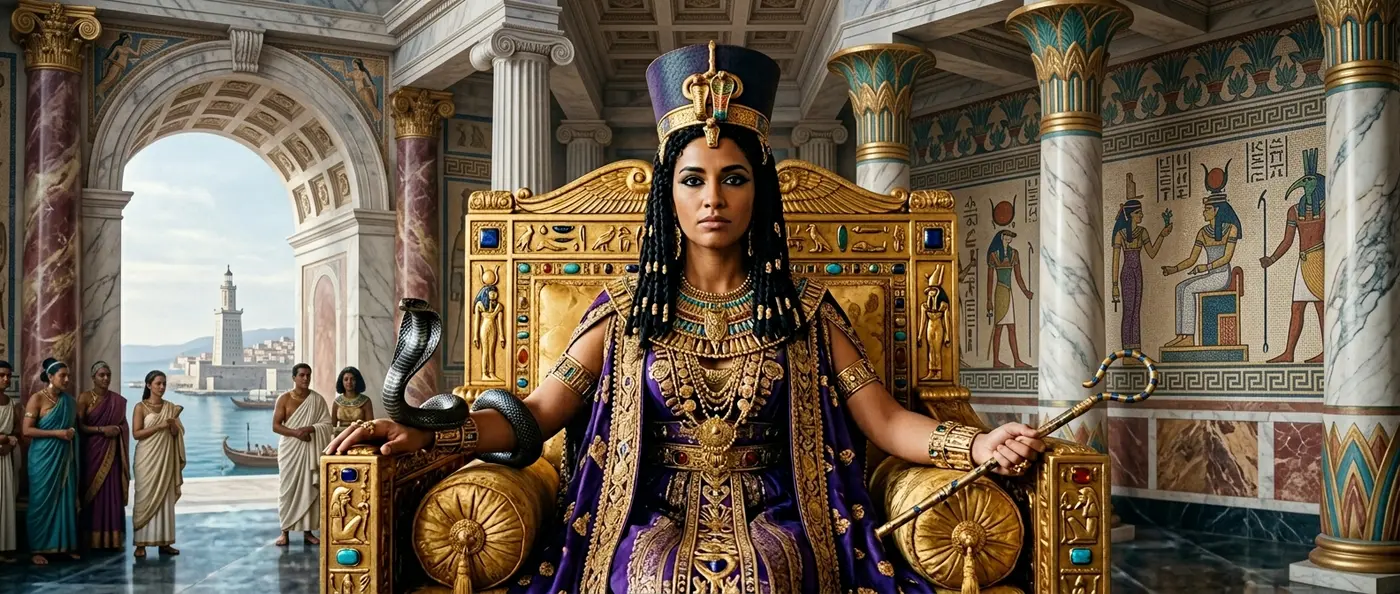
In early 2024, archaeologists at Taposiris Magna discovered hundreds of coins bearing the image of a woman wearing a royal crown. Dig leader Kathleen Martinez believes they depict Cleopatra VII — Egypt's last pharaoh. If her theory proves correct, we might be closer than ever to finding the lost tomb of antiquity's most famous queen.
📖 Read more: Pharaoh Stole Another Pharaoh's Tomb
👑 Rise of the Last Ptolemy
Cleopatra VII was born in 69 BC, daughter of Ptolemy XII Auletes and an unknown mother. Descended from the ancient Greek Ptolemaic dynasty that had ruled Egypt since 305 BC, she grew up speaking Koine Greek in cosmopolitan Alexandria. She was the only one of her generation to learn Egyptian — a calculation that would prove crucial to her survival.
📖 Read more: Why Did the Sphinx Lose Its Nose? The Truth Revealed
When her father died in 51 BC, the 18-year-old Cleopatra found herself at the center of a brutal succession fight. Following tradition, she married her 10-year-old brother Ptolemy XIII and they ruled together. But the young king wanted power exclusively for himself. Civil war erupted, and Cleopatra was forced to flee to Roman-controlled Syria.
There, in exile, the young queen plotted her return. She turned to Julius Caesar, the 52-year-old Roman general who sought to become Rome's sole dictator. Despite their massive age gap — he was 30 years older — and the fact that he was married, they began a romantic relationship. In 47 BC, Ptolemy XIII drowned in the Nile while fleeing Caesar's forces, and Cleopatra reclaimed her throne.
💕 Roman Alliances That Changed History
Cleopatra's relationship with Caesar wasn't merely romantic. It was a strategic alliance that secured Egypt's protection from Rome. She bore a son, Caesarion, whom contemporaries believed was Caesar's child. Egyptian priests taught that the god Ammon had incarnated in Caesar to father the young prince.
In late 46 BC, Cleopatra visited Rome at Caesar's invitation, bringing Caesarion and all the royal magnificence of her court. Caesar received her at one of his suburban villas, the Horti Caesaris, and showered her with official honors. He even erected a statue of her in the Temple of Venus Genetrix.
Many Romans observed that the child bore a striking resemblance to Julius Caesar. Mark Antony, Caesar's lieutenant, told the Senate that Caesar had acknowledged to his closest friends that Caesarion was indeed his son.
But on the Ides of March 44 BC, Caesar was assassinated. Cleopatra and Caesarion were in Rome at the time. Realizing their lives were in danger, they immediately returned to Egypt. There, the queen poisoned her brother Ptolemy XIV and appointed her three-year-old son as co-ruler under the name Ptolemy XV Caesar.
⚔️ Antony and Cleopatra: The Final Chapter
In 42 BC, Mark Antony arrived in Egypt as the Roman triumvir responsible for the eastern provinces. He requested a meeting with Cleopatra to continue the Egyptian-Roman alliance. The queen traveled to Tarsus in modern-day Turkey in 41 BC aboard a luxurious ship, dressed as a goddess.
Art historian Diana E. E. Kleiner writes in "Cleopatra and Rome" that Cleopatra "invested her sea voyages with carefully chosen costumes, divine associations, expensive fabrics and jewelry, music, and exotic perfumes." The pharaoh aimed to impress, and she succeeded.
The Tarsus Arrival
Cleopatra arrived on a gilded barge with purple sails. Dressed as Aphrodite, she reclined under a golden canopy while young boys dressed as cupids fanned her.
Love with Antony
Almost immediately, a passionate romance began with the married Antony, who moved to Alexandria to be with her. They had three children together.
Vision of an Empire
Together they envisioned an empire uniting East and West, with Alexandria as capital and their children as heirs.
But Antony's relationship with Cleopatra and the rumored excesses of their life in Alexandria led to both their downfalls. The Roman leader became embroiled in total war with his fellow triumvirs and his own people, who were outraged by what they saw as Egyptian influence on Roman affairs.
📖 Read more: Valley of Kings: Hidden Tombs That Rewrote Death
🗿 The Hunt for the Lost Tomb
After Mark Antony's defeat at the Battle of Actium in 31 BC, Cleopatra barricaded herself in her royal mausoleum. Antony, believing she had already killed herself, stabbed himself and died in her arms. The queen tried to negotiate with Octavian, but when she realized he planned to take her prisoner and parade her through Rome's streets as a trophy, she committed suicide, likely with poison.
Her death marked the end of the Ptolemaic dynasty and Egypt's incorporation into the Roman Empire. But her tomb has never been found. As Chip Brown wrote for National Geographic in 2011, "Most of the glory that was ancient Alexandria now lies about 20 feet under water."
💡 The Taposiris Magna Mystery
Archaeologist Kathleen Martinez believes Cleopatra was buried at Taposiris Magna, a temple dedicated to Isis and Osiris. Her team has discovered hundreds of coins bearing Cleopatra VII's image, many found in a "sacred trench" that appears to have been deliberately hidden. They've also uncovered a sunken harbor beside the temple, where ceramic vessels and stone and metal anchors were found.
🏺 New Finds and Controversies
Recent discoveries at Taposiris Magna include not only hundreds of coins but also a small marble bust depicting a woman with a royal crown. Martinez claims it represents Cleopatra VII, though other archaeologists disagree.
Former Egyptian antiquities minister Zahi Hawass, examining the bust, stated: "I looked at it carefully. It's not Cleopatra at all; it's Roman." He points out that during the Ptolemaic dynasty, pharaohs were depicted in Egyptian, not Roman, artistic styles.
The debate hasn't stopped Martinez's team from digging. Along with the coins and bust, the team found oil lamps, a bronze ring dedicated to Hathor (goddess of love and beauty), and an amulet inscribed "The justice of Ra has risen."
📊 Evidence For and Against Taposiris Magna
🔬 The Ongoing Research
Martinez and her team have been working at Taposiris Magna since 2005. They've uncovered temples, tombs, and a massive tunnel beneath a temple. The coins found at the temple's entrance and courtyard were intended as offerings to the goddess Isis, according to Martinez.
Andrew Meadows, professor of classical studies at Oxford University, confirms: "Indeed, these are coins that were minted during Cleopatra's reign and bear her portrait." However, he adds: "Was she buried there? We have absolutely no ancient literary or documented evidence to suggest it."
Sitta von Reden, professor of ancient history at the University of Freiburg, believes Cleopatra was buried in Alexandria in a now-submerged area near the royal palace. However, she doesn't rule out the possibility that the Taposiris Magna temple claimed to have Cleopatra's body: "Individual sanctuaries may well have claimed to have Cleopatra's body and established a cult in their temple area for whatever reason."
👑 Legacy of the Last Pharaoh
Regardless of where her tomb lies, Cleopatra VII remains one of history's most captivating figures. She wasn't simply a woman who used her beauty to seduce powerful men. She was a shrewd politician who spoke nine languages, a capable administrator who kept Egypt independent for nearly two decades, and a mother who fought to secure her children's future.
Martinez remains optimistic: "In science I think it's good to have different views. I'm convinced we'll find Cleopatra's tomb at Taposiris Magna." Whether she's right or wrong, the search continues, and each new discovery brings us closer to understanding the life and death of Egypt's last pharaoh.