Walking through modern Athens, beneath your feet lie treasures from 2,500 years ago. In the basement of the Zara store on Stadiou Street, among children's clothes, a 2,000-year-old Roman tomb remains visible through reinforced glass. But what was life like when these streets bustled with Athenian citizens of the classical era?
🏛️ The City That Birthed Democracy
Ancient Athens in the 5th century BC was a city in constant motion. From 507 BC, under Cleisthenes' leadership, Athenians developed a system of popular governance they called democracy. In the Assembly of the People, all adult male citizens — roughly 10-15% of the total population — had voting rights.
The city had been continuously inhabited since the Neolithic period, around 3000 BC. By the classical period, it had evolved into one of the most powerful city-states in ancient Greece, wielding influence far beyond its borders.
The center of political life was the Agora, the public space where citizens gathered to discuss, vote, and conduct their daily business. There, among the stoas and temples, politics was shaped that would influence the entire Greek world.
🏺 Daily Life in the Agora
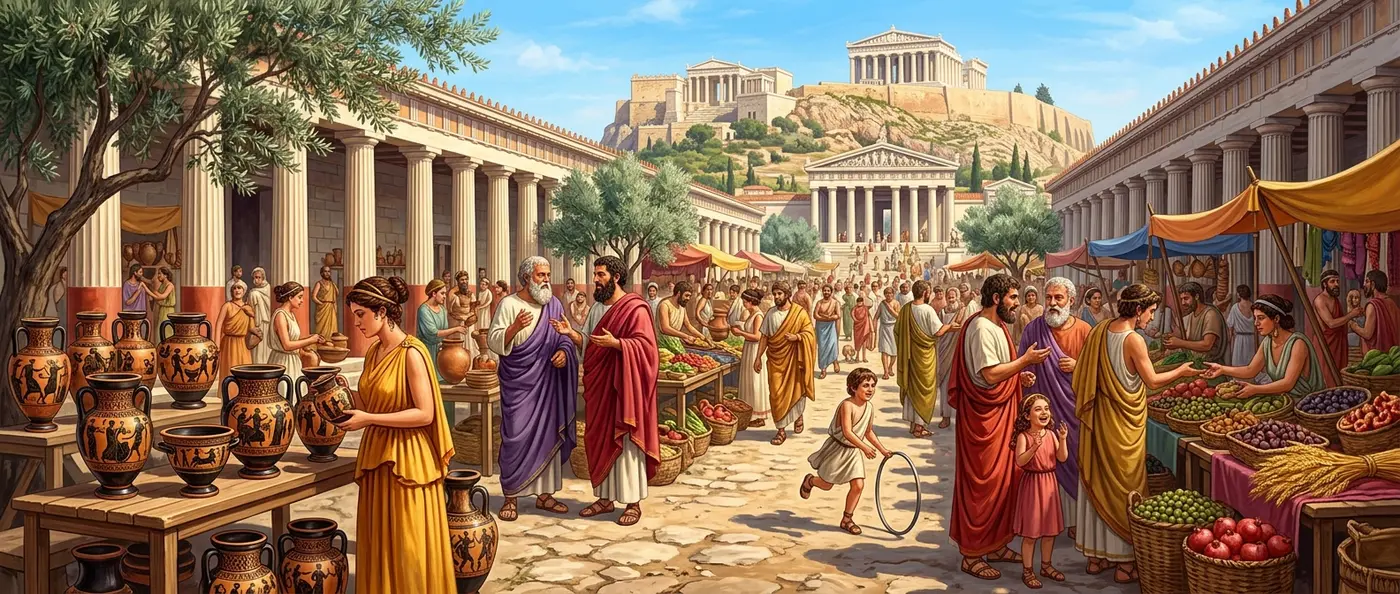
The Agora wasn't merely a political space. It was the heart of Athenian daily life. From early morning, merchants set up their stalls, selling everything from oil and wine to ceramics and textiles. Craftsmen worked in their workshops around the square, creating the famous Attic pottery that would travel throughout the Mediterranean.
Citizens met in the stoas to discuss the day's news, close business deals, or simply pass time. Philosophers like Socrates wandered among the crowds, engaging passersby in discussions about virtue and justice.
Around the Agora stood important public buildings: the Bouleuterion where the Council of 500 met, the Tholos where the prytanes ate and slept, and various temples dedicated to the city's gods. Each building had its own function in the complex machinery of Athenian democracy.
🎭 Symposiums and Social Life
After sunset, Athenian social life moved to private homes. Symposiums were the center of upper-class male social life. In specially designed rooms, symposiasts reclined on couches and enjoyed wine mixed with water, discussing politics, philosophy, or reciting poetry.
Symposiums followed strict etiquette rules. A symposiarch set the wine-to-water ratio and the pace of consumption. Musicians and dancers entertained guests, while games like kottabos — where players tried to hit targets with the last drops of their wine — added competitive elements to the evening.
Symposium Rules
Strict etiquette governed wine-water ratios, speaking order, and entertainment methods. Undiluted wine was considered barbaric.
Entertainment
Flute girls, dancers, and acrobats entertained symposiasts. Guests recited poetry and played musical games.
Discussions
From light conversation to deep philosophical debates, symposiums were spaces for exchanging ideas and forming political alliances.
⚓ The Port of Piraeus
Piraeus, Athens' port, was a world unto itself. Ships from across the Mediterranean arrived here, bringing grain from the Black Sea, metals from Thrace, and luxury goods from the East. Merchants from dozens of different cities traded on the docks, creating a multilingual marketplace.
Piraeus' shipyards were the base of Athenian naval power. Hundreds of triremes, the warships that secured Athens' dominance at sea, were built and maintained here. Thousands of workers — citizens, metics, and slaves — labored in the shipyards, contributing to the maintenance of the fleet that protected the empire.
👥 Women and Family Life
Athenian women's lives differed dramatically from men's. Upper-class women spent most of their lives in the household, managing domestic affairs and supervising slaves. They had no political rights and rarely appeared in public without escort.
Nevertheless, women played important roles in the city's religious life. They participated in religious festivals like the Thesmophoria, dedicated to Demeter, and the Panathenaea, the great festival honoring Athena. Some women served as priestesses in important sanctuaries.
Lower-class women had more freedom of movement by necessity. They worked as vendors in the agora, midwives, or wet nurses. Hetairai, educated women who provided companionship to men, enjoyed greater freedom and could participate in symposiums and public events.
💡 Did You Know?
Aspasia, Pericles' companion, was one of the most influential women in ancient Athens. Though not an Athenian citizen, her home became a center of intellectual discussions where philosophers and politicians gathered.
🏋️ Gymnasiums and Athletics
Gymnasiums were central to the education and social life of young Athenians. There, adolescents and young men exercised naked — the word "gymnasium" comes from "gymnos" (naked) — in sports like wrestling, running, and the pentathlon. Physical exercise was considered essential for shaping the ideal citizen.
Athens' three great gymnasiums — the Academy, the Lyceum, and the Cynosarges — weren't just athletic centers. They evolved into spaces for philosophical teaching. Plato taught at the Academy, Aristotle at the Lyceum. There, between exercises, young men learned rhetoric, music, and philosophy.
🎨 Art and Culture
Classical Athens' artistic production left an indelible mark on world culture. The Theater of Dionysus, at the foot of the Acropolis, hosted performances by the great tragic poets — Aeschylus, Sophocles, Euripides — and the comic playwright Aristophanes. Thousands of citizens attended performances during the Dionysia festivals.
Kerameikos workshops produced the famous black-figure and red-figure pottery depicting scenes from mythology and daily life. Sculptors like Phidias created statues combining ideal beauty with realistic representation.
The city's architecture, crowned by the Parthenon, expressed values of harmony, symmetry, and logic that characterized Athenian culture. Architects calculated every proportion to achieve mathematical harmony.
🏛️ Great Works of the Era
🔱 Religion and Festivals
Religious life permeated every aspect of Athenian society. Athenians believed in a pantheon of anthropomorphic gods headed by Zeus, but their patron goddess was Athena, goddess of wisdom and war. Temples and altars were scattered throughout the city, and citizens offered sacrifices to secure divine favor.
The religious calendar was packed with festivals. The Panathenaea, the city's greatest festival, included processions, athletic competitions, and musical contests. Every four years, the Great Panathenaea attracted visitors from across the Greek world. The procession, depicted on the Parthenon frieze, was the festival's climax.
Other important festivals included the Dionysia with theatrical competitions, the Eleusinian Mysteries promising better afterlife to initiates, and the Anthesteria, a festival of wine and the dead. Each festival strengthened community bonds and affirmed Athenian identity as a people favored by the gods.
Great Dionysia
Five-day festival featuring tragedies and comedies. Winning poets and sponsors gained great prestige in the city.
Eleusinian Mysteries
Secret rites honoring Demeter and Persephone. Initiates believed in better afterlife.
💀 Slaves and Metics
Athenian society relied heavily on slave labor. An estimated 100,000 slaves lived in classical Athens, nearly as many as free inhabitants. They worked in homes, workshops, fields, and the silver mines of Laurium, where conditions were particularly harsh.
Metics, free foreigners who permanently resided in Athens, formed another significant group. Without political rights, they contributed significantly to the economy as merchants, craftsmen, and bankers. They paid a special tax, the metoikion, and served in the military. Some, like the orator Lysias, gained great influence despite their status.
The presence of these groups reminds us that Athenian democracy, despite its achievements, was limited to a minority of the population. This mix of peoples made Athens the Mediterranean's busiest trading hub.
🌅 From Dawn to Dusk
A typical day for an Athenian citizen began at sunrise. After a simple breakfast of bread dipped in wine, men headed to the Agora for their business. Farmers brought produce from the countryside, craftsmen opened their workshops, merchants prepared their wares.
At midday, when the sun blazed, many sought shade in the stoas or returned home to rest. Afternoons were devoted to exercise at the gymnasium or social gatherings. The wealthy might attend philosophical discussions or visit the barbershop, a center of gossip and news.
At sunset, families gathered for dinner, the day's main meal. In wealthier homes, a symposium might follow. In poorer ones, the family slept early to wake again at dawn. Thus life flowed in the city that birthed democracy, philosophy, and theater — a city that left an indelible mark on human history.