📖 Read more: Etruscans: The Mysterious People Before Rome
📜 The Discovery That Shook the World
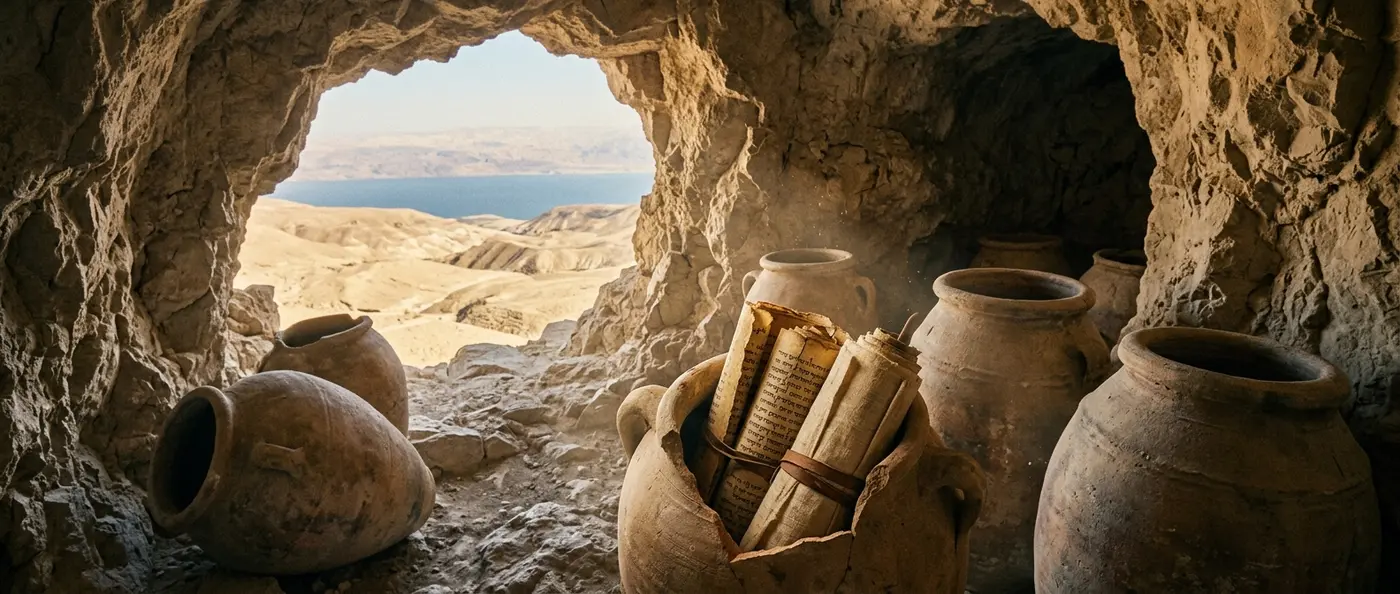
The Dead Sea Scrolls rank among the 20th century's most explosive archaeological finds. Between 1947 and the mid-1960s, researchers uncovered roughly 15,000 fragments representing 800 to 900 original manuscripts. Most came from 11 caves near Qumran, on the Dead Sea's northwestern shore.
These scrolls span five centuries, from the 3rd century BCE to the 2nd century CE. They include biblical texts, hymns, prayers, and apocalyptic writings. Written primarily in Hebrew, with sections in Aramaic and Greek, they offer an unfiltered window into Judaism during Jesus's era.
Their significance is staggering. Before this discovery, the oldest known Hebrew Bible manuscripts dated to the 9th century CE. The Dead Sea Scrolls bridged a thousand-year gap, showing us biblical texts as they existed much closer to when they were originally written.
The scrolls demolished assumptions about ancient Judaism. They revealed not one monolithic faith, but a fractured landscape of competing sects, each with distinct beliefs about law, calendar, and the coming end times.
🗿 The Essenes of Qumran
Who hid these treasures? Most scholars point to the Essenes, an ascetic Jewish sect that lived in the Qumran community. Archaeological evidence shows the settlement was occupied from roughly 100 BCE to 68 CE, when Romans destroyed it during the First Jewish Revolt.
The Essenes had fled Jerusalem after clashing with Temple priests over sacred calendar calculations and legal interpretations. In the Judean desert, they built a community devoted to ritual purity and preparation for divine judgment.
Their worldview was starkly dualistic. Light versus darkness. Good versus evil. Sons of Light versus Sons of Darkness. They believed they were living in the final days, when cosmic battle would determine humanity's fate.
The scrolls paint a picture of religious extremism. These weren't moderate reformers — they were radicals who viewed themselves as the only true Israel, surrounded by corruption and apostasy. Their "Community Rule" scroll lays out harsh punishments for members who broke regulations, including temporary expulsion for spitting during community meetings.
🔬 New Technology Reveals Ancient Secrets
In 2020, an international team from Israel, Sweden, and the US applied advanced genetic testing to the scrolls. By analyzing DNA from the animal skins used as parchment, scientists discovered that some manuscripts originated from other locations, not just Qumran.
One stunning revelation involved two fragments that scholars had assumed belonged to the same Jeremiah manuscript for decades. DNA analysis proved they came from different texts entirely — one written on sheepskin, the other on cowhide.
Artificial intelligence adds another layer. In 2025, researchers unveiled "Enoch," an AI model trained on radiocarbon-dated manuscripts. The model suggests many scrolls are older than previously estimated, pushing some dates back by centuries.
Machine learning algorithms are also tackling the world's most complex jigsaw puzzle. With 25,000 fragments scattered across institutions worldwide, computers can now identify which pieces belong together based on writing patterns, material composition, and damage signatures.
DNA Analysis
Genetic material from animal skins reveals manuscript origins and helps connect fragments that belong to the same text, revolutionizing how we piece together ancient documents.
Artificial Intelligence
The "Enoch" AI model predicts manuscript dating with unprecedented accuracy, revealing that many scrolls are significantly older than initial estimates suggested.
Digital Reconstruction
Computer algorithms help place 25,000 fragments in their correct positions, solving one of archaeology's most challenging puzzles through pattern recognition.
📚 What the Scrolls Contain
The Dead Sea Scrolls contain a stunning variety of texts. Roughly one-quarter are biblical manuscripts covering the entire Hebrew Bible except Esther. Among the most significant finds is the Isaiah Scroll from Cave 1 — 1,000 years older than any other known copy.
Beyond biblical texts, the scrolls include works previously known only from translations, like the books of Enoch and Jubilees. There are also texts unique to the Qumran community, such as the "Community Rule," which describes the sect's beliefs and practices.
The "War of the Sons of Light Against the Sons of Darkness" stands out as an apocalyptic text detailing the final battle between good and evil. The Copper Scroll from Cave 3 is equally unique — a treasure list engraved on copper, describing Temple treasures and their hiding places.
📖 Read more: Göbekli Tepe: World's Oldest Temple Rewrites History
Perhaps most intriguing is the Temple Scroll from Cave 11. With 66 preserved columns, it describes construction of the ideal Jerusalem Temple in minute detail. The text presents instructions supposedly given directly by God, suggesting the Qumran community viewed the existing Temple as corrupted.
💡 The Temple Scroll Mystery
The Temple Scroll from Cave 11, with its 66 preserved columns, describes in extraordinary detail the construction of the ideal Jerusalem Temple. The text presents instructions supposedly given directly by God, suggesting that the Qumran community considered the existing Temple to be contaminated and illegitimate.
🌍 Impact on Understanding the Ancient World
The Dead Sea Scrolls overturned previous theories about Second Temple Judaism. They shattered the notion of uniform "Judaism" in that era, revealing instead a spectrum of competing beliefs and practices.
The texts show different liturgical calendars existed, meaning different dates for festivals. They reveal beliefs about history's imminent completion, the coming of messianic figures, and the absolute necessity of complete obedience to Mosaic Law.
For early Christianity studies, the scrolls provide crucial context. They offer sociological parallels with early Christian communities and help explain the Jewish background from which Christianity emerged. However, similarities between the two groups can equally be explained by their shared Jewish heritage, without implying direct connection.
The scrolls also illuminate Jewish mysticism's roots. Texts like the "Songs of the Sabbath Sacrifice" describe heavenly liturgies performed by angels, prefiguring later Jewish mystical traditions that would culminate in medieval Kabbalah.
🔍 Ongoing Discoveries and Future Prospects
New discoveries keep coming. In 2025, archaeologists working at the Church of the Holy Sepulchre in Jerusalem uncovered evidence of an ancient garden beneath the church floor. Archaeobotanical analysis revealed traces of grain, grapes, and figs, confirming John's Gospel reference to Jesus being crucified and buried near a garden.
Meanwhile, new finds from other Dead Sea sites continue enriching our picture. At Wadi Al-Murabbaʿāt, 18 kilometers south of Qumran, documents from the Bar Kokhba revolt (132-135 CE) were found, including two letters from the rebel leader himself.
Technology continues playing a critical role. Israeli and German researchers are developing computer algorithms that can find the correct position of each fragment in the massive scroll puzzle. As Pnina Shor, former head of the Israel Antiquities Authority's Dead Sea Scrolls unit, notes, these different approaches will enable fuller understanding of the texts.
Multispectral imaging reveals text invisible to the naked eye. Researchers can now read erased words, detect corrections, and identify different scribal hands working on the same manuscript. Each technical advance opens new research avenues.
📊 The Scrolls by the Numbers
⚡ Significance for the Modern World
The Dead Sea Scrolls document a world of theological creativity, social fracture, and intense expectation. They witness to a period when people grappled with questions that remain urgent: the tension between personal holiness and national redemption, between free will and predestination, between faith and knowledge as means of salvation.
The contradictions that occasionally surface in the texts betray the tensions of an era in transition. In this ferment we can see, in hindsight, the matrix from which two great systems emerged: rabbinic Judaism and Christianity.
The scrolls remind us that religious traditions we consider ancient and unchanging were once new, controversial, and contested. They show us a time when the boundaries between orthodoxy and heresy were still being drawn, when competing groups claimed exclusive access to divine truth.
As technologies evolve and new discoveries surface, the Dead Sea Scrolls continue revealing their secrets. Each new find, each successful DNA analysis, each correctly placed fragment brings us closer to understanding this extraordinary archive of ancient thought and faith. The journey of discovery that began when a young shepherd threw a rock into a cave in 1947 continues, promising even more revelations about the ancient world that shaped our cultural heritage.