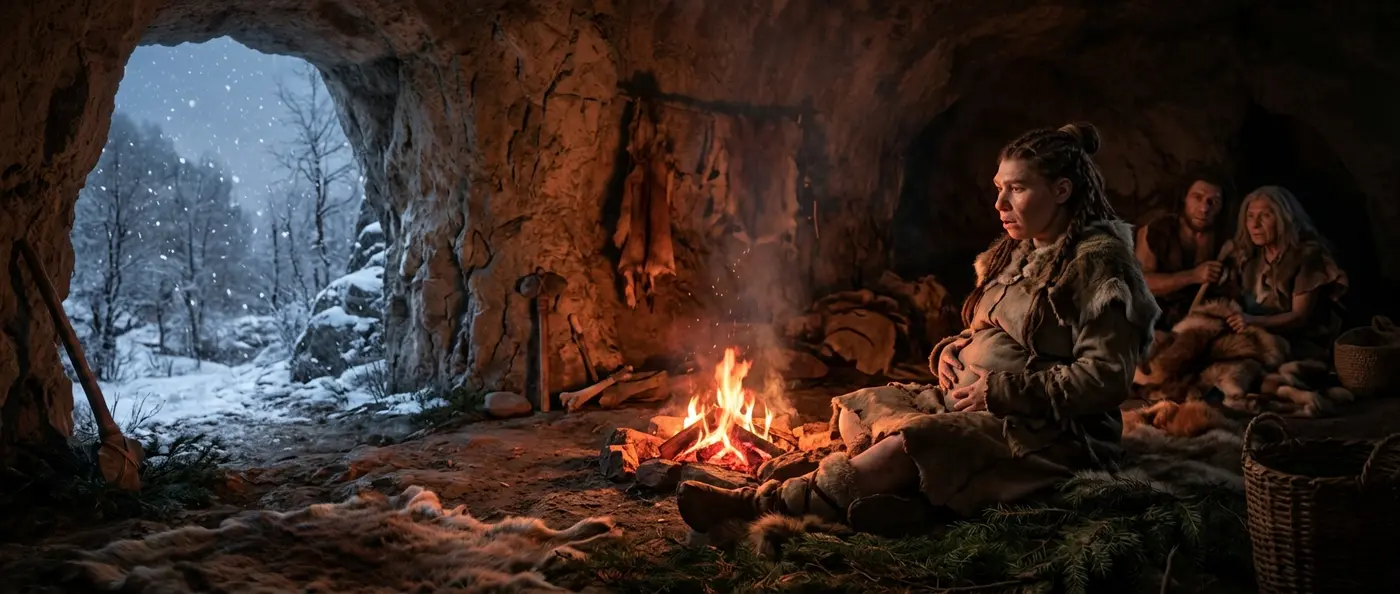
A team of doctors just floated something that sounds almost absurd: preeclampsia, a dangerous pregnancy complication that threatens both mother and baby, might have played a decisive role in wiping out the Neanderthals. The theory is sparking fierce debate in scientific circles, but it forces scientists to examine reproductive biology in our extinct cousins.
📖 Read more: Neanderthals Collected Skulls for 43,000 Years — But Why?
🧬 Preeclampsia as an Evolutionary Death Trap
Preeclampsia hits like a biological sledgehammer. Blood pressure skyrockets during pregnancy, hammering the mother's heart, kidneys, and liver. Today, this condition strikes up to 8% of pregnancies worldwide.
A study published in the Journal of Reproductive Immunology in January 2026 makes a bold claim. An international team of neonatologists and obstetrician-gynecologists argues that preeclampsia and eclampsia —a related disorder involving seizures during pregnancy— have never been seriously examined as factors in Neanderthal reproductive biology.
Research shows that abnormal, shallow placental implantation in the uterus triggers the condition. Big-brained human species faced extraordinary metabolic demands. Their babies needed deep placental implantation to guarantee sufficient nutrient transfer from mother to fetus.
💡 The Big Brain Paradox
Neanderthals had brains equal to or larger than modern humans. Their fetuses demanded extreme energy, especially during the third trimester when brain development explodes. The energy demands set up a biological collision course.
🔬 What Placenta Data Reveals
Scientists created detailed maps of immune cells in the placenta for the first time. They watched how cells protect the fetus from invaders during early pregnancy. Using "mini-placentas" grown from just 1 square centimeter of placental tissue, researchers observed how various pathogens infect the organ.
The placenta works as a selective barrier between mother and developing fetus. It allows nutrients through while blocking harmful microbes and toxins. This becomes critical during early pregnancy stages, when the fetal immune system barely functions.
The hypothesis centers on inadequately positioned placentas struggling to secure enough nutrients for the fetus. This can spike maternal blood pressure, leading to preeclampsia, eclampsia, and fetal growth restriction —conditions that complicate pregnancy and threaten survival of mothers and babies.
🧪 The Scientific Pushback
Not everyone's buying this theory. Patrick Eppenberger, co-head of the Evolutionary Pathophysiology and Mummy Studies Team at the Institute of Evolutionary Medicine in Zurich, fired back: "The claim that 'preeclampsia doomed the Neanderthals' far exceeds the available evidence."
Eppenberger agreed that preeclampsia is uniquely human and linked to human placental evolution. But he stressed that proving it was more common or deadlier in Neanderthals than early Homo sapiens is much harder.
April Nowell, a Paleolithic archaeologist at the University of Victoria in Canada, added: "Why Neanderthals went extinct has captured public and researcher imagination, and everyone's hunting for a smoking gun. But the reasons for Neanderthal extinction are complex."
🗿 Alternative Extinction Theories
Neanderthal extinction remains one of human prehistory's biggest mysteries. Beyond preeclampsia, scientists have proposed multiple theories that might have contributed to their disappearance.
Climate Change
Dramatic climate shifts during the last ice age may have reduced available resources and altered ecosystems Neanderthals had adapted to over millennia.
Competition with Homo sapiens
Modern human arrival in Europe may have created resource and territory competition, with Homo sapiens possibly holding technological or social advantages.
Genetic Incompatibility
Research shows genetic differences between Neanderthals and modern humans may have caused problems in hybrid babies, reducing their survival rates.
🔍 What Mini-Placentas Teach Us
Lab-grown mini-placentas let researchers watch pregnancy complications unfold in real time. Scientists used these models to map how the organ responds to infections at individual cell levels.
They discovered that immune cells called Hofbauer cells —fetal versions of pathogen-eating cells called macrophages in adults— activate in response to all infections. But different molecular switches trigger them.
Infections caused placental inflammation that disrupted critical functions like cell-to-cell communication. This suggests certain pregnancy complications could be side effects of this inflammatory response.
Future research includes exploring genes involved in mother-fetal immune interactions and regulating placental and fetal development. Genetics might provide clues about likelihood and population differences, but probably won't "confirm" preeclampsia in Neanderthals the way clinical data would.
🧬 Neanderthal vs Homo sapiens Comparison
🌍 The Future of This Research
Understanding why Neanderthals vanished isn't just academic curiosity. It helps us grasp human evolution, adaptability, and factors that determine species survival.
Preeclampsia research, regardless of its Neanderthal connection, carries massive importance for modern medicine. Scientists hope their research can help the global research community develop new ways to understand and treat pregnancy complications affecting millions of lives annually.
Whether preeclampsia played a role in Neanderthal extinction or not, this study highlights reproductive health's importance in evolutionary success. Neanderthals survived over 300,000 years —an impressive feat showing that whatever challenges they faced, they overcame them for a remarkably long time.
As we continue uncovering our past's secrets, each new theory and discovery brings us closer to understanding human evolution's complex story. The Neanderthal story is ultimately our story too —a reminder that species survival depends on a delicate combination of biology, environment, and luck.