Three hundred fifty dog teeth. Sewn into a pattern like roof tiles. Covering a baby carrier that held an infant 5,000 years ago. When German archaeologists pulled these bedazzled burial bags from Bronze Age graves, they weren't just looking at prehistoric fashion — they were staring at symbols of power that took dozens of dogs to create.
🗿 First Discoveries in the German Countryside
Death wasn't an ending for these people. It was a transition with rules. Near the village of Krauschwitz in Saxony-Anhalt, archaeologists uncovered 10 female burials from the Corded Ware culture, dating between 2900 and 2350 BC. Each grave told a story about how prehistoric Europeans organized their world — even in death.
The Corded Ware people had strict burial codes. Men went into the ground on their right side, women on their left. Both faced south, as if watching the same distant horizon. But these weren't the first people to bury their dead here — archaeologists found even older graves beneath them, 6,000-year-old burials from the Baalberg culture (4100-3600 BC).
The Baalberg people buried their dead under wooden structures, a practice that had been abandoned by the Bronze Age. Yet here, thousands of years later, the Corded Ware culture was building on top of these ancient burial grounds. Coincidence? Archaeologists don't think so.
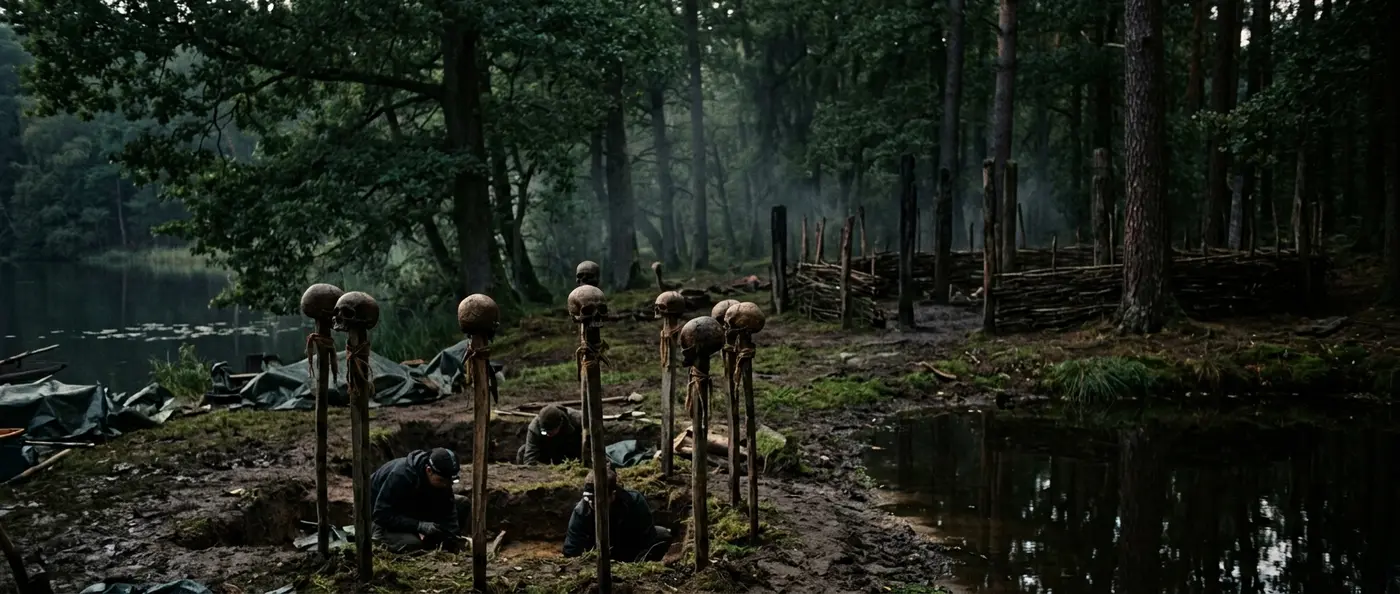
💀 The Mystery of Skulls on Stakes
One hundred kilometers east of Hanover, at Eilsleben, archaeologists found something that bridged two worlds. A deer skull with antlers, modified into a headdress. The find dates to roughly 7,500 years ago, discovered in a Neolithic settlement covering nearly 8 hectares.
The discovery defies expectations: the skull-headdress belongs to the Mesolithic period, not the Neolithic. Similar finds have been discovered at sites up to 11,000 years old, including more than 30 at Star Carr in England. Yet this Mesolithic artifact was found in a Neolithic farming village.
The presence of this ancient hunting culture's ceremonial gear in a farming settlement suggests a "technology transfer" between hunter-gatherers and Europe's first farmers. Archaeologists also found tools made from deer antlers — material the Linear Banded Pottery (LBK) culture people didn't typically use.
🏺 The Elite Women and Their Bedazzled Baby Bags
Three Bronze Age women were buried with something unprecedented: large bags decorated with hundreds of dog and wolf teeth. The fabric or leather has long since decomposed, but the perforated teeth found in the graves reveal they were sewn in overlapping patterns like roof shingles.
Each bag measured roughly 30 centimeters wide and 20 centimeters deep, covered with nearly 350 dog teeth. Specifically, canines and incisors from medium-sized dogs, similar to modern small Münsterlanders. The animals were bred specifically for this purpose and killed at a young age.
The bags' dimensions and the presence of infant bones inside one of them reveal their true purpose: baby carriers. The head, hands, and feet of the infant wouldn't fit inside, but babies lying on their backs were likely covered with small blankets lined with dog fangs.
Decorative Teeth
350 dog teeth per bag, sewn in overlapping shingle patterns. Canines and incisors from young dogs bred specifically for this purpose.
Baby Carriers
30x20 cm dimensions, designed for carrying newborns. Blankets with dog fangs likely covered the infants during transport.
Status Symbols
Only 3 of 10 burials contained these bags, indicating high social status of the women who owned them.
⚔️ When Two Worlds Collided
The village at Eilsleben was "a kind of outpost" for some of Europe's first farmers. The inhabitants belonged to the LBK culture that migrated to Central Europe 7,500 years ago from the Aegean region and Anatolia. They brought agriculture — and they weren't alone.
The settlement contained numerous Mesolithic artifacts, showing that these Neolithic farmers interacted with the hunter-gatherers already living in the area. Remains of a defensive wall and ditch show the village was fortified — but against what, nobody knows.
The relationship between the two groups was paradoxical. The fortifications said "we live here now." But the abundance of hunter-gatherer material inside the settlement told a different story. Previous genetic studies found little evidence of interbreeding between the groups, but this village appears to have been a place of exchange — "not just of material objects, but of symbolic meanings."
💡 Genetic Traces in Modern Europe
The genetic traces of these Neolithic people from the Aegean and Anatolia still exist in the genomes of many modern Europeans. Along with Mesolithic hunter-gatherers and later Yamnaya from the steppe, they form the three main genetic ancestries of Europeans today.
🔬 What the Burials Reveal About Ancient Societies
Burial practices reveal ancient beliefs and social organization. In the Corded Ware culture, gender distinctions were clear even in death. Men were buried with axes, symbols of the warrior, while women were interred with jewelry and decorative objects.
The difficulty of acquiring dog teeth and crafting the decorated bags made them "likely indicators of high social status." Only two of the ten female burials at Krauschwitz contained such bags, while a third was found at the nearby village of Nessa.
At the Nessa burial, the bag contained the remains of a newborn. Researchers will analyze the woman's bones to determine her age at death. If enough DNA from the infant is preserved, they'll also examine the child's relationship to the woman.
🗺️ The Broader Picture of Prehistoric Burials
The German discoveries aren't isolated finds. Similar bags have been found at other sites in Saxony-Anhalt. The deer skull from Eilsleben connects to a broader tradition stretching from Scandinavia to England.
The Neolithic people were the first to introduce farming to Europe — a critical technology that was fully adopted by the people already living there and those who came later. But their interaction with Mesolithic people was complex.
The relationships between Europe's first farmers and hunter-gatherers remain murky. The village near Eilsleben appears to have been a trading post where people shared not just objects but ideas, rituals, and perhaps even sacred symbols.
⚖️ Burial Practice Comparison
🏛️ Significance for Modern Archaeology
These discoveries challenge assumptions about prehistoric Europe. The transition from hunter-gatherers to farmers involved exchange and adaptation, not simple replacement.
Geomagnetic analysis revealed that the Eilsleben settlement was possibly the largest in the region at that time. The site offers insights into Europe's first farming communities and their relationships with older populations.
As excavations continue, each new find adds a piece to the puzzle of European prehistory. The skulls on stakes and bedazzled baby carriers reveal sophisticated cultural traditions dating back millennia.