🗿 The Mysterious Statues of Rapa Nui
Easter Island, known to locals as Rapa Nui, hosts 1,043 completed Moai statues according to the most recent count. These massive monoliths, averaging 13 feet tall and 10 tons, have full bodies — not just the heads that tourists photograph. They have entire bodies, many buried under centuries of accumulated soil.
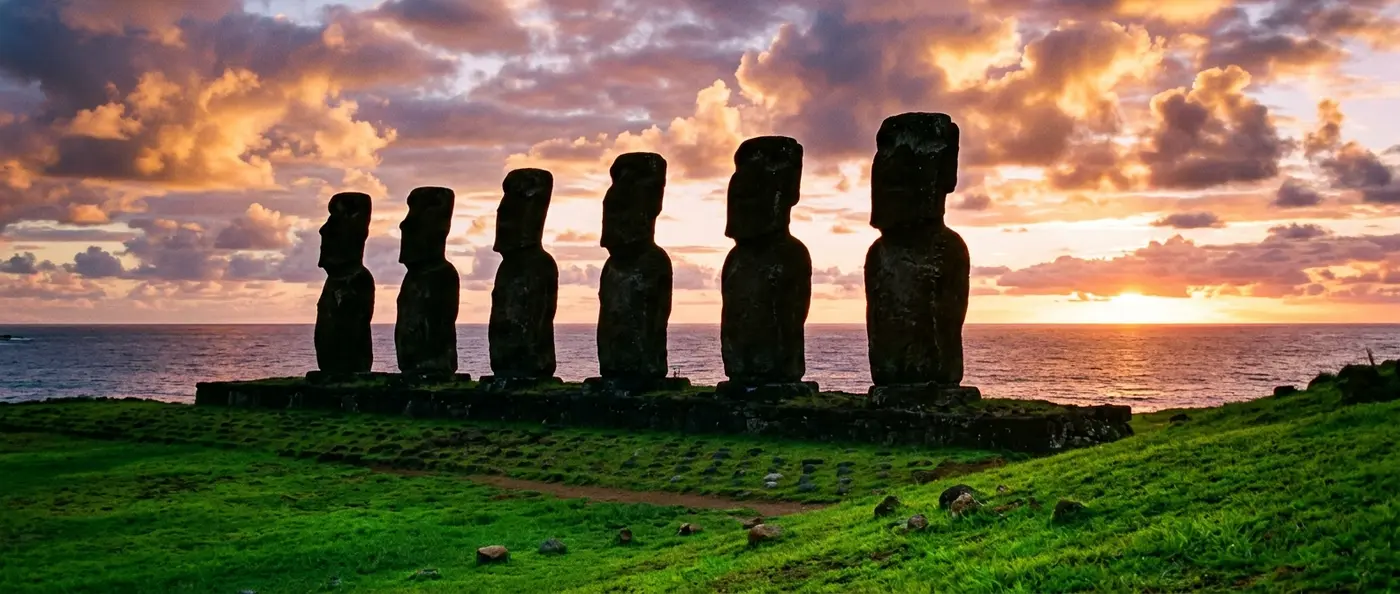
Most statues stand with their backs to the sea, positioned on stone platforms called ahu. Each ahu can support up to 15 statues. Some Moai wear cylindrical red stones on their heads — the so-called pukao — representing a topknot of hair, a symbol of high social status.
The largest Moai ever discovered, known as "El Gigante," remains unfinished in the Rano Raraku quarry. Standing 69 feet tall with an estimated weight of 200 tons, this colossus never left its birthplace. Its existence raises questions: Why create such a massive statue? How did they plan to move it?
⚒️ The Mystery of Construction
The Rapa Nui carved their statues directly from volcanic tuff, a porous rock made from hardened ash, at the extinct Rano Raraku volcano. The craftsmen who created the Moai held special status in Rapa Nui society. Their process was secretive — sculptors took great care not to offend the spirits during construction.
The process began by carving the front face and sides of the statue. Gradually, craftsmen freed the back from the quarry rock. Next, the statue was moved downhill and placed upright in a pit, where sculptors completed the back and added petroglyphs to its surface.
The real puzzle isn't carving — it's transport. Hundreds of Moai remain half-buried at the quarry, as if abandoned suddenly. Others lie scattered along ancient roads, as if they were "walking" to their final destinations when something stopped them.
🔱 The Spiritual Meaning of the Colossi
The Rapa Nui believed their chiefs descended from gods and would become divine again after death. The statues were built to temporarily contain the spirits of their ancestors. The ahu platforms they stand on were once death ritual sites — excavations have found human remains, both cremated and buried, at certain locations.
According to archaeologist Jo Anne Van Tilburg, director of the Easter Island Statue Project, the Moai functioned as "vessels" for spirits: "It is my personal theory that they are vessels into which these moving spirits can be captured and held safely, so they can continue to help the people they left behind."
There's a clear connection between the Moai and similar monoliths found throughout Polynesia. Experts believe these statues stem from a common religion. However, Rapa Nui's Moai are unique in their serene expression — unlike the fierce faces of similar statues in Hawaii.
💡 The Mystery of the Pukao
The red "hats" of the Moai, the pukao, come from a different quarry than the statues themselves. Made from red scoria, these cylinders weigh up to 12 tons. How they were placed atop multi-meter-tall statues remains an unsolved mystery.
🌊 The Collapse of a Civilization
When Dutch navigator Jacob Roggeveen arrived at the island on Easter Sunday 1722 — hence the name Easter Island — he found a civilization in decline. The island was completely deforested, likely cleared to create space for crops. Without timber for canoes, inhabitants were trapped on their isolated island.
The island's resources were quickly exhausted as population grew. Evidence shows the Rapa Nui tried to adapt — there were isolated reforestation attempts and advanced agricultural systems were created for crops like taro and sweet potato, protecting them from strong winds and rapid evaporation.
Colonialism, slave raids, and disease epidemics devastated the population. By 1877, the island's population had dwindled to just 111 people. Today, about 2,000 indigenous Rapa Nui live on the island in a total population of roughly 7,000 residents.
Polynesian Arrival
Polynesian navigators discovered the island around 1000 AD, traveling thousands of miles in double-hulled canoes, using stars for navigation.
Ecological Collapse
Island deforestation for agriculture and Moai transport led to ecological disaster, with the last tree cut around 1650.
Demographic Crisis
From an estimated peak population of 15,000, the island dropped to 111 people in 1877 due to disease and slavery.
🔥 Modern Threats and Destruction
In October 2022, a devastating fire caused "irreparable damage" to hundreds of Moai, mainly around the Rano Raraku quarry. Photos of the statues show surface damage greater than observed in previous fires, which could indicate internal stone cracks.
Climate change also poses a serious threat. The vast majority of Moai are located along the island's coastline, directly vulnerable to rising sea levels and coastal erosion. The Rapa Nui had foreseen this centuries ago and built sea walls, some of which are collapsing and need reinforcement.
Today the statues are still considered sacred — touching the Moai is illegal — and a source of spiritual life force, or mana. For the Rapa Nui, the dangers run deep. "They love the memory of people who have passed," says Van Tilburg. "They are angry that so much was lost through no fault of their own."
❓ Unexplained Mysteries That Remain
Despite decades of research, many Moai mysteries remain unsolved. How exactly were multi-ton statues moved for miles without wheels or large animals? One theory suggests wooden sleds rolling on tree trunks were used, similar to the method believed used at Stonehenge.
Why do hundreds of statues remain unfinished at the quarry? Some are nearly complete, freed from rock except for a thin "umbilical" connection. Others have barely begun taking shape. It's as if all production suddenly stopped.
And perhaps the greatest mystery: why were all the Moai toppled? Until the 19th century, no statue stood upright. The prevailing theory is that the islanders themselves knocked them down, having lost faith in the statues' power. The roughly 40 standing today have been re-erected in recent decades.
🗿 The Moai in Numbers
🌅 The Legacy of the Silent Giants
As the sun rises over the Pacific, illuminating stone faces that gaze eternally toward the island's interior, the Moai continue guarding their secrets. For visitors, they offer a glimpse into a lost world of advanced engineering and profound spirituality. For the Rapa Nui, they remain living connections to their ancestors.
Sebastián Yankovic-Pakarati, a local conservator, puts it simply: "Look where we are. Everything here — the bays, the ruins, the rocks — they're all just part of our story." A story that, despite challenges from fire, climate, and time, continues unfolding in Earth's most isolated inhabited place.
Some questions may never find answers. In a world mapped by satellites and decoded by DNA, the Moai keep their secrets.