🌟 The Birth of Egyptian Astronomy
Egyptian astronomy began with a simple observation: the bright star Sirius appeared just before the Nile's annual flood. The first systematic sky observations began around 3000 BCE, when Egyptians realized that Sirius's heliacal rising (Sothis in Egyptian) coincided with the annual Nile flood.
This discovery drove Egyptians to create one of the world's first accurate calendars. The Egyptian year contained 365 days, divided into 12 months of 30 days each, plus 5 additional days at year's end. Each month split into three 10-day periods called "decans," each corresponding to specific star groups.
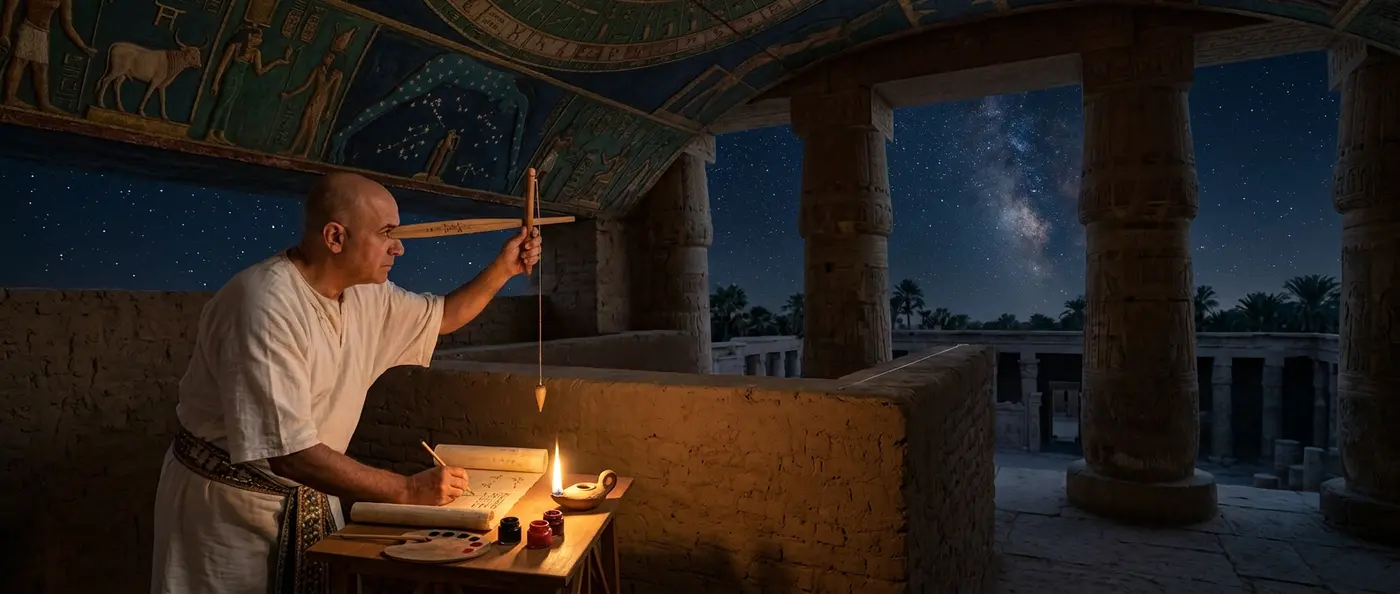
Priest-astronomers at major temples in Memphis, Thebes, and Heliopolis developed complex systems for tracking celestial bodies. They used simple instruments like the merkhet (an astronomical plumb line) and sundials to measure time and determine stellar positions.
💫 The Mystery of the Decans
Egypt's 36 decans were star groups that rose successively every 10 days. Each decan had its own protective deity and was believed to influence the fate of people born under its influence. From this system grew the astrology that would sweep across the ancient Mediterranean.
🔱 The Gods of Heaven
For ancient Egyptians, every celestial body was the incarnation or dwelling of a deity. The sun was the god Ra, who traveled daily across the sky in his barque and each night passed through the underworld to be reborn at dawn. The moon connected to Thoth, god of wisdom and writing, who measured time and recorded human deeds.
The goddess Nut, depicted as a woman bending over the earth with her star-filled body, was the sky itself. According to mythology, she swallowed the sun each evening and gave birth to it each morning. The stars on her body were souls of the dead who had become worthy of eternal life in heaven.
Planets also had divine identities. Mars was "Horus the Red," Venus was "the star that crosses" or "god of the morning," while Jupiter was called "Horus who limits the two lands." Saturn connected to the god Horus and was named "Horus the bull of the sky."
⭐ Constellations and Mythology
Egyptians recognized many constellations but interpreted them differently from other cultures. What we call the Big Dipper was the "Thigh of the Bull" or "Leg of Seth" to Egyptians. They believed it was the severed leg of Seth, god of chaos, bound in the sky to prevent him from harming other gods.
Orion was known as Sahu and identified with Osiris, god of death and rebirth. The three Giza pyramids are believed to align with Orion's Belt, symbolizing the pharaoh's connection to Osiris and eternal life among the stars.
📜 Astronomical Texts and Horoscopes
Recent discoveries in the ancient city of Athribis in Upper Egypt uncovered over 130 ostraca (inscribed pottery shards) containing astrological texts, horoscopes, and zodiacal symbols. These texts, dating from the 3rd century BCE to the 11th century CE, reveal that Athribis was a major center of astronomical and astrological activity.
The discovered horoscopes recorded star and planet positions at the moment of a person's birth, providing the basis for divination and character analysis. This practice shows the integration of Babylonian astrology into Egyptian tradition during the Hellenistic period.
The Pyramid Texts
The world's oldest religious texts contain detailed astronomical references. They describe the dead pharaoh's journey through constellations to unite with gods in heaven.
The Book of Day and Night
These sacred texts described the sun's journey through the 12 hours of day and night, with each hour guarded by different deities.
Astronomical Papyri
Contained tables for calculating moon phases, eclipses, and planetary positions, essential for determining religious festivals.
🏛️ Temples Aligned with Stars
Egyptian architecture was deeply connected to astronomy. Many temples were oriented so that on specific dates, sunlight or starlight would illuminate the inner sanctuary. Ramesses II's temple at Abu Simbel is the most famous example: twice yearly, on February 22 and October 22, sun rays penetrate 60 meters into the temple to illuminate the god statues.
The great temple of Amun-Ra at Karnak was oriented toward the winter solstice, while many Isis temples aligned with Sirius's rising. These orientations weren't random but held deep religious significance, connecting the earthly temple with the heavenly realm of gods.
🌙 Egyptian vs Babylonian Astronomy Comparison
🌌 The Legacy of Egyptian Astronomy
Egyptian astronomy's influence extends far beyond ancient Egypt's borders. The 24-hour system we use today originates from Egyptians, who divided day and night into 12 hours each. The decan concept influenced Western astrology's development, while Egyptian observations of eclipses and planetary motions contributed to astronomical progress during the Hellenistic period.
Claudius Ptolemy, the great 2nd-century CE astronomer of Alexandria, built upon centuries of Egyptian observations to compose his "Mathematical Treatise" (Almagest), which became Western astronomy's foundation for over a thousand years. The Egyptian tradition of systematic observation and recording of celestial phenomena laid the groundwork for scientific astronomy.
Egyptian astronomy teaches us that human curiosity about the heavens is timeless. Just as ancient Egyptians looked at stars and saw their gods, we continue looking up, seeking answers to existence's great questions. The difference is that where they saw the goddess Nut bending over the earth, we see galaxies and nebulae. But the wonder remains the same.