📖 Read more: Senet: The World's First Board Game
🏺 The Art That Conquered Death
Mummies hold the secret to eternal life. They're preserved bodies that have broken the law of decay — death wearing the mask of the living. As Dr. Michael Tellenbach notes, "All humans want to live forever, and especially we want our loved ones to live forever. We want to keep them close to us, physically close, even if it's only their bodies."
📖 Read more: Osiris, Isis and Horus: Egypt's Divine Trinity
Mummification doesn't always require human intervention. It can happen naturally in cold places like glaciers, where the body essentially deep-freezes, or in places like peat bogs, where unique chemical conditions can also preserve the body. However, many civilizations observed this natural phenomenon, adopted it, and tried to perfect the process.
Egypt is naturally the place from which the most famous mummies originate. The ancient Egyptians embalmed in a way that spared themselves and the dead from the stench of decomposition. In fact, Tellenbach comments: "I would very much like to open a cabinet containing the remains of an ancient Egyptian mummy right now for you to smell inside. They smell absolutely divine."
🔬 The 1994 Experiment: When Science Met Antiquity
Bob Brier and Ronn Wade recreated the ancient mummification process using a 76-year-old man who had donated his body to science. They somewhat jokingly named him "E. M. Balm." For the sake of authenticity, they used replicas of pharaonic-era tools: linen fabrics, a strangely wide wooden embalming table, and blades made from copper and obsidian — though they quickly abandoned the copper ones, which couldn't cut flesh well.
Before starting on their mummy, they practiced a crucial step using other corpses: brain extraction. Instead of using whole corpses, they acquired some decapitated heads left over from a medical school plastic surgery class. Scattered references told Brier that Egyptian embalmers removed the brain by inserting a hooked rod through the nostrils.
Initially they tried to extract the brain with such a rod, but the tissue proved too soft and wouldn't come out. They ended up spraying water into the corpse's nose and then using the rod to stir the brain into pulp. After that, it flowed straight out. "Like a milkshake," says Brier. "A strawberry milkshake, to be precise."
💀 The Mummification Process: Step by Step
The duo began making their mummy in May 1994. The first step involved removing the organs. In ancient Egypt, different organs had different fates. Not knowing the brain's purpose, embalmers usually discarded it. The heart, conversely, remained in place — it was considered the seat of all thought, emotion, and intelligence. The abdominal organs were carefully extracted and preserved.
Following this protocol, Brier and Wade made a 3.5-inch incision in their corpse's abdomen and removed the spleen, liver, gallbladder, lungs, and 22 feet of intestines. Due to their size, extracting the liver and lungs required some creative geometry and decisive squeezing.
Brain
Extracted through the nose with a special hook and discarded. Egyptians didn't know its function.
Heart
Always remained in the body. Considered the center of thought and emotion.
Internal Organs
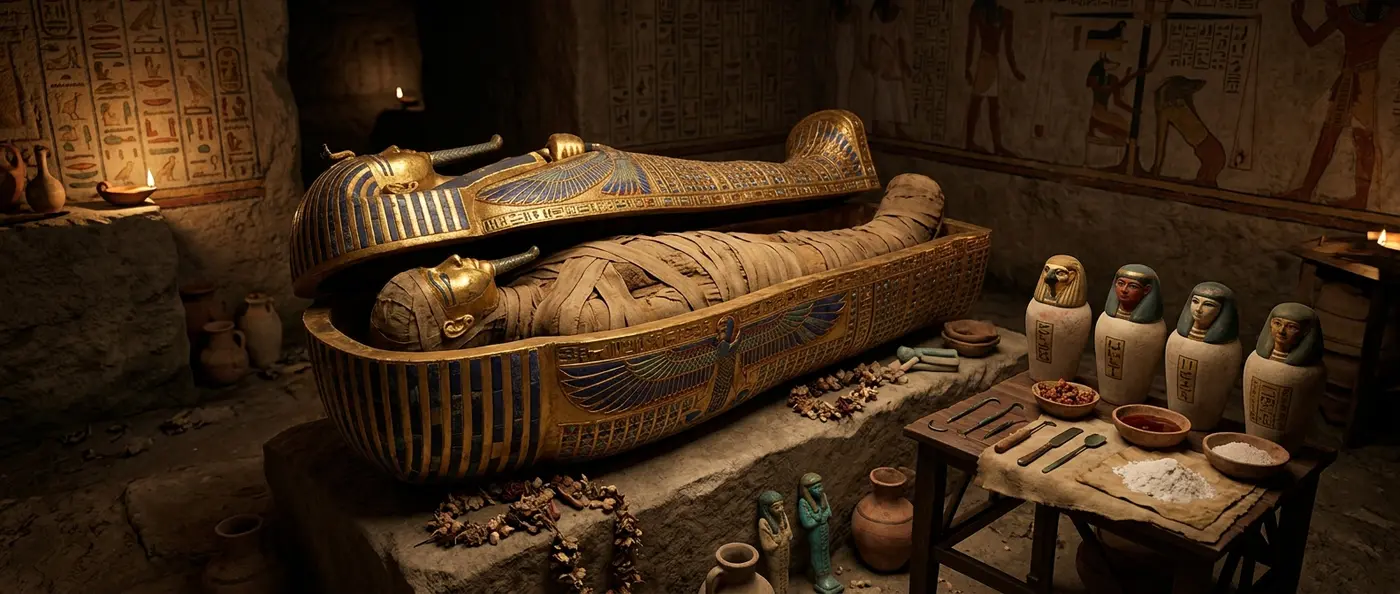
Carefully removed and placed in special containers called canopic jars.
🧂 The Secret of Natron: The Chemistry of Eternity
With the organs removed, the pair cleaned the abdomen with palm wine and myrrh, then filled the skull with frankincense. This was a crucial ritual step for preparing the body for the afterlife, and also helped kill microbes and mask bad odors.
Next, Brier and Wade dehydrated the body using natron, a mineral with equal parts salt and baking soda that forms naturally in Egyptian wadis (dry streambeds). Like a sponge, natron sucks moisture from flesh, leaving it too dry to support bacteria, worms, beetles, and other agents of decay. The remaining tissue is essentially jerky.
⚖️ Body Changes During Mummification
Fully committed to authenticity, Brier dug the natron himself in Egypt and remembers that getting hundreds of pounds of unidentified white powder through customs at JFK airport was one of the most difficult aspects of the project. Fortunately, he was traveling with a film crew and could hide the powder in suitcases among their equipment.
🗿 The Transformation: From Human to Mummy
Over the next five weeks, the natron on top became hard and brown from absorbing bodily fluids, forcing Brier and Wade to break it with an iron rod. The sight of the body underneath thrilled Brier. As it dries, mummy skin tightens and wrinkles, especially on the face and scalp. Lips retract to reveal teeth, and skin with less melanin turns brown-yellow.
Brier had always wondered if these changes resulted from the direct mummification process or from several thousand years of wear in Egypt's dry climate. One look at his mummy and Brier knew the answer: even after just five weeks, "it looked exactly like Ramses the Great," he recalls, with leathery skin, a hooked nose, and sparse hair standing upright.
💡 The Scent of Eternity
Ancient embalmers used sacred substances imported from Europe and Asia at great cost: pistachio resin, beeswax, pine resin. Ramses the Great's mummy had peppercorns from India stuffed in his nose!
📖 Read more: Ancient Egypt's Bread and Beer: Sacred Food of the Pharaohs
🏺 The Secrets of Canopic Jars
Beyond changing the body's appearance, the dehydration process left limbs hard as tree branches and reduced weight from 187 pounds to just 79. The organs drying in bowls also shriveled, which helped explain another mystery of Egyptian mummification.
Embalmers usually placed organs in canopic jars, funerary containers with narrow necks — so narrow it seemed impossible for the larger organs to fit inside. But natron shrunk them enough to slip easily through.
📜 The Final Wrapping and Magical Amulets
After removing him from the natron, Brier and Wade gave Mr. Balm a full-body massage with lotus, cedar, and palm oils, another step that, while ritually important, also had practical benefits — it restored flexibility to joints, making the mummy easier to handle.
They wrapped the body with linen bandages. Ancient embalmers started with hands and feet, wrapping each finger separately, then proceeded to arms, legs, and torso. The penis was also wrapped separately — or, if embarrassingly shrunken, a protective made of hard linen was tied in its place.
At this point, they let the mummy dry for three more months in the dry office, which reduced its weight to 51 pounds. Then they added several more layers of wrapping. Between layers, they placed magical amulets and pieces of papyrus with spells on them, a common practice in antiquity.
⚖️ The Judgment of the Dead: Journey to the Afterlife
The primary purpose of mortuary preparation was to ensure safe and successful passage to the afterlife. Belief in an afterlife and passage to it is evident in predynastic burials, which are oriented westward, the region of the dead, and which include pottery grave goods as well as personal objects of the deceased.
The next world was believed to be located in the area around the tomb, on the "perfect roads of the West," among the stars or in celestial regions with the sun god, or in the underworld, the domain of Osiris. One prominent idea was that of the "Fields of Reeds," where the deceased could enjoy an ideal agricultural existence in a marshy land of abundance.
The journey to the next world was fraught with obstacles. One could imagine it as ferry passage after a succession of gates or through an "Island of Fire." A critical test was the post-mortem judgment, a theme often depicted from the New Kingdom onward. The relevant text, Chapter 125 of the Book of the Dead, magically corresponded to the dangers of judgment, which evaluated the deceased's compliance with maat (cosmic order and justice).
The Weighing of the Heart
The deceased's heart was weighed against a feather of the goddess Maat. If heavier than the feather, it was devoured by the monster Ammit.
The Negative Confession
The deceased had to declare they had not committed 42 specific sins before the judge-gods.
🌍 The Influence on Other Civilizations
Egyptian civilization influenced Nubia from predynastic times and Syria in the 3rd millennium BC. During the New Kingdom, Egypt was very receptive to cults from the Middle East, while Egyptian medical and magical expertise was particularly valued among the Hittites, Assyrians, and Babylonians.
Egyptian influence peaked during the 1st millennium BC and the Roman period. Egypt was an important center of the Jewish diaspora starting from the 6th century BC, and Egyptian literature influenced the Hebrew Bible. With Greek dominance there was significant cultural exchange between Egyptians and Greeks.
Notable among the Egyptian cults that spread abroad were those of Isis, which reached much of the Roman world as a mystery religion, and Serapis, a god whose name probably derives from Osiris-Apis. The myth of Osiris shows some analogies with the Gospel story and, in the form of Isis, with the role of the Virgin Mary. The iconography of the Virgin and Child has obvious affinities with that of Isis and the infant Horus.
🔬 Mummies Today
Ancient physicians ground Egyptian mummies into medicines, praising them as miraculous cures that could extend life. The fascination with mummies reflects humanity's craving for eternal life.