🏛️ A Civilization That Came Before Rome
The Etruscans are archaeology's ultimate cold case. They flourished in central Italy from the 8th to 1st century BC, building a sophisticated society that profoundly influenced Roman culture. Etruria, as their territory was called, stretched from the Tiber River south to the Arno River north, covering modern-day Tuscany and parts of Umbria and Lazio.
Their mystery starts with origin. For centuries, historians debated whether they were native Italians or migrants from Asia Minor. Their language, which doesn't belong to the Indo-European family, remains partially unreadable despite thousands of inscriptions. What we know comes mainly from their tombs — cities of the dead that mirror the wealth and complexity of their society.
The San Giuliano discovery, about 70 kilometers northwest of Rome, is part of the international San Giuliano Archaeological Research Project (SGARP). Since 2016, the team has cataloged over 600 Etruscan tombs in the area. But this 7th-century BC tomb is the only one found completely intact.
🗿 The Rare San Giuliano Find
Davide Zori, an archaeologist from Baylor University in Texas, called the discovery "a rare find for Etruscan archaeology." In the inland hill country of central Italy where the SGARP team works, a preserved chamber tomb of this age had never been excavated using modern archaeological techniques.
The tomb is carved into rock shaped like a small house — a typical Etruscan practice reflecting their beliefs about the afterlife. Inside, four individuals lie on stone beds, surrounded by objects meant to accompany them to the other world. Preliminary data suggests two male-female couples, though further bone analysis will reveal more details.
Kendall Peterson, an undergraduate researcher who participated in the excavation, described the experience as "extremely surreal." She noted that this is something archaeologists hope for throughout their entire careers, and watching not only the professors' reactions but also the pride and enthusiasm of the local Barbarano community was incredibly moving.
💎 Treasures That Reveal a Civilization
The artifacts found in the tomb are a window into Etruscan daily life and beliefs. Ceramic vessels of various sizes and shapes suggest ritual offerings of food and drink. Weapons, likely belonging to the men buried there, testify to the importance of warrior ideals in Etruscan society.
Bronze ornaments and silver hair accessories reveal the sophisticated aesthetics and technical skills of Etruscan metalworking. The Etruscans were renowned for their art, particularly in metal processing and ceramics. Their influence on Roman art and architecture is undeniable — from temple design to arch construction techniques.
Ceramic Art
Etruscan vessels are distinguished by their black glossy surface (bucchero) and detailed representations from mythology and daily life.
Metallurgy
The Etruscans exploited Tuscany's rich iron and copper deposits, creating exceptional weapons and jewelry.
Writing and Language
The Etruscan language, written with an alphabet adapted from Greek, remains partially unreadable despite thousands of inscriptions.
⚔️ From Peak to Subjugation
Etruscan society was organized into independent city-states, each with its own governance but united by common language, religion, and culture. Major cities included Veii, Cerveteri, Tarquinia, and Vulci. Each city was initially ruled by kings (lucumones) and later by oligarchic elites.
The Etruscan relationship with Rome was complex. Rome's first kings were of Etruscan origin, and the city absorbed many elements of Etruscan civilization — from religious rituals to symbols of power like the fasces. However, after expelling the last Etruscan king in 509 BC, Rome gradually expanded at the expense of Etruscan cities.
The Roman-Etruscan Wars lasted centuries. Veii fell in 396 BC after a ten-year siege. Other cities followed one by one. The last independent Etruscan city was subjugated in the 1st century BC, and Etruria was officially incorporated into the Roman Empire. Nevertheless, Etruscan influence continued to permeate Roman civilization.
🔱 Etruscan Legacy in Rome
Many elements we consider typically Roman have Etruscan origins: the art of divination through liver examination (haruspicy), temple design with high podiums and deep porticoes, even gladiatorial games that likely began as Etruscan funeral rituals.
🏺 Necropolises: Cities of the Dead
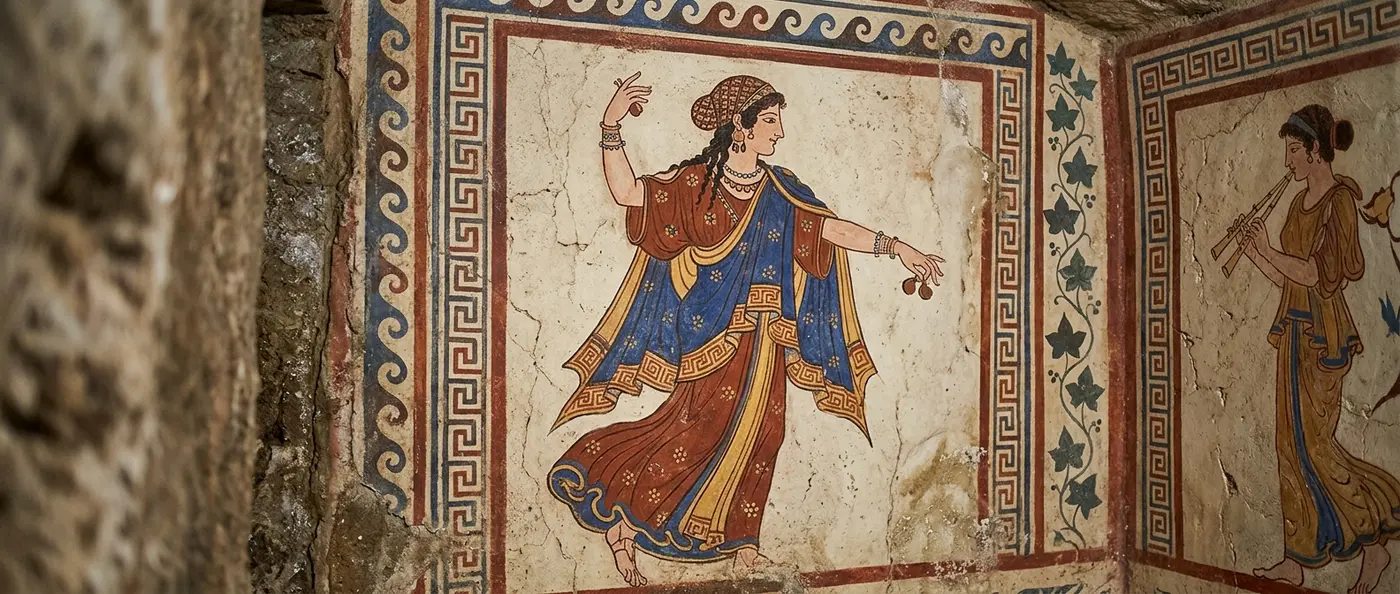
The Etruscans placed exceptional importance on the afterlife, reflected in their imposing tombs. Their necropolises were literally cities of the dead, with tombs resembling houses, streets, and squares. The walls of many tombs are decorated with vivid frescoes depicting banquets, dances, athletic competitions, and scenes from daily life.
These depictions give us valuable information about Etruscan society. We see women participating equally in banquets — something unthinkable in ancient Greece or Rome. The position of women in Etruscan society appears to have been much more equal than in other contemporary civilizations.
The newly discovered tomb at San Giuliano offers concrete evidence about Etruscan burial practices and social structure. The SGARP team has completed the excavation, but study and analysis of the archaeological data is just beginning. Every object, every bone, every detail of the burial arrangement could reveal new information about the beliefs and burial traditions of this fascinating pre-Roman civilization.
🔬 Modern Archaeology Meets Ancient Mystery
What sets this discovery apart is the chance to use modern scientific methods on an undisturbed site. DNA analysis from the bones could reveal family relationships between the deceased and shed light on Etruscan genetic origins. Isotopic analysis could show their diet and whether they were locals or migrants.
Studying ceramics with spectroscopy could reveal clay origins and trade routes. Metal objects can be analyzed to understand manufacturing techniques and metal sources. Every element adds to the broader picture of a civilization that profoundly influenced European history.
📊 Etruscans vs Ancient Rome
🌅 The Future of Etruscan Archaeology
The San Giuliano tomb shows how much we still don't know about the Etruscans. Finding an intact tomb only deepens the mystery. Why did this tomb remain intact when all surrounding ones were looted? Who were the four people buried with such care?
New technology is changing how archaeologists study ancient sites. Three-dimensional scanning of tombs preserves every detail for future study. Artificial intelligence helps decrypt the Etruscan language. Satellite archaeology reveals buried cities and necropolises.
The Etruscans may have disappeared as an independent civilization two millennia ago, but their legacy lives on. From Roman temples to modern Italian place names, from divination arts to metallurgical techniques, their influence permeates European culture. Each new discovery, like the San Giuliano tomb, brings us closer to understanding this mysterious people who laid the foundations for one of history's greatest civilizations.