📖 Read more: Alexander the Great: World Conqueror Who Changed History
🗺️ The Strategic Setup
This wasn't just another battle in Alexander's campaign. Gaugamela was the climactic showdown between two worlds. On one side, the young Macedonian who had already beaten the Persians at Granicus River in 334 BC and at Issus in 333 BC. On the other, Darius III, who had gathered every force from his vast empire for one final, decisive confrontation.
Darius chose his battlefield carefully. The plain of Gaugamela, northeast of ancient Nineveh, was perfect for his powerful cavalry. He'd even ordered the ground leveled at strategic points so his 200 scythed chariots could charge unimpeded at the Macedonian phalanx.
According to historian Plutarch, Alexander always carried a copy of Homer's Iliad, annotated by his teacher Aristotle, which he kept under his pillow alongside his dagger. He called it "a perfect portable treasure of all military virtue and knowledge." Homer's warriors would guide him into his defining battle.
⚔️ The Battle Lines
Dawn fog still covered the plain when both armies began forming up. Darius positioned himself at the center, surrounded by elite Greek mercenaries and Persian heavy infantry. On his left wing, Bessus, satrap of Bactria, commanded cavalry from Bactria, Scythia, and Arachosia. On the right wing, Mazaeus led Armenian and Cappadocian horse.
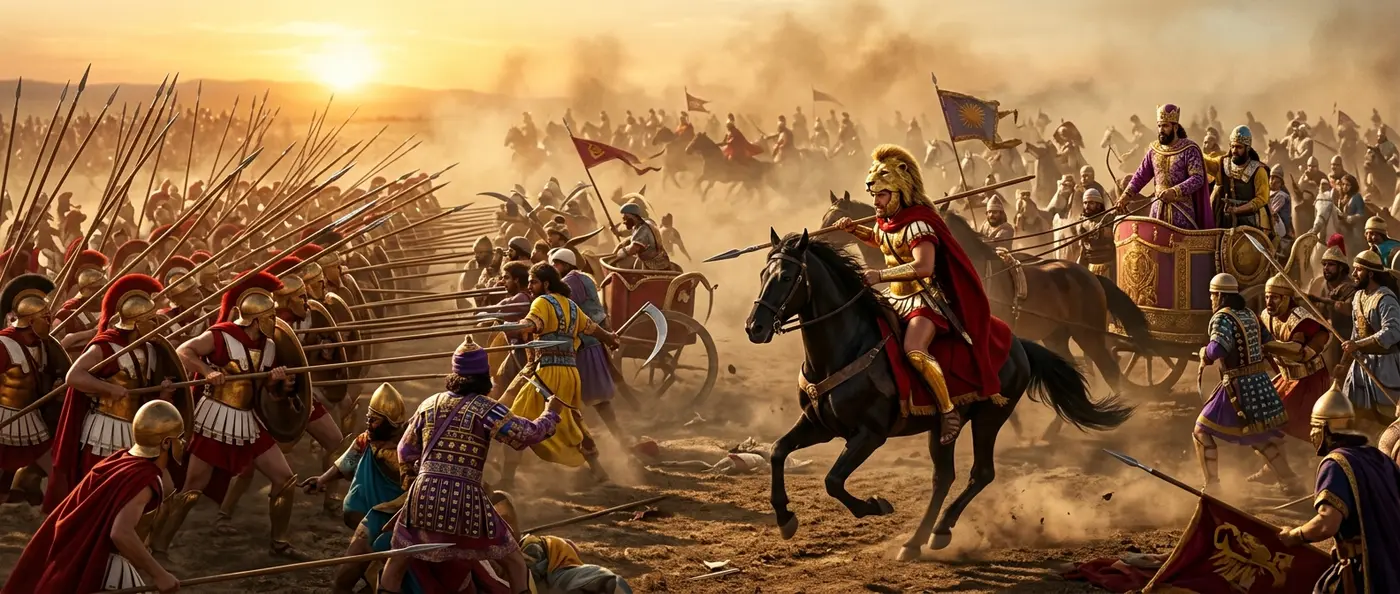
Alexander had designed a complex but flexible formation. He placed himself on the right wing, leading the famous Companion Cavalry. In front, he deployed Agranian archers and javelin throwers to counter the scythed chariots. The center belonged to the fearsome Macedonian phalanx with their 13-foot sarissas, while veteran Parmenion commanded the left wing with Greek and Thessalian cavalry.
The most innovative element was Alexander's second line of infantry, ready to face about if needed, plus reserves on each flank positioned at angles. This formation allowed Alexander either to extend his line or handle attacks from the sides.
🎯 Alexander's Strategic Genius
As battle began, Alexander executed a maneuver that proved decisive. Instead of attacking straight ahead, he began leading his right wing diagonally right, away from the leveled ground Darius had prepared for his chariots. Bessus was forced to send wave after wave of cavalry to stop this movement.
Darius unleashed his scythed chariots, but the Macedonians were ready. Archers and javelin throwers picked off many drivers, while the phalanx opened corridors to let chariots pass through harmlessly. It was a moment that showcased the exceptional training and discipline of the Macedonian army.
The critical moment came when Alexander spotted a gap opening in the Persian line as Bessus had moved forces to counter the flank threat. Without hesitation, the young king formed his famous "wedge" with the Companion Cavalry and struck straight at the center, targeting Darius himself.
💡 The Wedge Formation
The wedge attack was Alexander's signature move. With himself at the tip, the Companion Cavalry penetrated deep into enemy lines like a spear point, shattering cohesion and creating panic. At Gaugamela, this tactic reached perfection.
🏃 Darius Flees and the Collapse
The sight of Alexander and his Companions breaking through and approaching threateningly was enough to spread panic through the Persian center. Darius, seeing death approaching, made the decision that would forever stain his reputation: he abandoned the battlefield for the second time, just as he had at Issus.
The Great King's flight triggered a chain collapse. Persian units, seeing the royal chariot retreating, began dissolving. But the battle wasn't over yet. On the left wing, Parmenion faced serious pressure from Mazaeus's Persian cavalry, which had managed to partially encircle Macedonian forces.
Alexander faced a dilemma: pursue Darius or help Parmenion. He chose the latter, showing that care for his men mattered more than personal glory. With lightning speed, he wheeled his cavalry against the Persians threatening the left wing, completing the victory.
Battle Outcome
Alexander's crushing victory marked the end of the Persian Empire as an organized force. The road to Babylon, Susa, and Persepolis was now open.
Casualties
The Macedonians lost just 100-500 men, while Persian losses numbered in the tens of thousands. The casualty asymmetry shows Macedonian tactical superiority.
Political Impact
After the battle, Alexander was proclaimed King of Asia. Many Persian satraps and nobles switched sides, recognizing the new reality.
🗿 Gaugamela's Legacy
The Battle of Gaugamela wasn't just a military victory. It was the moment the Greek world met the East, creating conditions for the Hellenistic age. The spread of Greek culture from Egypt to India, the founding of dozens of cities named Alexandria, the diffusion of common Greek language - all began that day on the plain of Gaugamela.
Modern historians like Nikolaus Overtoom from Washington State University emphasize that without the victory at Gaugamela, our world would be unrecognizable. The common Greek that spread after Alexander's conquests became the language of trade, diplomacy, and later Christianity. Without this linguistic unity, spreading new ideas and religions would have been far more difficult.
Recent archaeological research led by Professor Reyhan Körpe from Canakkale Onsekiz Mart University has identified possible sites of other Alexander battles, like Granicus. These discoveries help us better understand the Macedonian general's strategic thinking and the conditions under which he achieved his victories.
📜 Lessons for Today
The Battle of Gaugamela continues being taught at military academies worldwide. The principles Alexander applied - flexibility, concentration of force at the critical point, exploiting enemy weaknesses, caring for troop morale - remain timeless.
A gap in the Persian line lasted maybe thirty seconds. Alexander saw it and charged. If Alexander had hesitated to exploit the opening in the Persian line, if Darius had stayed to fight instead of fleeing, world history would be radically different.
Today, 2,355 years later, the plain of Gaugamela near Mosul, Iraq, is a quiet place. It's hard to imagine that there, one October day, two civilizations clashed and the world changed forever. The dust kicked up by thousands of horses has long settled, but that day's echo still reverberates through history.
⚔️ Force Comparison at Gaugamela
🔬 New Archaeological Discoveries
In 2025, Professor Körpe's team announced the possible identification of the Battle of Granicus field, Alexander's first major clash with the Persians. The discovery was based on combining geomorphological studies, which showed the river bed has remained nearly unchanged since antiquity, with finds of weapons and human bones.
Local farmers had found graves with weapons dating to Alexander's era. In 2024, during plowing, human bones of an adult male were discovered on the southern slope of a hill matching ancient descriptions of the Greek mercenary position. The absence of typical burial markers suggests these were battle casualties, not an organized cemetery.
These discoveries matter because they let us better understand the tactics Alexander used from the start of his campaign. At Granicus, according to sources, Persian satrap Spithridates nearly struck Alexander in the head - an event that, had it occurred, would have radically changed history's course.
Geophysical surveys and excavations planned for coming years are expected to reveal more about these crucial battles that shaped the ancient world. Each new find brings us closer to understanding how a young king from Macedonia managed to conquer most of the known world in just 13 years.