📖 Read more: 5,000-Year-Old Rock Art Reveals Saudi Arabia's Hidden Past
🗿 The Discovery That Broke Archaeology
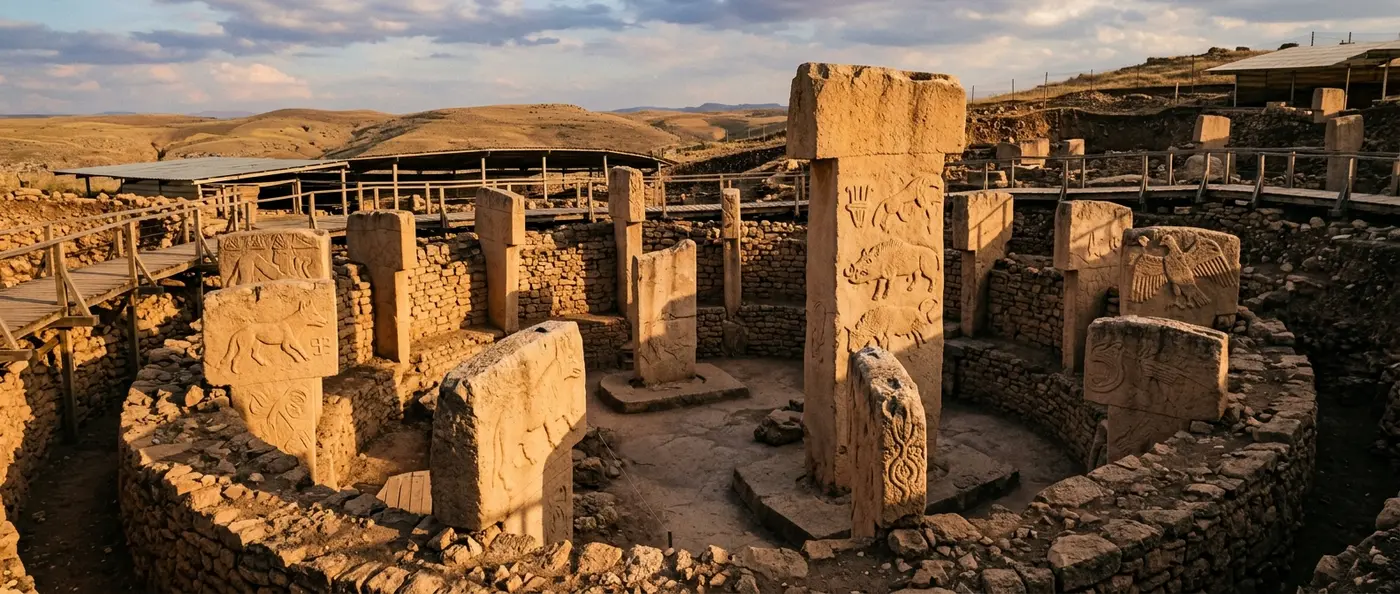
Klaus Schmidt was walking Turkish hills near Şanlıurfa in 1994 when he spotted something locals had dismissed as ordinary rocks. Those "rocks" turned out to be the tops of massive stone pillars. What Schmidt unearthed over the next two decades defied every archaeological textbook: circular structures filled with T-shaped limestone columns, some reaching 18 feet tall and weighing 16 tons.
Radiocarbon dating delivered the knockout punch. Göbekli Tepe was built around 9600 BCE, during the Pre-Pottery Neolithic period. That makes it the world's oldest known temple — predating Stonehenge by 6,000 years and the Great Pyramid of Giza by 7,000 years.
The kicker? The people who built it hadn't invented agriculture yet. These were nomadic hunter-gatherers who somehow organized themselves to create this monumental complex. The discovery flipped archaeology's fundamental assumption: that organized religion and monumental architecture emerged only after humans settled into farming communities.
🏛️ Engineering Without Agriculture
Göbekli Tepe consists of at least 20 circular enclosures, though only four have been fully excavated. Each circle contains two central T-shaped monoliths surrounded by smaller pillars arranged around the perimeter. The precision is staggering — these limestone columns were quarried, carved with stone tools, and transported up to 500 meters to their final positions.
Moving just one of the largest pillars would have required at least 500 people. The logistics alone stagger: coordinating hundreds of workers, feeding massive construction crews, and keeping the project alive across multiple generations. All without permanent settlements, draft animals, or metal tools.
What's missing is as telling as what's there. No hearths. No food storage areas. No signs of daily life. Göbekli Tepe wasn't a settlement — it was purely ceremonial. People traveled here periodically for religious rituals, then returned to their nomadic lives. The site upends textbook claims about hunter-gatherer capabilities.
🎨 Stone Age Masterpieces
The pillars aren't just massive — they're artistic masterpieces. Intricate reliefs cover the stone surfaces: lions, bulls, wild boars, foxes, cranes, ducks, scorpions, and snakes parade across the limestone with stunning detail. Some pillars feature carved hands and belts, suggesting they represented anthropomorphic deities or ancestors.
One of the most enigmatic carvings shows a headless human figure with an erect phallus, surrounded by vultures. Archaeologists interpret this as depicting "sky burial" — leaving corpses exposed for scavenging birds to consume. The practice links Göbekli Tepe to later Neolithic cultures across Anatolia and the Levant.
The animal menagerie isn't random. These weren't necessarily the creatures people hunted for food, but animals with symbolic or spiritual significance. The imagery reveals a complex mythological system whose meaning archaeologists are still piecing together.
Animal Carvings
Over 60 different animal species have been identified in the reliefs, from wild mammals to reptiles and birds.
Human Features
Hands, belts, and other human characteristics on pillars suggest possible deities or ancestral figures.
Abstract Symbols
Geometric patterns and symbols whose meanings remain mysterious to researchers today.
⚗️ Theories That Reshape History
Göbekli Tepe has ignited fierce debates in archaeology. The traditional view held that organized religion and monumental architecture emerged after agriculture, when humans settled into permanent communities. This site flips that sequence on its head.
Schmidt proposed that the need for regular religious gatherings at Göbekli Tepe might have driven the development of agriculture. As more people converged for ceremonies and construction projects, the demand for reliable food supplies would have become critical. Religion didn't follow farming — it may have caused it.
Other researchers suggest Göbekli Tepe functioned as an astronomical observatory. Certain pillars appear aligned with specific celestial bodies, though this theory remains contentious. The site's builders clearly possessed sophisticated knowledge of engineering and astronomy, regardless of their agricultural status.
📖 Read more: Çatalhöyük: 9,000-Year-Old World's First City
A newer theory connects Göbekli Tepe to the end of the last ice age. Dramatic climate change and megafauna extinctions may have triggered social and religious upheavals expressed through monument construction. The site could represent humanity's response to a world in ecological crisis.
🔬 The Mystery of Deliberate Burial
Around 8000 BCE, Göbekli Tepe was abandoned and deliberately buried. The inhabitants filled the circular enclosures with soil, stones, and refuse, creating the artificial hill that gives the site its modern name ("Potbelly Hill" in Turkish). The reasons for this intentional burial remain unknown, adding another layer to the site's mystery.
🌍 Rewriting Human Prehistory
Göbekli Tepe's implications stretch far beyond archaeology. It demonstrates that hunter-gatherers were capable of far more complex social organization than previously believed. They could plan and execute major public works, develop intricate belief systems, and create sophisticated art — all without permanent settlements or agriculture.
The site suggests that religion and ritual may have played central roles in the transition from nomadic to sedentary lifestyles. Instead of agriculture leading to complex societies and religions, the opposite may be true. Shared spiritual beliefs might have provided the social glue necessary for large-scale cooperation and eventual settlement.
Ongoing research promises more revelations. With only 5% of the site excavated, archaeologists estimate decades of work remain. Each new discovery reshapes what we know about Stone Age societies.
🔍 Current Excavations and Future Discoveries
After Schmidt's death in 2014, research continues under the German Archaeological Institute in partnership with Turkish universities. New technologies — ground-penetrating radar, 3D scanning, and advanced dating techniques — are mapping unexcavated areas and revealing the site's full scope.
Recent discoveries include potential quarries and workshops where the pillars were carved. Analysis of animal bones found at the site shows evidence of massive feasts, with hundreds or thousands of people consuming wild game during religious gatherings. The evidence suggests Göbekli Tepe drew pilgrims from hundreds of miles away.
In 2018, UNESCO inscribed Göbekli Tepe on its World Heritage List, recognizing its significance to humanity. This designation ensures protection and funding for future research, guaranteeing that the site's secrets will continue to emerge.
📊 Ancient Monument Timeline
💭 What Göbekli Tepe Teaches Us
Göbekli Tepe reminds us that human history is far richer and more complex than we often imagine. The people who lived 12,000 years ago weren't simple "primitives." They had sophisticated beliefs, artistic abilities, and the capacity to organize for common goals that required generations to complete.
As excavations continue, Göbekli Tepe will keep challenging our assumptions and expanding our understanding of the past. It stands as a monument not just to human creativity and spirituality, but to our endless curiosity about where we came from and what we're capable of achieving.
The story of Göbekli Tepe is still being written. Each excavation season reveals new evidence that enriches our picture of this unique site. One thing is certain: Göbekli Tepe will continue to surprise and teach us for many years to come, rewriting the textbook on human civilization one stone pillar at a time.