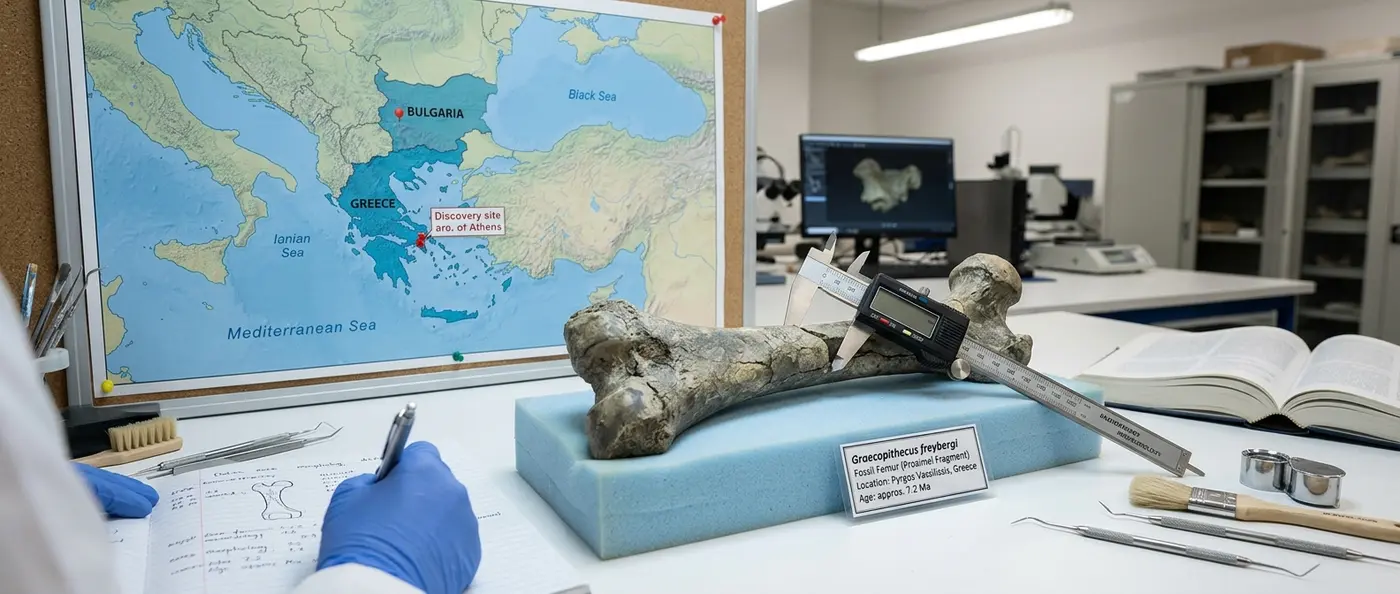
A jawbone and a single tooth. That's all scientists had to work with when they made one of the most explosive claims in paleoanthropology: that Europe, not Africa, might be where the human story began. In 2017, researchers announced that 7.2-million-year-old fossils from the Balkans belonged to Graecopithecus freybergi—a potential human ancestor that predates anything found in Africa. The claim would overturn decades of accepted science.
📖 Read more: Neanderthal-Sapiens Sex: Males Him, Females Her
🦴 Two Fossils, One Bombshell Discovery
The Graecopithecus story starts with fossils that sat in collections for decades, waiting for their moment. The first piece—a lower jaw—turned up in 1944 near Athens at Pyrgos Vasilissis. The second, a lone tooth, came from Asenovo in Bulgaria. For seventy years, these fragments sat in museum drawers, too damaged and incomplete for researchers to identify.
Then came 2017. A team led by Professor Madelaine Böhme from the University of Tübingen and Professor Nikolai Spassov from the Bulgarian Academy of Sciences decided to take another look. They used micro-computed tomography to peer inside the fossils without destroying them. What they saw changed everything.
The tooth roots told a story. Graecopithecus had partially fused premolar roots—a trait found in hominins but not in great apes. The canine teeth were smaller than those of modern chimps and gorillas, another hominin characteristic. Most shocking of all: the fossils dated to 7.24 million years ago in Greece and 7.175 million years ago in Bulgaria. That makes Graecopithecus several hundred thousand years older than Sahelanthropus tchadensis from Chad, previously considered the oldest potential human ancestor.
The dates were stunning. If Graecopithecus is indeed a hominin, it means the human-chimp split happened earlier than we thought—and possibly in a completely different place. Europe, not Africa, might have witnessed the first stirrings of the human lineage.
🌍 The Miocene Balkans: A Lost World
Seven million years ago, Europe was unrecognizable. The Mediterranean had nearly dried up during the Messinian salinity crisis, turning much of it into a vast salt desert. The Balkans, where Graecopithecus lived, resembled today's African savannas—open grasslands dotted with scattered trees.
Researchers analyzed sediments from the fossil sites and reconstructed an environment perfect for evolutionary change. Pollen samples revealed grasses, shrubs, and occasional trees like oaks and pines. The climate was warmer and drier than today, with seasonal rainfall patterns. This savanna-like habitat was ideal for the evolution of upright walking—one of the defining traits that separates hominins from other apes.
The region teemed with large mammals. Primitive horses galloped across the plains alongside antelopes, rhinos, and other savanna-adapted mammals. This assemblage mirrors what we see in Africa during the same period, suggesting ecological corridors connected the continents. Animals—including early primates—could move between Africa and Europe more easily than today.
The Mediterranean's periodic drying created land bridges that lasted thousands of years. During these episodes, the sea level dropped by over 1,500 meters, exposing vast stretches of seafloor. What is now underwater became highways for migrating species. Graecopithecus might have been part of a back-and-forth movement of primates between continents.
🔬 The Teeth That Started a Revolution
Teeth preserve better than any other body part and carry evolutionary signatures that last millions of years. The Graecopithecus dental evidence is what makes this discovery so compelling—and so controversial.
Using micro-CT scanning, researchers could examine the internal structure of the fossils without damaging them. The premolar roots showed partial fusion—a characteristic that appears in hominins but not in great apes. The canines were reduced in size compared to modern chimps and gorillas, another hominin trait. The overall dental morphology suggested a diet that included hard foods like nuts and seeds.
But here's where it gets tricky. Dental features can evolve independently in response to similar environmental pressures—a phenomenon called convergent evolution. Critics argue that similar-looking teeth don't necessarily mean close evolutionary relationships. The reduced canines could have evolved for reasons unrelated to hominin ancestry.
Fused Roots
The premolar roots of Graecopithecus show partial fusion, a characteristic found in hominins but absent in great apes—a key piece of evidence for human ancestry.
Small Canines
The canine teeth are significantly smaller than those of modern chimps and gorillas, approaching the proportions seen in early hominins.
Diet Adaptation
Tooth morphology indicates adaptation to hard foods, possibly nuts and seeds available in the savanna-like environment of the Miocene Balkans.
⚡ The Scientific Firestorm
The Graecopithecus announcement split the scientific community. Paleoanthropologists divided into opposing camps, each interpreting the evidence differently.
Their main argument: you can't rewrite human evolution based on a jaw and a tooth. They point out that hominin classification requires evidence from multiple parts of the skeleton, especially the skull and limb bones that reveal brain size and locomotion. Dental similarities could result from convergent evolution rather than shared ancestry.
Critics also emphasize Africa's overwhelming fossil record. The continent has yielded hundreds of early hominin specimens spanning millions of years. Lucy, Ardi, the Taung Child—all the famous early human ancestors come from Africa. One European jaw, they argue, doesn't overturn decades of African discoveries.
Supporters of the discovery counter with different arguments. They argue that absence of evidence isn't evidence of absence. The Balkans have been far less explored than Africa's fossil-rich sites. More discoveries could be waiting in European sediments. They also point out that the dental evidence is compelling when viewed in context with the environmental data.
📖 Read more: Bone Needles: How Prehistoric Sewing Tools Changed History
The debate reflects deeper tensions in paleoanthropology. The field has long been dominated by African discoveries, creating an "Out of Africa" orthodoxy. Challenging that paradigm requires extraordinary evidence—and extraordinary courage.
💡 Why This Matters
If Graecopithecus is truly a hominin, it means the human-chimp split occurred earlier than previously thought and possibly in a different geographic location. It could suggest that early hominins had a wider geographic distribution and that Europe played a role in early human evolution—fundamentally changing our understanding of where and when the human story began.
🗺️ Rethinking Human Origins
The traditional narrative places humanity's cradle firmly in Africa. That's where we've found most early hominin fossils, from Australopithecus to Homo habilis. The "Out of Africa" theory suggests humans evolved in Africa and later spread to other continents in multiple waves.
Graecopithecus doesn't necessarily overturn this theory, but it complicates it. If confirmed as a hominin, it could suggest that early human ancestors had a broader geographic range than previously thought. Maybe our ancestors moved between Africa and Eurasia much earlier than we imagined.
The geographic context matters. Seven million years ago, the world looked different. The Mediterranean's periodic drying created temporary land bridges between Africa and Europe. The Strait of Gibraltar was narrower. Climate corridors allowed species to migrate more freely between continents.
This raises tantalizing possibilities. Maybe the human-chimp split occurred in a population that ranged across both Africa and southern Europe. Maybe early hominins evolved in multiple locations simultaneously. Maybe the story of human origins is more complex and geographically distributed than our Africa-centric models suggest.
The implications extend beyond paleoanthropology. If Europe played a role in early human evolution, it changes how we think about human dispersal, adaptation, and the environmental factors that shaped our lineage. It suggests that the Mediterranean basin, rather than being a barrier, was a highway for early human evolution.
🔍 The Future of the Hunt
The Graecopithecus story is far from over. Science demands more evidence, and researchers are delivering. New excavations in the Balkans are turning up additional fossils from the same time period. Advanced imaging techniques are revealing details invisible to previous generations of scientists.
Technology is revolutionizing paleoanthropology. Micro-CT scanning allows researchers to examine fossil interiors without destruction. Isotope analysis reveals ancient diets and environments. Even if DNA doesn't survive 7 million years, other molecular techniques might extract information from ancient proteins.
The search is expanding geographically. If early hominins lived in the Balkans, they might have left traces elsewhere in southern Europe. Sites in Spain, Italy, and Turkey are being re-examined with fresh eyes. Every new discovery adds pieces to the puzzle.
Climate modeling is providing context. Researchers are reconstructing Miocene environments with unprecedented detail, mapping ancient vegetation, rainfall patterns, and temperature fluctuations. This environmental backdrop helps explain why and where early hominins might have evolved.
⚔️ Graecopithecus vs Other Early Hominins
🌟 The Bigger Picture
Whether Graecopithecus ultimately proves to be a hominin or not, its discovery has already changed paleoanthropology. It's forced researchers to look beyond Africa for evidence of early human evolution. It's highlighted the importance of the Balkans as a corridor between Africa and Eurasia. It's shown how new technologies can extract fresh insights from old fossils.
The controversy itself is valuable. Science advances through debate, challenge, and the constant testing of ideas against evidence. The Graecopithecus debate is pushing researchers to refine their methods, expand their search areas, and question their assumptions about human origins.
The search for our ancestors continues. Every new discovery brings us closer to understanding how and where the human journey began. Graecopithecus, with its mysteries and controversial implications, reminds us that this journey might have been far more complex and geographically extensive than we ever imagined.
As excavations continue in the Balkans and elsewhere, we can only wait to see what other surprises the earth holds. Perhaps somewhere out there, buried in ancient sediments, lie the fossils that will once again rewrite the story of human evolution. The only certainty is that the story isn't over—it's just beginning to unfold.