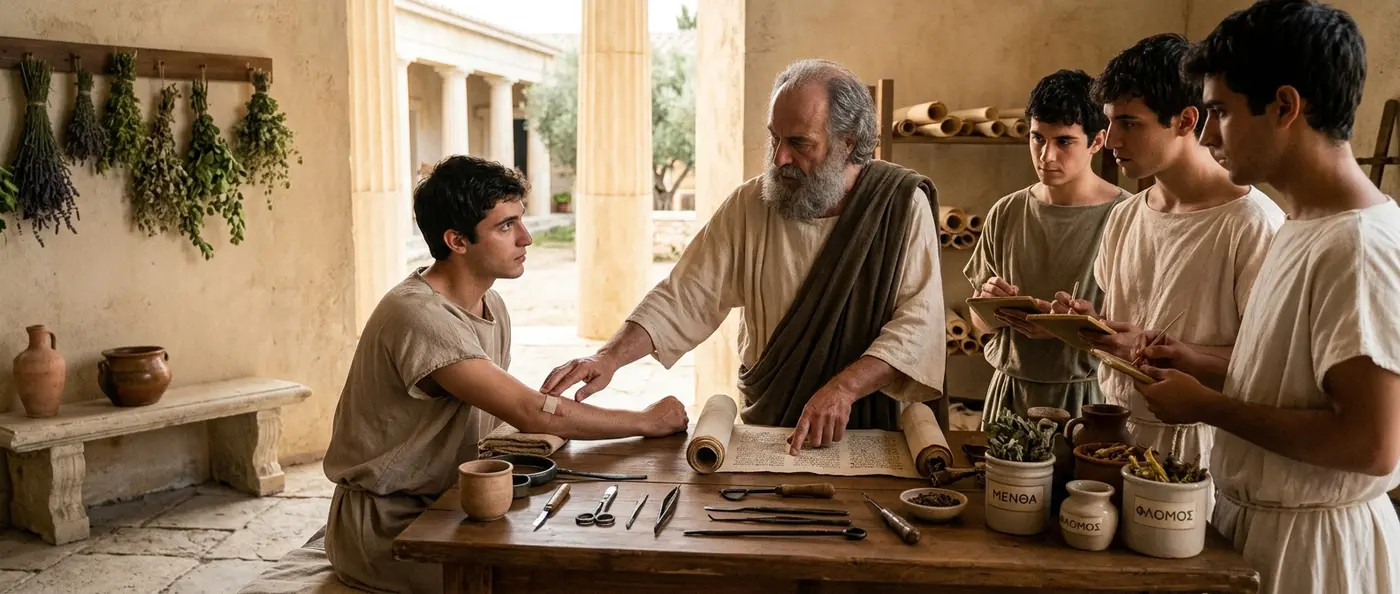
On the ancient streets of Kos and Pergamon, where patients once walked seeking healing, medical science as we know it was born. Two physicians, Hippocrates and Galen, separated by five centuries, transformed healing from mystical practice into systematic science.
📖 Read more: Hippocratic Oath: The Foundation Stone of Medicine
🏛️ Hippocrates and the Birth of Scientific Medicine
Around 460 BCE, on the island of Kos, was born the man who would forever change how we approach disease. Hippocrates wasn't just another healer of his time. He was the first to dare say that diseases don't come from the wrath of gods, but from natural causes that can be studied and understood.
He built his practice on observation and documentation. In the texts of Epidemics, written around 400 BCE, anonymous physicians from his school meticulously recorded the course of diseases. They described the case of Parmeniskos, a patient who fell into delirium and lost his speech for 14 days before recovering. No one had kept such detailed medical records before.
He also recognized that mental state affects physical health. Physicians of the Hippocratic school observed that our thoughts, along with lifestyle, clothing, housing, physical activity, and sexual life, constitute the main determining factors of our health. A revolutionary idea that preceded modern psychosomatic medicine by millennia.
⚕️ Galen: From Pergamon to Rome
Five centuries after Hippocrates, in 129 CE, Galen was born in Pergamon. Where Hippocrates established principles, Galen created a complete medical system. Pergamon wasn't a random choice for the birth of a great physician - the city hosted one of the most famous Asklepieia of the ancient world, where patients flocked from across the Mediterranean.
Galen systematically observed how mental state affects physical health. He recorded the case of a patient who had lost money and developed a fever that accompanied him for a long period. In his sleep, the man would scold himself for the loss and wake up disturbed. Grief consumed him until he fell into delirium and eventually died. For Galen, this was proof that thoughts can cause serious illness.
Galen's theory was that mental problems are caused by some idea that has taken over the mind. He believed healing comes when this false idea is removed, not through foods, drinks, or baths, but through changing the way of thinking. The approach mirrors today's cognitive psychotherapy.
🏺 The Asklepieia: The World's First Clinics
Before the great physicians, there were the Asklepieia - sanctuaries dedicated to the physician-god Asklepios. The first appeared around 500 BCE, and in the following centuries hundreds of such sanctuaries operated throughout Greece and the Italian peninsula. They were the first medical tourism centers in history.
📖 Read more: Romans Used Human Feces as Medicine With Thyme
Aelius Aristides, a 2nd-century CE orator, is perhaps the most famous "patient" of the Asklepieia. When he became so ill he couldn't deliver speeches, he traveled to the Asklepieion of Pergamon. He described how he felt his teeth would fall out, his intestines would come out, and he often couldn't breathe. He stayed there two years - unusually long - and received multiple treatments.
The strangest part? One of his dreams led him to take a honey enema. He saw a small statue of Athena, and since Attica was famous for its honey, he immediately understood what he had to do. Other treatments included exercise, cold baths, special diets, and composing speeches - even if he was too sick to deliver them.
Incubation
Patients slept in the sanctuary waiting to see Asklepios in their dreams, who would heal them or give them advice.
Thermal Baths
Many Asklepieia were built near hot springs, where patients took therapeutic baths.
Herbs & Diets
Special diets, herbs like hellebore, and exercises were prescribed for treating various ailments.
💊 Therapeutic Methods: From Mysticism to Science
Ancient physicians developed an impressive spectrum of therapeutic approaches. The philosopher Aristippus, in the 5th century BCE, advised people to focus on the present to avoid mental disturbance. He said: "Concentrate your mind on the day, and especially on that part of the day in which you act or think. Only the present belongs to us, not the past nor what is expected."
The philosopher Kleinias had his own method: whenever he felt anger rising within him, he played the lyre to calm down. Physicians recommended lifestyle changes - new exercise programs, different diets, sea voyages, attending philosophical lectures, games like backgammon, and mental exercises resembling today's crosswords.
The physician Caelius Aurelianus in the 5th century CE believed that patients with mental disorders could benefit from varied nutrition including fruits and mild wine. For depression, he recommended activities that provoked laughter and joy, such as watching comedies in the theater.
🌿 The Dangerous Herb
Hellebore was used to treat paranoia, but ancient physicians knew its dangers. Sometimes it caused toxic spasms that killed patients - a reminder that medicine always involved risks.
📖 Read more: 2,000-Year-Old Paracas Skulls Reveal Ancient Brain Surgery
🔬 The Legacy That Survives
Ancient Greek and Roman physicians developed ideas that sound surprisingly modern. They treated mental and physical health as equally important - an understanding modern medicine only regained in the 20th century. They understood that treatment requires a holistic approach including nutrition, exercise, mental calm, and social interaction.
The World Health Organization reports that today approximately 280 million people worldwide suffer from depression and about one billion have some mental health problem. The ancients faced similar problems and developed methods that continue to make sense.
The rod of Asklepios with its coiled serpent endures as medicine's symbol. After 2,500 years, it remains the global symbol of medicine. The symbol connects us to Hippocrates, who taught physicians to observe and record, and Galen, who mapped the connection between body and spirit.
📜 The Oath That Endures Centuries
The Hippocratic Oath remains perhaps the most famous legacy of ancient Greek medicine. Although it has been modified to fit the modern era, its basic principles - do no harm, respect patient confidentiality, act for the patient's benefit - remain fundamental to medical ethics.
The ancients believed that maintaining mental health requires effort. One activity or one treatment isn't enough. It requires comprehensive change in lifestyle and thinking. This understanding echoes in modern approaches to mental health, which emphasize the importance of exercise, nutrition, sleep, and social relationships.
⚖️ Ancient vs Modern Medicine
From Hippocrates who freed medicine from superstition, to Galen who systematized knowledge, ancient Greek medicine laid foundations that withstand time. These physician-philosophers didn't have the tools we have today, but they had something equally valuable: the ability to observe, think critically, and see humans as a whole.
At every pharmacy and hospital, the serpent coiled around Asklepios' rod marks where medicine began: in ancient Greek temples and schools, where humans first said, "Let us understand disease, so we can heal it."