September 27, 1822. A young French philologist named Jean-François Champollion stood before the Academy of Inscriptions and Belles-Lettres in Paris. What he announced that day ended 2,000 years of silence. He'd cracked Egyptian hieroglyphs — and suddenly, an entire civilization could speak again.
📜 Birth of the Sacred Script
Around 3000 BCE, Egyptian scribes invented one of humanity's first writing systems. For centuries, scholars dismissed hieroglyphs as primitive picture-writing. They had it backwards. This was a sophisticated phonetic system that blended pictographic symbols with sound values — more complex than early scholars realized.
The script evolved in stages. First came the bare essentials — just enough symbols to record what mattered. Then scribes added layers: more symbols for clarity, determinatives to nail down meaning, phonetic complements to avoid confusion.
For 2,000 years, the system stayed relatively stable. Around 500 BCE, the system changed. The symbol count exploded into the thousands as scribes unleashed possibilities that had been dormant since the beginning. They weren't inventing new rules — they were finally using all the tools the system had always contained.
🗿 The Rosetta Stone: A Key Waiting to be Turned
July 1799. French soldiers building fortifications near the town of Rashid stumbled across a chunk of granodiorite built into an old wall. Officer Pierre François Bouchard recognized its potential immediately.
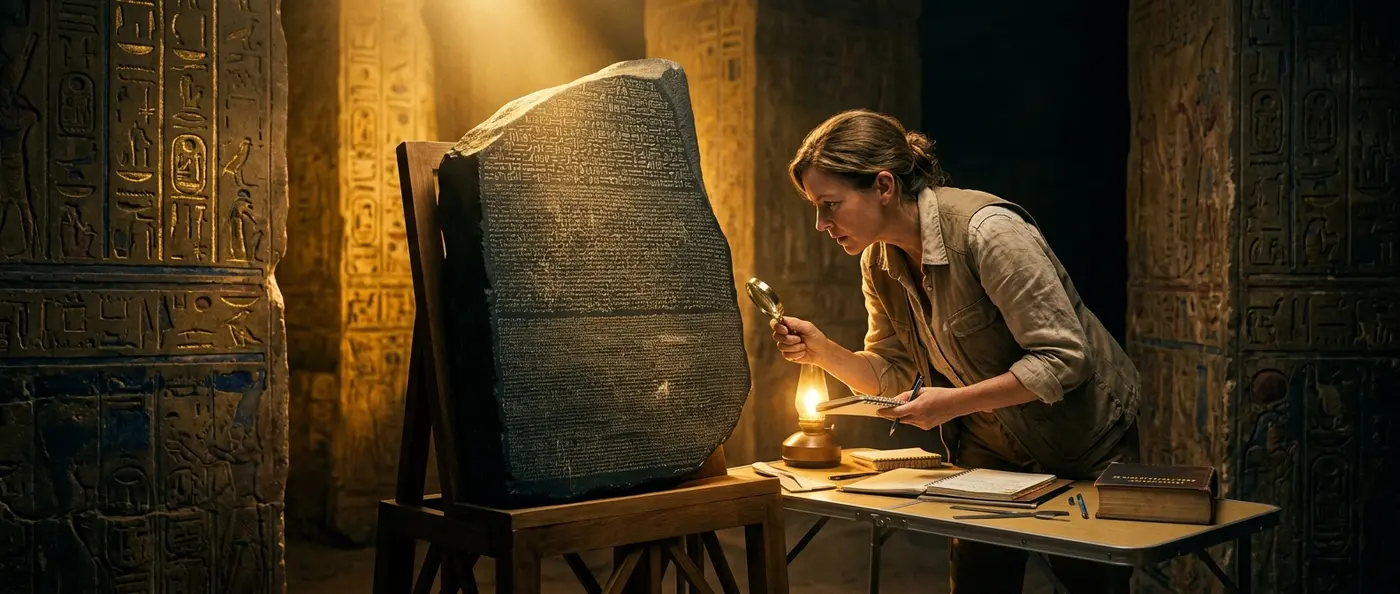
The slab stood 112 centimeters tall and weighed 760 kilograms. Carved into its surface was the same text in three scripts: ancient Greek, hieroglyphs, and demotic (a simplified Egyptian cursive). Bouchard saw what this could mean — a way to decode Egyptian writing.
The text was a royal decree from 196 BCE, honoring young King Ptolemy V Epiphanes on his first coronation anniversary. The decree aimed to cement the Macedonian Greek pharaoh's authority during turbulent times. Three scripts, one message — the perfect setup for a cryptographic breakthrough.
🔍 The First Attempts
When the British seized the stone in 1801 under the Treaty of Alexandria, it landed in the British Museum. The decipherment race began immediately.
By 1802, Swedish diplomat Johan David Åkerblad had made progress with the demotic script, connecting it to Coptic — the final stage of the Egyptian language, still understood by scholars. He cracked several words but couldn't break the whole system.
In 1819, British polymath Thomas Young published his Encyclopedia Britannica article defining 218 demotic words and linking them to roughly 200 hieroglyphic equivalents. He even deciphered the phonetic hieroglyphs for "Ptolemy." But Young made a crucial error — he believed only foreign names and words were phonetic. Everything else, he thought, was purely symbolic.
Coptic Connection
The last phase of Egyptian language, written in Greek letters, provided crucial clues about how ancient words were pronounced.
Royal Names
Pharaoh names like Ptolemy and Cleopatra, enclosed in oval cartouches, became the first hieroglyphs to be successfully decoded.
Trilingual Text
Having the same message in three scripts allowed scholars to compare and gradually understand the hieroglyphic system.
💡 Champollion's Revolution
When Champollion studied Young's work, he spotted the fatal flaw. Young had assumed hieroglyphs were mostly symbolic. Champollion believed they formed a complete alphabet that could be systematically decoded.
Years of obsessive work followed. Champollion methodically matched ancient Greek and Coptic words with their hieroglyphic counterparts. His breakthrough came when he realized hieroglyphic writing — like the hieratic and demotic scripts derived from it — wasn't symbolic at all. It was phonetic.
Starting with the royal names Ptolemy and Cleopatra, then adding Ramesses, Champollion determined the phonetic values of the signs. Soon he could read and translate vast numbers of Egyptian words. The floodgates opened.
🎯 The Key to Success
Champollion understood that hieroglyphs combined three types of signs: phonetic (representing sounds), ideograms (representing concepts), and determinatives (clarifying meaning). This insight was the key to complete decipherment.
🔐 Cryptographic Hieroglyphs: The Art of Concealment
From the mid-3rd millennium BCE, but especially during the New Kingdom (roughly 1539-1075 BCE), Egyptian texts started looking weird. Missing familiar word groups, packed with symbols that didn't follow standard rules — these were cryptographic inscriptions.
This hieroglyphic variant was designed to grab attention, to tempt people into the pleasure of decipherment. Composed according to the script's original principles, these inscriptions differed only in exploiting features that had been excluded when the standard rules were established.
The new possibilities affected not just symbol shapes but their selection. A mouth might be drawn in profile instead of the standard frontal view, though it kept the same phonetic value. The scribes were showing off — demonstrating the full flexibility their writing system had always possessed.
🏛️ New Discoveries on the Paris Obelisk
In 2021, during restoration work on the famous Egyptian obelisk in Paris, Egyptologist Jean-Guillaume Olette-Pelletier from the Institut Catholique de Paris found something unexpected. The obelisk, roughly 3,300 years old, had been built at Luxor Temple on Ramesses II's orders early in his reign.
Climbing scaffolding around the obelisk, Olette-Pelletier could study the granite masterpiece in greater detail than possible from ground level. He discovered what he believes are hidden messages that would only be visible to specific people under specific conditions.
He observed that when the obelisk was built, its western face looked toward the Nile. Travelers on the river would have had a clear view of inscriptions and images near the top of the 23-meter monument. These inscriptions declared that Ramesses II "had been chosen by the gods, was of divine essence, and therefore had the right to rule Egypt."
📊 Types of Hieroglyphic Writing
⚒️ The Tools of Writing
The tools for carving hieroglyphic symbols varied by surface. Stone inscriptions required chisels and hammers. Wood and other smooth surfaces used brushes and paints.
A modified form called calligraphic hieroglyphs, where certain details of monumental signs were abbreviated, served decorative and secondary arts. This form appeared on inscriptions carved in metals, engraved in wood, or painted on papyrus.
For truly cursive writing — hieratic and demotic — specialized materials evolved. Leather and papyrus became writing surfaces. Reed stems 15 to 33 centimeters long, cut diagonally at the writing end and chewed to separate fibers into a brush-like tip, served as writing instruments. The split reed used as a writing tool was introduced to Egypt by the Greeks in the 3rd century BCE.
🌅 The End and Rebirth
With Christianity's triumph, knowledge of hieroglyphic writing vanished along with ancient Egyptian religion. For nearly 1,400 years, hieroglyphs remained silent mysteries carved in stone.
The Rosetta Stone's decipherment essentially created the field of Egyptology. Because of it, we've unlocked the intricate rituals and religious beliefs governing life and death in the Book of the Dead. We've reconstructed the complex mummification recipes ancient Egyptians used. We have detailed pictures of daily life for both kings and commoners. We've untangled the stories of dynasties that ruled for thousands of years.
Today, the Rosetta Stone remains in the British Museum, despite Egypt's repeated calls for its return. It remains a central piece of Egyptian heritage and one of our most tangible links to ancient Egypt.