🏛️ The Discovery That Changed History
The story of the Indus Valley Civilization begins with a series of chance discoveries. In 1921, Sir John Hubert Marshall, Director-General of the Archaeological Survey of India, initiated systematic excavations at Harappa in the Punjab region of present-day Pakistan. A year later, in 1922, Mohenjo-daro was discovered near the Indus River in the Sindh region.
These discoveries revealed a civilization that flourished from 2600 to 1900 BCE, making it one of the world's three earliest urban civilizations, alongside Mesopotamia and Ancient Egypt. The Indus civilization was the most extensive of the three, covering an area stretching from Sutkagen Dor in southwestern Balochistan, near the Arabian Sea, to Ropar in eastern Punjab, India, at the foothills of the Himalayas.
The civilization covered nearly one million square kilometers. To the south, it reached the Gulf of Khambhat, 800 kilometers southeast of Karachi, and to the east, it extended to the Yamuna River basin, just 50 kilometers north of Delhi. This vast geographical spread required sophisticated administrative systems to maintain trade and communication networks.
🏺 The Indus Megacities
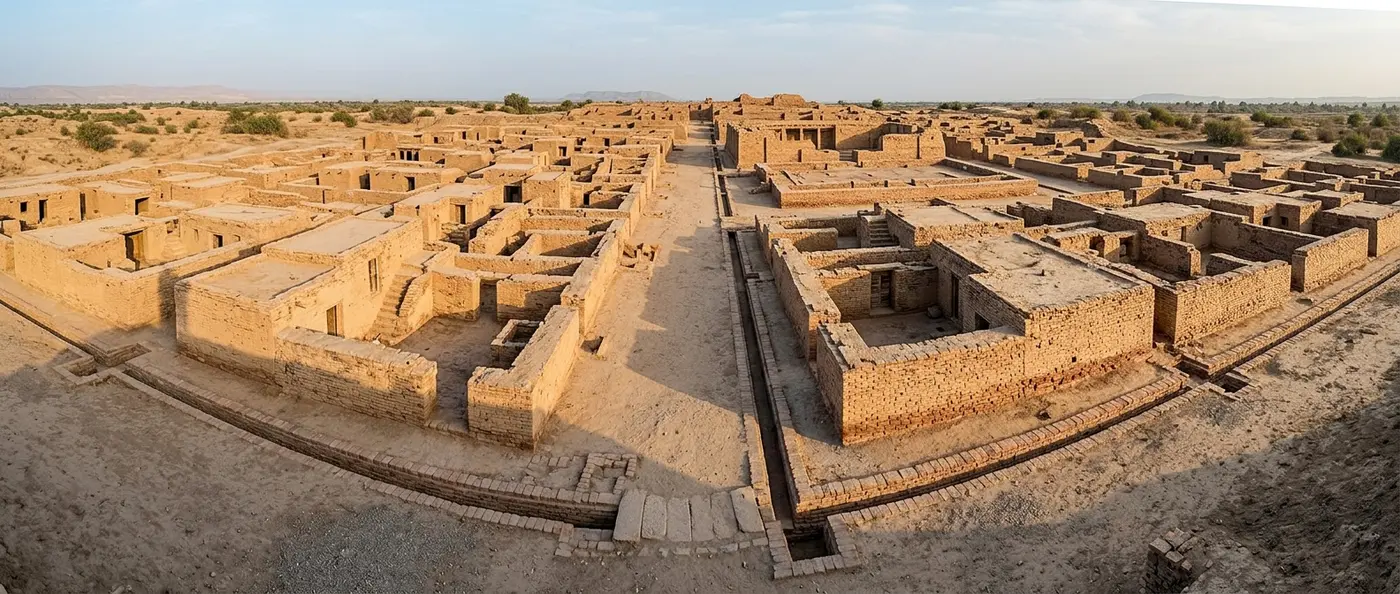
Harappa and Mohenjo-daro were the two largest cities of the civilization, with estimated populations of 23,500-35,000 and 35,000-41,250 inhabitants respectively. Each city covered approximately 2.6 square kilometers, a size that indicates significant political concentration of power.
These cities pioneered urban planning techniques still used today. Streets were laid out in a perfect grid system, with main arteries up to 10 meters wide intersecting perpendicularly with smaller roads. This grid system predates similar designs in other civilizations by millennia.
The cities featured sophisticated drainage systems, with covered sewers running beneath every street. Every house had a private bathroom and toilet connected to underground sewers constructed from fired bricks. The main sewers had inspection openings at regular intervals for maintenance and cleaning.
⚒️ Technology and Innovations
The Indus civilization was distinguished by its technological innovations. The inhabitants had developed a standardized system of weights and measures used throughout the civilization's extent. The weights followed a decimal system with ratios of 1:2:4:8:16:32:64, with the basic unit weighing approximately 28 grams.
Metallurgy was particularly advanced. Craftsmen manufactured tools and weapons from copper and bronze, as well as intricate jewelry from gold, silver, and semi-precious stones. The first known traces of cotton were also discovered, indicating that the Indus people were among the first to cultivate and weave this plant.
Standardized Measures
Uniform system of weights and measures across all cities, with standardized bricks in 1:2:4 proportions used everywhere.
Hydraulic Engineering
Advanced water supply and drainage systems with sealed pipes, public baths, and water reservoirs.
Maritime Technology
Port facilities with docks and shipyards, evidence of extensive maritime trade.
📜 The Mystery of the Script
The Indus script remains undeciphered after nearly a century of attempts. Thousands of seals with symbols that appear to constitute a writing system have been found, but despite decades of effort, no one has managed to read them.
The seals, usually made from steatite, depict animals such as bulls, elephants, and mythical creatures, accompanied by short inscriptions of 4-5 symbols. The fact that no longer texts or bilingual inscriptions have been found makes decipherment extremely difficult.
🔍 Why Can't We Read the Indus Script?
The Indus script contains approximately 400-600 different symbols, far more than an alphabet but fewer than a complete logographic system. Most inscriptions are extremely short (averaging 5 symbols), making statistical analysis difficult. Additionally, we don't know what language the inhabitants spoke, making it impossible to connect symbols with sounds or words.
🌾 Economy and Daily Life
The Indus civilization's economy was primarily based on agriculture, with inhabitants exploiting the river's annual floods to cultivate wheat, six-row barley, peas, mustard, and sesame. Date pits and the first traces of cotton cultivation have also been found.
Domesticated animals included dogs, cats, humped and humpless cattle, chickens, and possibly pigs, camels, and water buffalo. The Asian elephant was likely domesticated, and ivory tusks were widely used for manufacturing decorative objects.
Trade was equally important. Archaeological findings show commercial relationships with Mesopotamia, Central Asia, and possibly even Egypt. Products such as carnelian beads, seals, and cotton textiles were exported, while precious stones, metals, and other luxury goods were imported.
🏛️ Comparison with Contemporary Civilizations
🗿 Art and Culture
Indus civilization art was characterized by simplicity and functionality. Unlike their contemporaries in Egypt and Mesopotamia, the Indus people didn't build magnificent palaces or temples. Instead, their architecture focused on practicality and quality of life for inhabitants.
The most famous artworks are small figurines, such as the famous "Dancing Girl" bronze sculpture found at Mohenjo-daro, standing just 10.5 centimeters tall. Another characteristic example is the "Priest-King" bust, a small steatite statue depicting a bearded man in elaborate dress.
Pottery was of high quality, featuring characteristic geometric designs and animal depictions. Craftsmen also manufactured intricate jewelry from gold, silver, copper, and semi-precious stones, as well as toys and board games that suggest a society with leisure time for entertainment.
💀 Decline and the Mystery of Disappearance
Around 1900 BCE, the Indus civilization began to decline. The collapse wasn't sudden or uniform — different regions were affected at different times and in different ways. At Mohenjo-daro, evidence shows the city suffered from repeated catastrophic floods before being permanently abandoned.
Theories for the collapse vary. Some researchers argue that climate change and the drying of the Sarasvati River led to ecological disaster. Others believe that Aryan invasions from the north dissolved the civilization. More recent theories propose a combination of factors: overexploitation of natural resources, changes in trade routes, and internal social upheavals.
Most mysterious is that, despite the civilization's apparent prosperity and organization, there's no evidence of central authority or military hierarchy. No palaces, temples, or monumental statues of rulers were found. This led some researchers to propose that the Indus civilization was a form of "early democracy" or oligarchic governance.
🔬 Modern Discoveries and Research
Research on the Indus civilization continues with undiminished interest. New technologies such as satellite imaging and LiDAR have revealed hundreds of new sites, increasing the total number of known settlements to over 1,000. Excavations at sites like Dholavira and Kalibangan have provided new information about the civilization's organization and way of life.
DNA analysis of ancient skeletons has overturned previous theories about the civilization's end. Results show that modern South Asian inhabitants have significant genetic continuity with Indus civilization people, debunking earlier theories of complete population replacement.
Computer algorithms now analyze thousands of seal inscriptions, searching for grammatical patterns. While complete decipherment hasn't been achieved, patterns have been identified suggesting the script might represent a form of the Dravidian language family.
🧬 What Does DNA Tell Us?
Recent genetic studies showed that Indus civilization inhabitants had mixed ancestry from early Iranian farmers and South Asian hunter-gatherers. This genetic mixture continues to form a significant part of modern regional inhabitants' DNA, proving that the civilization didn't disappear but transformed and integrated into later populations.
🌍 The Indus Legacy
The Indus Valley Civilization left a deep and lasting legacy. Many of its innovations — from urban planning to systems of weights and measures — influenced later South Asian civilizations. The emphasis on hygiene and public health, evident from sophisticated drainage systems, predates similar concerns in other civilizations by millennia.
The Indus cities show that complex urban societies can function without kings, armies, or massive temples. The apparent equality and peaceful character of the civilization offer an alternative model of social organization that continues to interest researchers and thinkers.
As excavations and research continue, each new discovery adds another piece to the puzzle of this enigmatic civilization. The Indus Valley reminds us that human history is far richer and more complex than we often imagine, and that even after a century of research, there are still mysteries waiting to be revealed.