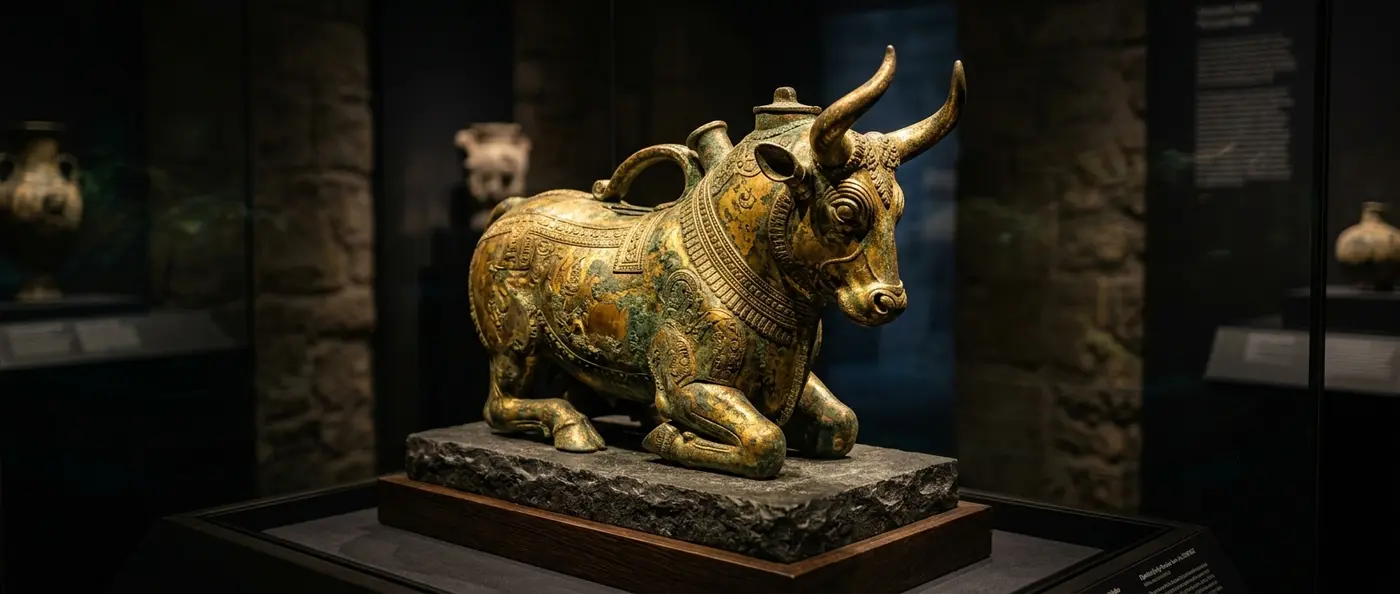
Picture an ancient Persian craftsman, hands covered in clay, shaping what would become one of archaeology's most puzzling riddles. Five millennia later, the Animal Crater of Iran sits in a museum case, its zoomorphic forms as enigmatic as the day it emerged from the kiln. This Bronze Age vessel doesn't just challenge our understanding of ancient Iranian art — it rewrites what we thought we knew about ritual practices in 3000 BCE.
🏺 The Seizure That Shocked Archaeologists
The story begins like a crime thriller, not an archaeological discovery. U.S. customs officials intercepted a shipment of ancient artifacts linked to Iran's Talish mountains. Hidden among the contraband: Bronze Age vessels that would make any museum curator's pulse quicken.
This particular crater stood out immediately. Animal forms writhed across its surface with such precision that experts knew they were looking at something extraordinary. The dating came back around 3000 BCE — a time when Iran sat at the crossroads of civilizations, buzzing with trade and artistic innovation.
The age alone wasn't what caught researchers' attention. The craftsmanship blended techniques from multiple traditions, suggesting the artisan had contact with neighboring cultures. This wasn't isolated village pottery. This was cosmopolitan art from a Bronze Age metropolis.
🔬 Masterclass in Bronze Age Engineering
The Animal Crater reveals just how sophisticated Iranian craftsmen were 5,000 years ago. High-grade clay. Kilns that reached temperatures requiring advanced knowledge of ceramics. This wasn't amateur hour.
Every animal form tells a story. Eyes, ears, body posture — each detail was deliberate. Researchers believe these weren't decorative flourishes but symbolic elements tied to religious beliefs or mythological narratives that have been lost to time.
Tool marks on the surface reveal specialized instruments. Bronze Age Iranian artisans had developed complex techniques for creating detailed relief patterns. This level of detail demanded formal training in organized workshops.
🗺️ Iran's Bronze Age Boom
To understand the Animal Crater's significance, you need to grasp what Iran was in 3000 BCE. Strategic location between Mesopotamia, Central Asia, and the Indus Valley. A crossroads where goods, ideas, and artistic techniques collided and merged.
Archaeological digs across the region paint a picture of advanced societies with organized urban centers, extensive trade networks, and sophisticated art. The Talish mountains, where this crater likely originated, were famous for their rich metal deposits — the raw materials that powered the Bronze Age economy.
Trade Networks
Ancient Iran was a crucial hub on trade routes connecting East and West, facilitating the exchange of goods, technologies, and artistic ideas.
Metallurgy
The Talish mountain region was a center for mining and metalworking, with craftsmen who mastered advanced techniques for the era.
Artistic Tradition
Iranian artisans developed a unique artistic style that blended local traditions with foreign influences from their trading partners.
🔱 Sacred Beasts and Divine Messages
Animals on ritual vessels weren't random decoration in the ancient world. In Bronze Age Iran, animals carried deep symbolic weight — connections to deities, cosmic forces, or the fertility of the earth itself.
This crater, with its intricate zoomorphic forms, likely played a role in ceremonies related to fertility, prosperity, or protection. Similar vessels from other regions often contained offerings to gods or served in sacred rituals where the boundary between human and divine blurred.
The choice of specific animals wasn't arbitrary. Each carried its own symbolic baggage. Bovines represented strength and fertility. Felines connected to protection and divine power. The craftsman who shaped these forms was encoding messages we're still trying to decode.
💡 Did You Know?
In ancient Persia, ritual vessels with animal imagery were believed to carry prayers from worshippers to the gods. The animals served as intermediaries between the human world and the divine realm, their forms literally bridging earth and heaven.
⚗️ Decoding the Crater's Purpose
What did ancient Iranians actually do with this vessel? The size and construction suggest it wasn't for everyday use. This was special occasion pottery.
One leading theory: ritual drink mixing and serving. Ancient Near Eastern civilizations often used elaborate vessels for wine or other ceremonial beverages consumed during religious ceremonies or elite symposiums. The crater's capacity and design would have been perfect for such purposes.
Another possibility: an offering container. Ornately decorated vessels frequently held precious liquids, oils, or even animal blood during sacrificial ceremonies. The elaborate animal decorations would have made the offerings more pleasing to the gods — a Bronze Age version of gift wrapping.
🏛️ Global Context: Animals Across Civilizations
Iran's Animal Crater isn't unique in depicting animals on ritual vessels. Similar objects have surfaced across the ancient world — from Mesopotamia to Egypt, Crete to the Indus Valley.
Mesopotamian vessels featured bulls and lions from the same period. These often connected to specific deity worship or royal ceremonies. The widespread nature of animal imagery on ceremonial objects suggests shared beliefs about the relationship between humans, animals, and the divine.
🏺 Ritual Vessels Across Civilizations
Animal imagery appears on ritual vessels from Mesopotamia to the Indus Valley, suggesting common beliefs about divine connections. Iran's Animal Crater fits into a broader tradition that spanned the entire ancient Near East.
🔍 The Provenance Problem
One of the biggest mysteries surrounding the Animal Crater is its exact origin story. While experts agree it comes from Iran's Talish mountain region, the precise circumstances of its discovery remain murky.
The seizure of such artifacts highlights a serious problem plaguing archaeology: illegal excavation and antiquities trafficking. When an object gets ripped from its archaeological context, we lose invaluable information about dating, usage, and significance.
Despite these challenges, archaeologists have managed to extract significant information by studying the object itself. Clay analysis, stylistic techniques, and comparisons with other regional finds have helped date and interpret the crater's meaning.
📚 Window Into a Lost World
The Animal Crater of Iran, despite its mysterious circumstances, offers invaluable insights into Bronze Age culture in the region. Through studying such objects, archaeologists can reconstruct aspects of daily life, religious beliefs, and artistic traditions of ancient societies.
The fact that such exceptional quality objects were being produced 5,000 years ago testifies to the high level of technical and artistic development achieved by regional civilizations. The crater preserves techniques and beliefs from a vanished civilization.
As archaeological research continues and new technologies enable more detailed analyses, we'll likely learn more about the Animal Crater and the civilization that created it. Until then, it remains a silent witness to a brilliant past, reminding us of our ancestors' creativity and spirituality.