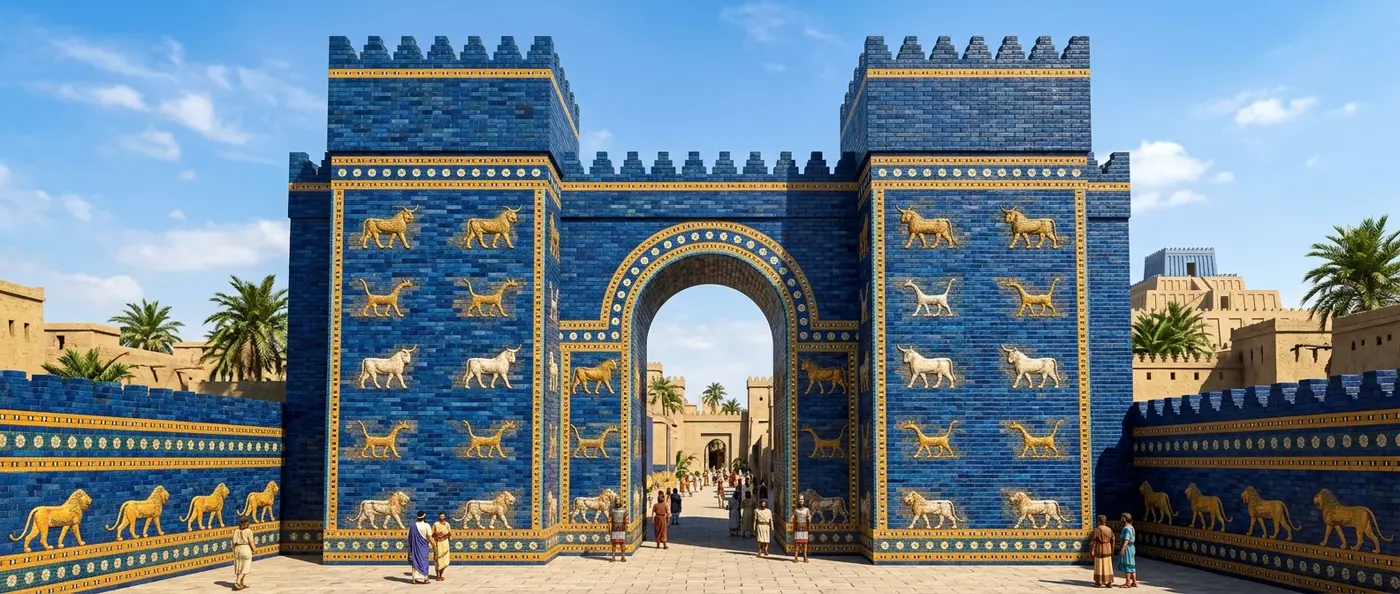
In the heart of ancient Mesopotamia, where the Euphrates River flowed through the most magnificent city of the ancient world, stood a monument that merged power with artistry. The Ishtar Gate wasn't merely an entrance to Babylon — it was a portal to a realm where gods walked among mortals and kings built monuments for eternity.
📖 Read more: Mesopotamian Gods: Enlil, Marduk, and Ishtar
🏛️ The Magnificent Gateway to Babylon
The Ishtar Gate served as the eighth and most spectacular of the eight gates leading to Babylon's inner city. Constructed around 575 BCE during the reign of Nebuchadnezzar II, the gate was dedicated to Ishtar, the Mesopotamian goddess of love and war.
This monument wasn't simply a defensive structure. It was a bold declaration of the Babylonian Empire's power and wealth. Standing 15 meters tall and 10 meters wide, the gate dominated the city's skyline, welcoming visitors and merchants from across the known world.
Its construction required specialized craftsmen and artists. Thousands of glazed bricks in brilliant blue adorned its surface, creating a spectacle that gleamed under the Mesopotamian sun. Against this azure backdrop, golden dragons and bulls — symbols of the gods Marduk and Adad — marched in eternal procession.
⚔️ Nebuchadnezzar and His Vision
Nebuchadnezzar II (605-562 BCE) wasn't merely a conqueror. He was a visionary who transformed Babylon into the ancient world's most wondrous city. The Ishtar Gate represented the pinnacle of his building program.
According to inscriptions found in the area, the king personally supervised the construction. The gate wasn't an isolated structure — it connected to the famous Processional Way, a 20-meter-wide road leading to Marduk's temple. Along this route, 120 lions crafted from glazed brick guarded the faithful's passage.
This project wasn't purely religious. It carried political significance. Each year, during the New Year festival (Akitu), the gate became the focal point of celebrations. The king passed through it in a ritual procession that confirmed his divine authority.
📖 Read more: Code of Hammurabi: The First Written Laws in History
🎨 Art That Spoke to the Gods
The Ishtar Gate's decoration wasn't random. Every element carried symbolic meaning connecting the earthly realm to the celestial. Babylon's craftsmen had perfected the art of glazed brick, creating colors that remained vibrant for centuries.
The deep blue background symbolized the sky and divine sphere. Against this, golden dragons (mushussu) represented Marduk, Babylon's patron god. The bulls symbolized Adad, the storm god. The lions adorning the Processional Way's walls were dedicated to Ishtar herself.
Construction Technique
Craftsmen used specialized kilns to fire bricks at temperatures exceeding 1000°C. The glaze was applied before firing, creating a lustrous surface resistant to time.
Precious Materials
The blue color came from lapis lazuli imported from Afghanistan. The golden hue was created with iron oxides, while white came from limestone from local quarries.
Workforce
Thousands of workers and hundreds of specialized craftsmen labored for over 10 years to complete the project.
🗺️ Babylon as the Center of the World
For the Babylonians, their city wasn't simply a metropolis. It was the universe's center. This concept is captured in the famous Babylonian World Map, a 6th-century BCE clay tablet showing Babylon at the center of a circular world, surrounded by the "Bitter River" — the ocean defining the known world's boundaries.
📖 Read more: Naram-Sin's Curse: How Hubris Destroyed the First Empire
The Ishtar Gate functioned as the contact point between this sacred center and the outside world. Through here passed caravans bringing precious goods from India and Arabia. Here they welcomed embassies from Egypt and Persia. From here armies departed for campaigns that extended the empire to the Mediterranean.
But the gate wasn't merely for display. It served a practical function in the city's defensive system. Double walls, guard towers, and a system of moats made it nearly impregnable. Even when the Persians captured Babylon in 539 BCE, they didn't need to besiege it — the city surrendered peacefully.
🔬 Discovery and Reconstruction
For centuries, the Ishtar Gate remained buried under tons of sand and mud. In 1899, German archaeologist Robert Koldewey began excavations in Babylon that would last 18 years. The gate's discovery was one of his most spectacular finds.
Archaeologists found thousands of glazed brick fragments. With patience and scientific precision, they managed to reconstruct much of the decoration. The finds were transported to Berlin, where a smaller but faithful reproduction of the gate was reconstructed at the Pergamon Museum.
💡 Did You Know?
The reconstructed Ishtar Gate at the Pergamon Museum is only one-third the original size. Nevertheless, at 14 meters tall and 30 meters wide, it continues to inspire awe in visitors.
🏺 Mysteries That Remain
Despite extensive research, many mysteries continue to surround the Ishtar Gate. How exactly did the Babylonians create such vivid and durable colors? What was the precise process for producing the glazed bricks?
📖 Read more: Sumerians: The Civilization That Invented the Wheel
Also, the gate's relationship to the legendary Hanging Gardens of Babylon remains enigmatic. Some researchers believe the gardens — if they ever existed in Babylon — would have been located near the gate, perhaps even above it. Others argue the gardens were actually in Nineveh, not Babylon.
Satellite imagery and 3D modeling now reveal construction details invisible to earlier generations of archaeologists. Perhaps in the future we'll be able to see the Ishtar Gate as the ancient Babylonians saw it — in all its glory, with dragons and bulls gleaming under the Mesopotamian sun.
🌟 Ishtar's Legacy
The Ishtar Gate isn't simply an archaeological find. It's a symbol of human creativity and ambition. In an era without modern tools and technology, the Babylonians managed to create a work of art combining architecture with sculpture, religion with politics, beauty with functionality.
Today, the gate inspires artists and architects worldwide. From Iraq, where reconstruction at its original site is being planned, to museums in Europe and America, Ishtar continues to enchant and educate.
Babylon's armies have long since crumbled to dust, but tourists still queue to see its blue-glazed dragons. The Ishtar Gate, like Babylon itself, may have lost its political power, but its cultural influence remains immortal.
🏛️ The Ishtar Gate in Numbers
As we stand before the remains of this ancient marvel, we can't help but wonder: What other secrets does Mesopotamian sand conceal? What other wonders await discovery? The Ishtar Gate reminds us that the past isn't dead — it lives within stones, colors, and stories waiting to be told again.