📖 Read more: 14,000-Year-Old Mammoth Ivory Tools Found in Alaska
🗿 The Age of Colossal Mounds
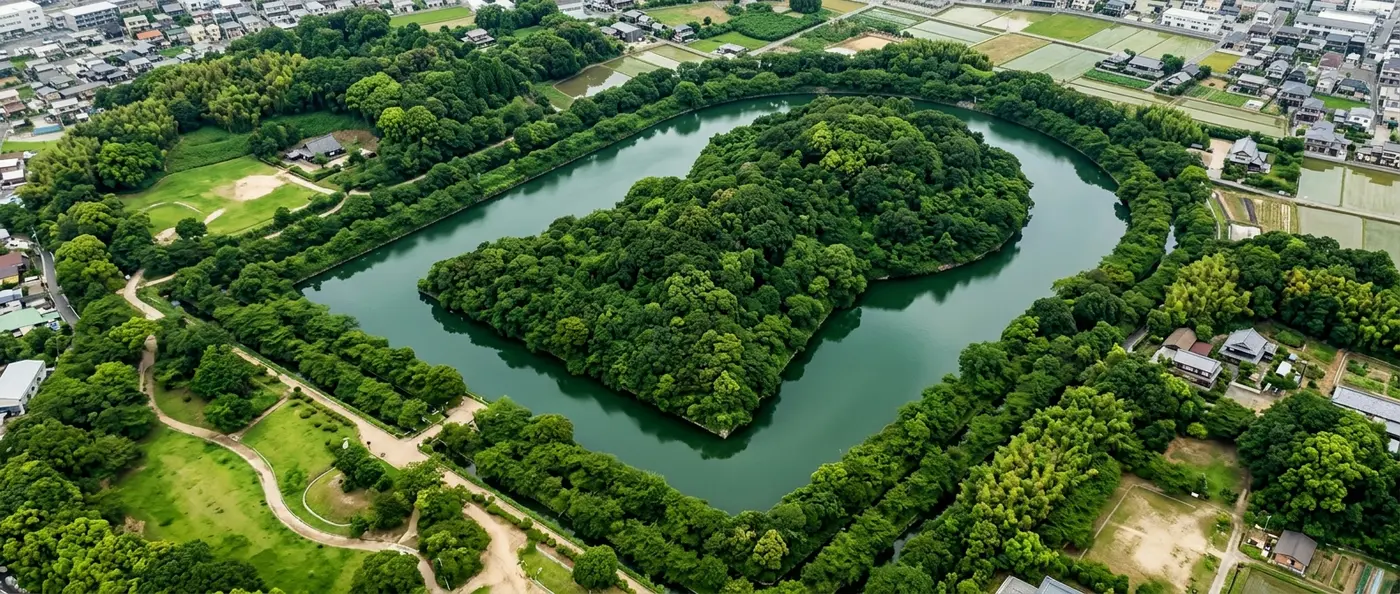
The Kofun period (250-552 AD) gets its name from these distinctive tombs built by the era's most powerful rulers. These enormous mounds, surrounded by water-filled moats, represent a unique form of monumental architecture found nowhere else on Earth.
The numbers are staggering. The largest of the 71 known tombs stretches 457 meters long and rises 36 meters high — dimensions that make it one of the world's largest burial monuments. It sits in the Nara Basin (Yamato) in Nara Prefecture, a region that served as the political power center during this ancient period.
Building such colossal works demanded massive human resources. Thousands of workers labored for years, moving millions of tons of earth and stone. Such projects required centralized authority on a scale Japan had never seen before.
⚔️ A Society of Warriors
Finds from the tombs reveal a society dominated by mounted warriors. The advanced armor and iron weapons discovered in the graves indicate a period of constant conquests and military expansion. The introduction of horses from mainland Asia fundamentally changed how warfare was conducted in Japan.
The rulers of the Kofun period weren't simple local lords. They were powerful warlords who controlled vast territories and commanded well-organized armies. Their ability to mobilize enormous human resources for tomb construction reflects the absolute power they wielded over their subjects.
🏺 The Mysterious Haniwa
Perhaps the most distinctive objects associated with Kofun tombs are the haniwa — hollow clay sculptures placed around the burial mounds. These sculptures, mounted on clay cylinders embedded in the ground, stood upright along the approach to the burial site.
The haniwa depicted various subjects: warriors in full armor, priestesses performing rituals, animals like horses and birds, even houses and boats. Archaeologists disagree about their purpose. They may have guarded the dead or represented servants for the afterlife.
Haniwa art evolved over time. Early examples were simple cylinders, but they gradually became more complex and realistic. Later haniwa provide valuable information about clothing, weapons, and daily life of the era.
Warrior Haniwa
Depicted soldiers in full armor, bows and swords, reflecting the military culture of the era.
Animal Haniwa
Horses with saddles, dogs and birds, likely symbolizing the power and wealth of the deceased.
Architectural Haniwa
Miniature houses and storehouses that give us information about the architecture of the period.
💎 The Treasures of the Tombs
Inside the tombs, archaeologists have discovered stunning treasures that accompanied the dead rulers. Among the most significant finds are the magatama — decorative jewelry made from green jade in comma shapes. Along with swords and mirrors, they still appear in Japan's imperial regalia today.
The magatama held deep religious and symbolic significance. They're believed to have represented the soul or spirit and were used in shamanistic rituals. Their presence in graves indicates that Kofun period rulers weren't just political and military leaders, but held important religious roles.
Other significant finds include bronze mirrors with intricate designs, iron swords of exceptional quality, and jewelry made from gold and silver. Many of these objects appear to originate from mainland Asia, indicating extensive trade and diplomatic relations.
📖 Read more: 2,000-Year-Old Scurvy Found in Philippines
🔱 The Three Sacred Treasures
According to Japanese tradition, the three sacred objects — the magatama (jade), the Kusanagi sword, and the Yata mirror — constitute the symbols of imperial power. It's believed that Japan's current imperial line descends directly from the rulers of the Kofun period.
🏛️ The Architecture of the Tombs
The distinctive keyhole shape of Kofun tombs isn't random. It consists of a circular section connected to a trapezoidal one, creating a unique form not found in other civilizations. Archaeologists believe the shape may have had cosmological significance, representing the connection between heaven and earth.
Building a tomb was a complex process requiring careful planning. First, the location was chosen, usually on elevated ground overlooking the surrounding area. Then thousands of workers began moving earth and stones, gradually creating the distinctive shape. The moats around the tomb were dug simultaneously and filled with water.
Inside, a stone burial chamber was constructed where the body of the deceased was placed along with grave goods. The chamber was carefully sealed and covered with additional layers of earth. Finally, the tomb's surface was covered with stones or slabs for protection from erosion.
🌅 The Legacy of the Kofun Period
The Kofun period shaped Japanese civilization in ways that lasted centuries. Political centralization, imperial symbols, and warrior culture all emerged during these three centuries. The emergence of powerful rulers controlling large regions laid the foundation for the country's later unification.
The Kofun tombs remain impressive monuments testifying to the power and wealth of ancient Japanese elites. Many continue to be sacred spaces, connected to the imperial family. The largest tomb, believed to belong to Emperor Nintoku, is so sacred that access is forbidden even to archaeologists.
Today, Kofun tombs constitute valuable sources of information for understanding ancient Japanese society. Each new excavation reveals more details about the life, beliefs, and contacts of this mysterious civilization. At the same time, their study continues to raise questions about the origins of the Japanese imperial line and ancient Japan's relationships with the rest of Asia.
📊 Comparison with Other Burial Monuments
🔬 Modern Archaeological Research
Modern technologies have allowed archaeologists to study Kofun tombs without disturbing the sacred spaces. Using ground-penetrating radar and satellite imagery, new details about the internal structure of tombs and the existence of unknown chambers have been revealed.
Recent DNA studies on skeletal remains from accessible tombs have shed new light on the ethnic composition of Kofun period elites. Results indicate a mixture of genetic elements from mainland Asia and indigenous Japanese populations, confirming theories about extensive migrations during this period.
Preserving and protecting Kofun tombs presents significant challenges. Many have suffered damage from natural disasters, urban development, and looting. In 2019, a group of tombs in the Osaka region was inscribed on UNESCO's World Heritage List, recognizing their international significance.
As research continues, Kofun tombs keep revealing their secrets. Each new discovery brings us closer to understanding this unique period of Japanese history, when powerful warrior-rulers laid the foundations for the birth of a unified Japanese state.