Picture a temple so massive it took 30 dynasties of pharaohs and over 2,000 years to complete. A complex covering 500 acres, with columns reaching 69 feet into the sky. This is Karnak Temple in Luxor, Egypt — the largest religious building ever constructed.
🏛️ Karnak by the Numbers
Karnak isn't just a temple. It's an entire city of temples, chapels, pylons and obelisks sprawling across an area larger than Vatican City. The central precinct of Amun-Ra alone covers 150 acres.
Construction began during the Middle Kingdom around 2000 BCE and continued through the Ptolemaic period. Every pharaoh who ruled Egypt wanted to leave their mark on this sacred site, adding new buildings, statues, and inscriptions in overlapping layers.
⚡ The Hypostyle Hall: A Stone Forest
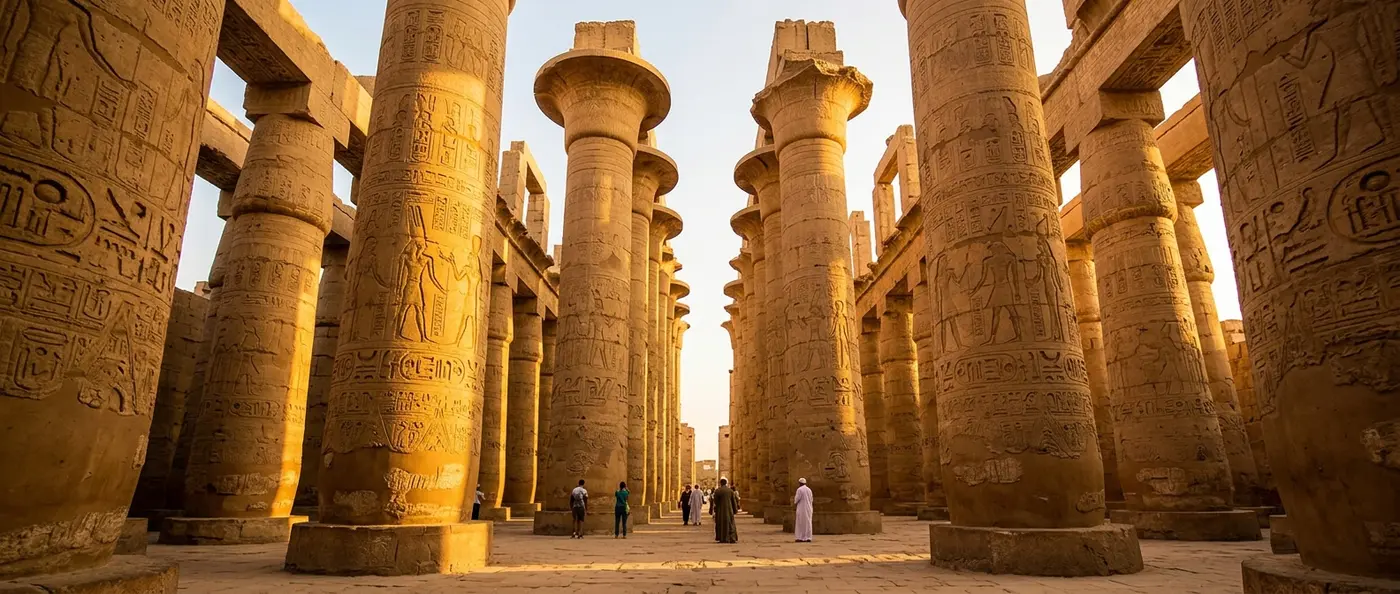
The Great Hypostyle Hall dwarfs everything else at Karnak. It covers 54,000 square feet and contains 134 massive columns arranged in 16 rows. The central 12 columns soar 69 feet high with a diameter of 11 feet — so large that 100 people could stand on top of each one.
These columns are covered in intricate reliefs showing pharaohs making offerings to the gods. The colors that once painted these scenes have faded over millennia, but traces of blue, red, and gold still cling to protected spots in the deepest crevices.
🔱 The Sacred Precinct of Amun-Ra
At Karnak's heart sits the sanctuary of Amun-Ra, king of the gods. Amun started as a local Theban deity, but when Thebes became Egypt's capital, their god shot to the top of the pantheon. He merged with sun god Ra to become Amun-Ra, Egypt's supreme deity.
Daily Rituals
Every morning, priests opened the sanctuary and "awakened" the god's statue. They dressed it, offered food, and sang hymns to start the divine day.
Royal Coronations
Pharaohs were crowned at Karnak, receiving divine approval from Amun-Ra to rule Egypt as living gods on earth.
The Opet Festival
Once yearly, Amun's statue sailed to Luxor Temple in a magnificent 11-day procession that brought all of Thebes to the streets.
The inner sanctuary, where the god's statue lived, was accessible only to the pharaoh and high priest. It was a small, dark space deliberately designed to inspire awe and mystery.
🏺 Karnak's Treasures
Karnak wasn't just a place of worship but an economic powerhouse. Ancient Egyptian temples functioned as banks, warehouses, and distribution centers. Karnak owned vast tracts of land, employed thousands, and collected taxes from all of Upper Egypt.
Within its walls lay countless treasures. Gold and silver vessels, jewelry of lapis lazuli and turquoise, statues of granite and alabaster. Many were looted over the centuries, but surviving pieces testify to the temple's staggering wealth.
💎 The Secret Chamber
In 1903, French archaeologist Georges Legrain discovered a hidden room containing over 17,000 bronze figurines and 779 stone statues. This "Karnak Cachette" held artwork hidden to protect it from invaders.
🗿 The Avenue of Ram-Headed Sphinxes
A ceremonial avenue leads to Karnak. A 1.8-mile avenue connects the temple to Luxor, lined on both sides with sphinxes. But these aren't your typical human-headed sphinxes.
Karnak's sphinxes sport ram heads — the sacred animal of Amun. Between each sphinx's paws stands a small statue of Ramesses II, protected by the divine power of the ram. Originally over 1,000 such sphinxes lined the route, though fewer than 100 survive today.
⚔️ Battles Carved in Stone
Karnak's walls record pharaonic history in stone. Here pharaohs recorded their military campaigns with detailed battle scenes, prisoner lists, and catalogs of conquered cities.
📜 Major Inscriptions
Most famous is perhaps Sesostris I's inscription describing the temple's founding. But equally significant is Thutmose III's "Poetic Stela," which recounts his victories in lyrical language, comparing the pharaoh to a bull trampling his enemies.
🔬 Modern Discoveries at Karnak
New discoveries continue at Karnak. Recent excavations and technologies have uncovered new evidence about the temple's construction and operation.
A study published in January 2026 suggests the temple may have been deliberately built on land that emerged from water, mimicking the Egyptian creation myth. According to mythology, the world began when the first hill rose from the primordial waters of chaos.
In March 2025, archaeologists discovered gold jewelry hidden in a small chamber near the sanctuary. The jewelry dates to the 22nd Dynasty and likely belonged to a priestess of Amun.
🌅 Decline and Renaissance
After Alexander the Great conquered Egypt in 332 BCE, Karnak continued operating under the Ptolemies. The new Greek rulers respected Egyptian traditions and kept building at the temple.
Real decline came with Roman conquest and especially the spread of Christianity. In 323 CE, Emperor Constantine ordered pagan temples closed. Karnak was abandoned and parts converted into churches.
For centuries, the temple lay buried under sand and rubble. Only the tallest column tops remained visible. Rediscovery began in the 18th century with European explorers, but systematic excavation started only in the 19th century.
1858-1860
Auguste Mariette begins the first scientific excavations and clears the Hypostyle Hall.
1895-1917
Georges Legrain restores fallen columns and discovers thousands of statues.
2000-Present
Laser scanning and 3D modeling document every detail of the temple complex.
🎭 Karnak Today
Today, Karnak Temple is Egypt's second most popular tourist attraction after the Giza Pyramids. Each year, hundreds of thousands of visitors walk the same corridors once trod by pharaohs.
At night, a spectacular sound and light show brings the temple's history to life. Columns blaze with color while narration tells the story of gods and kings who were worshipped here.
Conservation work continues. Each year, new sections of the temple are uncovered and restored. The goal isn't just preserving Karnak for future generations, but better understanding how this massive religious center functioned.
Karnak remains one of humanity's greatest architectural achievements. It's proof of the power of faith, pharaonic ambition, and ancient Egyptian craftsmanship. Every stone tells a 4,000-year story — a story that continues writing itself with each new discovery.