🏺 A Fifteen-Century Chronicle of Death
The Kerameikos served as Athens' primary burial ground from the 12th century BC through the Roman era. That's 1,500 years of continuous use — longer than Christianity has existed. Its strategic location just outside the city walls, along the Sacred Way to Eleusis, made it the perfect final destination for Athenian souls.
The Eridanos River split the cemetery into two distinct zones. North of the water lay the public necropolis, where fallen warriors and distinguished citizens received state honors. South stretched the private cemetery, where wealthy families competed to build the most spectacular monuments money could buy.
During Athens' golden age in the 5th and 4th centuries BC, the Kerameikos transformed into an open-air sculpture gallery. Rich families battled each other with marble instead of swords, commissioning increasingly elaborate tombs that turned grief into art. The result? A collection of masterpieces that rivals any museum.
⚱️ From Ashes to Marble: Evolution of Burial
Burial fashions changed with the times. During the Geometric period (900-700 BC), Athenians cremated their dead and stuffed the ashes into massive amphoras decorated with stick-figure funeral scenes. These ceramic giants — some reaching 5 feet tall — stood as grave markers, their geometric patterns telling stories of mourning and procession.
The Archaic period (700-480 BC) brought marble into the mix. The first stone stelae appeared, followed by kouroi — nude male statues that watched over graves with eternal youth. Burial replaced cremation for many families, and grave goods grew richer: jewelry, weapons, painted pottery.
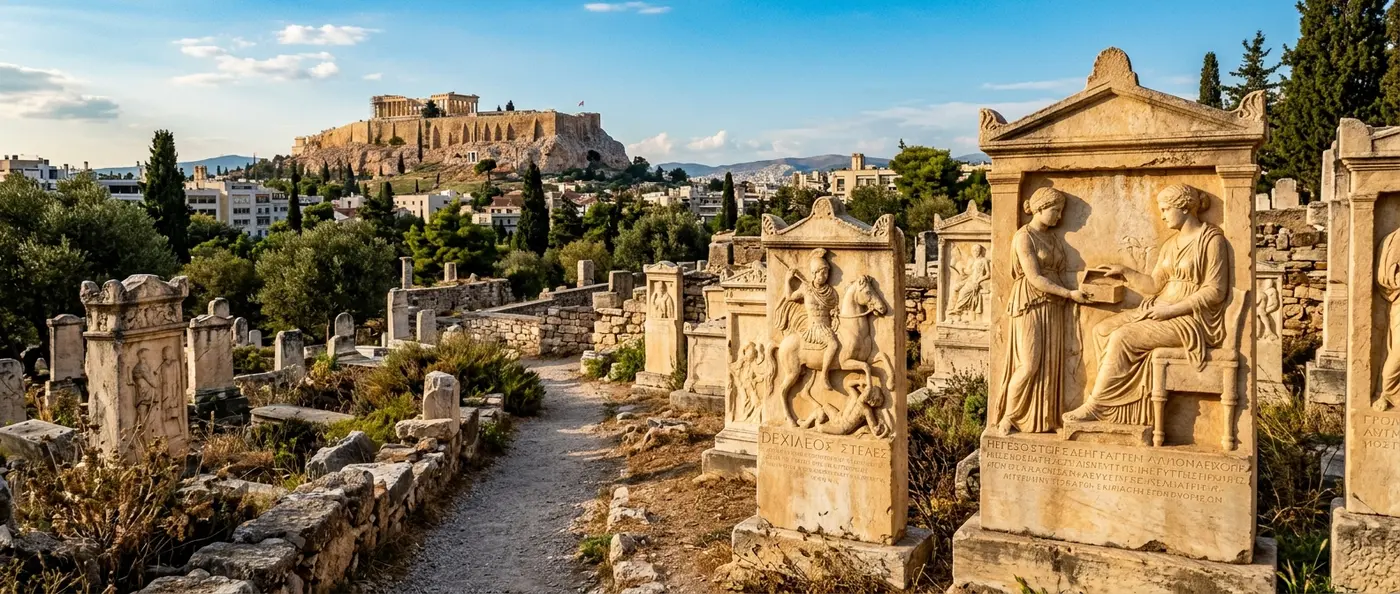
The Classical period (480-323 BC) brought the most elaborate monuments. Wealthy Athenians commissioned elaborate relief sculptures showing touching farewell scenes. A wife taking jewelry from her servant's box. A warrior mounting his horse for the last time. These reliefs turned family grief into public art.
🗿 Masterpieces Among the Tombstones
The grave relief of Hegeso, carved around 410 BC, captures a moment of quiet intimacy. The deceased woman sits calmly as her servant offers a jewelry box. No tears, no drama — just the simple dignity of a life remembered. The sculptor carved details so fine that Hegeso's chiton seems to flow like real fabric.
Equally stunning is the monument to Dexileos, a young cavalryman killed in the Corinthian War in 394 BC. The relief shows him on horseback, spearing an enemy in dynamic action. Every muscle of horse and rider strains with movement, frozen at the moment of victory and death.
The family burial plots tell their own stories. The precinct of Koroibos contained multiple generations of graves decorated with stelae, loutrophoroi, and marble statues. These spaces served as family mausoleums visited for generations.
Epitaph Inscriptions
The stone inscriptions reveal names, professions, and heartbreaking farewell messages. Simple words like "Chaire" (farewell) and references to the deceased's virtues give us intimate glimpses into ancient Athenian lives and losses.
Artistic Techniques
Sculptors used Pentelic marble and advanced carving techniques to create lifelike representations. Though the original paint has vanished, traces show these monuments were once brightly colored.
Social Stratification
Monument size and luxury directly reflected social status. From simple stone slabs to monumental naiskoi (temple-like structures), the variety reveals ancient Athens' rigid class hierarchy written in marble.
💀 Death Rituals and Sacred Protocols
Athenian burial followed strict choreography. The prothesis — laying out the body at home — lasted exactly one day. Female relatives washed and adorned the corpse while professional mourners sang funeral laments. The display allowed friends and family to pay final respects.
Before sunrise the next day, the ekphora (funeral procession) began. Men led, women followed, musicians played dirges. At the grave, mourners poured libations of wine, oil, and honey while placing grave goods around the body. The ritual connected the living with the dead through shared ceremony.
The funeral feast followed at home. Memorial services occurred on the third, ninth, and thirtieth days after death. Each year during the Genesia festival, Athenians visited ancestral graves with offerings and garlands, maintaining bonds that death couldn't break.
🔱 Solon's Funeral Laws
In the 6th century BC, lawgiver Solon clamped down on funeral excess. He banned excessive mourning, limited the number of funeral attendants, and capped the value of grave goods. The goal: prevent wealthy families from bankrupting themselves in death competitions while protecting poorer citizens from social pressure.
🏛️ The Public Cemetery and Funeral Orations
The public necropolis held special meaning in Athenian collective memory. Here lay citizens who died defending the city, buried with state honors. Each year, Athens organized an official ceremony for the war dead of that year.
The ritual was elaborate theater. Bones of the fallen were placed in cypress coffins, one for each tribe. An empty bier honored the missing in action. After burial, a prominent citizen delivered the epitaphios logos — funeral oration. The most famous was Pericles' speech in 431 BC, preserved by Thucydides.
Mass graves commemorated entire military units. The polyandreion of Spartans killed in 403 BC and the monument to cavalry fallen at Tanagra in 457 BC are prime examples. These memorials reinforced patriotism and civic unity through shared sacrifice.
🔬 Archaeological Discoveries and Treasures
Systematic excavations began in 1863 under the Greek Archaeological Society. Since 1913, the German Archaeological Institute has led research that continues today. The digs have uncovered thousands of graves and countless artifacts spanning fifteen centuries.
Major discoveries include the Sacred Gate, where three roads met and rituals honored the dead. Archaeologists also uncovered sections of the Themistoclean Wall and later city fortifications that protected Athens through its turbulent history.
Grave goods provide priceless insights into daily life. Pottery, jewelry, weapons, coins, and toys reveal how Athenians lived, worked, and played. White lekythoi with painted funeral scenes offer unique depictions of ancient burial practices.
📊 Chronological Evolution of Burial Practices
🏺 The Potter's Quarter: Where Art Met Industry
The Kerameikos wasn't just a cemetery — it was Athens' pottery production hub. The area had abundant clay from the Eridanos and Cephisus rivers. Hundreds of workshops churned out everything from storage jars to artistic masterpieces.
Kerameikos workshops created some of the finest examples of Attic pottery. Black-figure and red-figure vases with mythological scenes were exported across the Mediterranean. Master painters like Exekias and Euphronios had their studios here, creating works that still dazzle museum visitors.
The connection between pottery production and the cemetery wasn't coincidental. Many vessels were made specifically for burial use. White lekythoi, loutrophoroi, and massive kraters were essential for funeral rituals and as grave offerings.
"The Kerameikos represents a unique archaeological site where life and death, art and daily routine coexist harmoniously, offering invaluable insights into ancient Athenian society."
🌟 The Kerameikos Legacy Today
Today the Kerameikos operates as an archaeological site and museum, drawing thousands of visitors annually. The museum houses the most important finds from excavations, including original grave monuments, pottery, and small artifacts that bring ancient Athens to life.
Research continues to yield new insights. Modern techniques like DNA analysis from bones and isotopic analysis reveal information about ancient diet, health, and origins. Digital documentation allows three-dimensional reconstruction of monuments.
The Kerameikos remains a living space of memory connecting past and present. Its lessons about life, death, and art in ancient Athens are timeless. Through its graves and monuments, we can understand not just the practices but the values of a society that laid the foundations of Western civilization.