🏛️ The Legend That Won't Die
King Minos ruled Crete with an iron fist and a terrible secret. His wife Pasiphaë had fallen under a curse from Poseidon, bearing a child that was half-man, half-bull — the Minotaur. To contain this monster, Minos commissioned Daedalus, the master architect who'd fled Athens after murdering his nephew, to build an impossible prison.
Daedalus created a structure so complex that even he struggled to find his way out. Every nine years, Athens sent seven young men and seven young women as tribute to feed the beast, until Theseus arrived with Ariadne's thread and changed everything. The hero killed the Minotaur and escaped, but not before triggering a chain of events that would see Daedalus and his son Icarus imprisoned in their own creation.
Then the story takes a surreal turn. Daedalus crafted wings from wax and feathers to escape by air. Icarus flew too close to the sun. The wax melted. The boy fell into the sea that still bears his name. But what if this wasn't just a story? What if something real lurked beneath the myth?
🔱 The Labyrinth Symbol
Labyrinth symbols appear across ancient cultures — Egypt, India, Celtic Britain. In Minoan Crete, the pattern shows up on coins, seals, and frescoes, suggesting deep religious significance beyond mere decoration.
🗿 What Arthur Evans Found
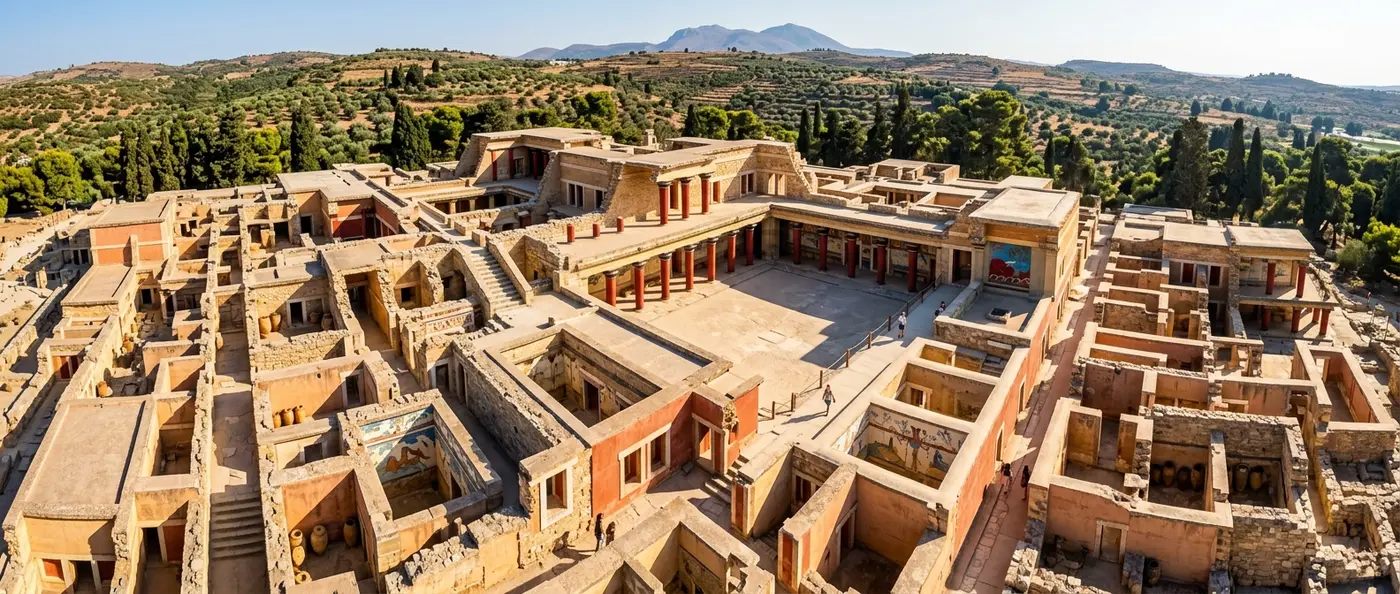
When Sir Arthur Evans started digging at Knossos in 1900, he uncovered a palace that sprawled beyond imagination. The palace sprawled across six acres with more than 1,300 rooms connected by a bewildering network of corridors, staircases, and chambers. Five stories deep. No clear layout. Visitors got lost within minutes.
The frescoes told their own story. Young athletes vaulted over charging bulls in death-defying displays. The double-headed axe — the labrys — appeared everywhere, leading some scholars to suggest "labyrinth" meant "house of the double axe." Bull imagery dominated the art. Sacred horns crowned the rooftops. This wasn't just a palace. This was a temple to the bull.
Evans found storage rooms that could hold enough olive oil to feed thousands. Workshops where artisans crafted goods for trade across the Mediterranean. Throne rooms with griffin frescoes. But no obvious labyrinth. No monster's lair. Just a building so vast and complex that it might as well have been designed by Daedalus himself.
⚔️ Three Theories, One Truth
Modern archaeologists have developed three competing theories about what the "labyrinth" really was. Each sounds plausible until you dig deeper.
The Palace Theory
The entire Knossos complex served as the labyrinth. For mainland Greeks accustomed to simple structures, this architectural marvel would seem impossibly maze-like.
The Underground Theory
Extensive storage tunnels and chambers beneath the palace formed the true labyrinth — a hidden world of narrow passages and dead ends.
The Ritual Theory
The labyrinth existed as a symbolic space for religious ceremonies, not a physical structure but a spiritual journey.
The bull-leaping frescoes support a darker interpretation. Those young Athenians sent as "tribute" might have participated in these dangerous rituals. Many would have died. Over time, this practice morphed into the myth of human sacrifice to the Minotaur. The monster wasn't a creature — it was the ritual itself.
The caves beneath Crete offer another explanation. The Agia Paraskevi cave near Skoteino stretches for miles underground with passages that branch and reconnect in bewildering patterns. Archaeological evidence shows Minoans used the cave for religious purposes. Perhaps this natural labyrinth inspired the myth.
🏺 When Civilization Collapsed
Around 1450 BCE, Minoan civilization vanished almost overnight. The Thera eruption. Mycenaean invasion. Natural disaster. Political collapse. Take your pick — the result was the same. The greatest Bronze Age civilization in Europe crumbled, leaving behind ruins that sparked the imagination of later Greeks.
Classical Greeks visiting Knossos centuries later saw massive ruins they couldn't fully understand. The sophisticated plumbing. The multi-story architecture. The advanced engineering. To them, only gods or monsters could have built such things. The myth of the labyrinth filled the gap between what they saw and what they could comprehend.
The Theseus story might reflect real political history. Minoan Crete dominated the Aegean for centuries, demanding tribute from mainland cities. When Mycenaeans finally conquered Crete, they cast themselves as heroes liberating Greece from the "Minotaur" of Minoan power. Theseus killing the monster became a metaphor for breaking free from foreign domination.
💡 What Modern Technology Reveals
Ground-penetrating radar has revealed hidden chambers beneath Knossos. Unexplored chambers. Hidden passages. Underground waterways connecting to natural cave systems. The palace sits atop a network of tunnels and caverns that extends far beyond what Evans excavated.
Some of these passages appear deliberately constructed. Others follow natural limestone formations. Together, they create an underground maze that rivals the complexity of the palace above. If the Minoans used these spaces for storage, workshops, or religious ceremonies, visitors could easily become lost in the darkness.
Analysis of Minoan seals and coins shows the labyrinth symbol appeared throughout their civilization, not just at Knossos. This suggests the labyrinth held deep religious or cosmological meaning for the Minoans — perhaps representing the journey of the soul through death and rebirth, or the cyclical nature of time itself.
🔬 Separating Myth from Reality
No archaeologist has found a structure matching the mythical labyrinth exactly. But the evidence suggests the myth drew from multiple real elements of Minoan culture. The complex palace architecture. The underground storage systems. The bull-leaping rituals. The memory of Minoan sea power. All these fragments fused in Greek collective memory to create one of humanity's most enduring myths.
📊 Myth vs Reality
The most likely explanation? The labyrinth wasn't a single structure but a combination of elements: the bewildering palace, the underground storage systems, the dangerous bull rituals, and the memory of Minoan naval dominance. These merged in Greek imagination to create a myth that has captivated humanity for three millennia.
Whether the labyrinth existed as a physical structure matters less than its cultural impact. From ancient art to modern literature, the labyrinth remains a powerful symbol of mystery, challenge, and the search for truth. Perhaps that's the real legacy of Knossos — not a physical maze, but a labyrinth of the imagination that continues to fascinate us long after the civilization that created it vanished into history.