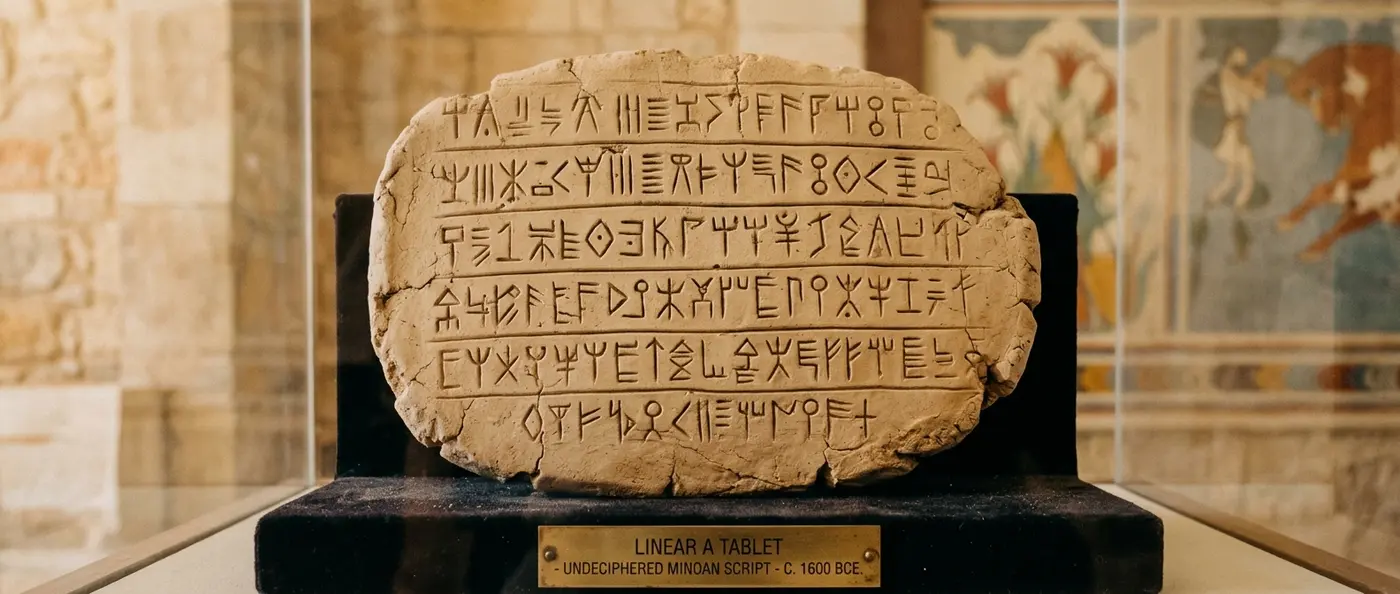
Clay tablets scattered across the palace floors of Knossos hold one of archaeology's most stubborn secrets. Linear A, the writing system of the Minoan civilization, has resisted every attempt at decipherment for over a century. 1,450 inscriptions sit in museums and archives, their meaning locked away like voices from a vanished world that refuse to speak.
📜 The Minoan Cipher
Linear A represents the earliest writing system used on Crete, flourishing from roughly 1800 to 1450 BCE. While its descendant Linear B was cracked in 1952 and revealed early Greek, Linear A guards its secrets with maddening persistence. Every symbol seems familiar yet foreign, like a half-remembered dream that dissolves when you try to grasp it.
The script appears on clay tablets, stone vessels, seals, and frescoes scattered across Crete and the Aegean islands. This geographic spread tells us the Minoans wielded considerable influence across the Bronze Age Mediterranean. They weren't just island dwellers — they were maritime power brokers whose reach extended from Egypt to Sicily.
What makes Linear A particularly frustrating is its longevity. For over 350 years, this advanced civilization used the script for everything from palace administration to religious ceremonies. A society sophisticated enough to build multi-story palaces with indoor plumbing and create stunning frescoes left behind a writing system that modern computers and cryptographers can't crack.
🔍 The Linear B Connection
Linear A and Linear B share about 70% of their symbols, creating a tantalizing puzzle. You'd think this overlap would unlock Linear A, but it's proven to be a red herring. The symbols look similar, but they don't behave the same way. It's like finding a key that almost fits — close enough to be maddening, not close enough to work.
Linear B records Mycenaean Greek, the language of the warriors who conquered Crete around 1450 BCE. They adapted the Minoan script to write their own language, keeping many symbols but changing their meanings. This evolutionary relationship should have provided the Rosetta Stone for Linear A. Instead, it's highlighted just how different the underlying Minoan language must have been.
Researchers have tried applying Linear B sound values to Linear A texts. The results read like gibberish — not Greek, not any known Indo-European language, not even recognizable as human language. This suggests the Minoans spoke something completely isolated, a linguistic island that disappeared without leaving relatives behind.
🏺 What the Tablets Tell Us
Even without reading Linear A, archaeologists have extracted crucial information from context and format. Most inscriptions appear to be administrative records — inventories, transaction lists, accounting documents. The Minoans were meticulous record-keepers, tracking everything from olive oil jars to livestock.
Religious inscriptions appear on ceremonial vessels and at mountain peak sanctuaries. These brief texts might contain dedications to Minoan deities or ritual formulas. The script also appears on seals used to authenticate documents and mark ownership — suggesting a complex bureaucratic system that required written verification.
The numerical system is sophisticated, using decimal notation with special symbols for units, tens, hundreds, and fractions. This mathematical precision reveals a society engaged in complex trade calculations and resource management. They weren't just keeping simple tallies — they were running a Bronze Age economy.
Administrative Records
Clay tablets listing products, quantities, and possibly personal or place names. Found primarily in palace archives throughout Crete.
Religious Inscriptions
Brief texts on ritual objects, likely dedications or invocations. Discovered at sacred sites and mountain sanctuaries.
Seal Stones
Short inscriptions on carved seals used to authenticate documents or identify ownership of goods and property.
⚗️ Why Linear A Resists Decoding
Since the early 20th century, dozens of scholars have thrown themselves against Linear A like waves against a cliff. Each approach has crashed against the same fundamental obstacles. The problem isn't lack of effort — it's the nature of the beast itself.
The corpus is too small and too uniform. With only 1,450 inscriptions, most of them brief administrative notes, there isn't enough linguistic variety for pattern recognition. Imagine trying to learn English from nothing but grocery lists and shipping manifests. You'd figure out that "2 apples" means something, but you'd never crack poetry or philosophy.
The absence of bilingual texts kills most decipherment attempts before they start. The Rosetta Stone worked because it said the same thing in three scripts. Linear A has no such crutch. Every inscription stands alone, offering no translation key or linguistic bridge to known languages.
💡 The Decipherment Problem
Linear A faces unique challenges that have defeated other ancient scripts: limited text corpus, unknown underlying language with no known relatives, absence of bilingual inscriptions, and predominantly short administrative texts that lack the linguistic richness needed for pattern analysis.
🗿 Voices Lost in Time
The silence of Linear A robs us of the Minoan voice. We can admire their palaces, marvel at their frescoes, and study their trade networks, but we can't hear them speak. We don't know what they called themselves, their gods, or their cities. Their thoughts, beliefs, and stories remain locked behind symbols we can see but cannot read.
This linguistic void creates a peculiar form of historical amnesia. The Minoans were Europe's first maritime empire, yet they remain essentially anonymous. We've assigned them a name borrowed from Greek mythology, but their real identity died with their script. They built a civilization that lasted longer than the Roman Empire, yet they can't tell us their own story.
Modern technology offers new hope. Machine learning algorithms analyze symbol patterns, searching for hidden structures that human eyes might miss. AI systems trained on other ancient scripts probe Linear A for statistical regularities. Each new archaeological season brings the possibility that the crucial missing piece might emerge from Cretan soil.
🔬 The Digital Hunt
International research teams now collaborate through digital databases containing every known Linear A inscription. High-resolution photography and 3D scanning capture details invisible to earlier scholars. Computer algorithms run pattern recognition across the entire corpus, looking for recurring sequences that might reveal grammatical structures.
New discoveries remain crucial. Every excavation season in Crete carries the potential for breakthrough finds. Archaeologists particularly hope for longer texts or different types of inscriptions that might provide the linguistic variety needed for decipherment. A single substantial text could transform our understanding overnight.
Even if Linear A never yields its secrets completely, its study continues revealing aspects of Minoan administration, trade, and cultural contacts. The script's distribution patterns map Minoan influence across the Bronze Age Aegean. Its numerical systems illuminate economic practices. Its very resistance to decoding reminds us that the past still holds mysteries beyond our technological reach.
📊 Bronze Age Script Decipherment Status
🌊 The Stakes for Aegean History
Cracking Linear A would rewrite Bronze Age Mediterranean history. The Minoans controlled crucial trade routes between Europe, Africa, and Asia. Their language might reveal diplomatic correspondence with Egyptian pharaohs, commercial contracts with Mesopotamian merchants, or religious exchanges with Anatolian kingdoms. These documents could illuminate the complex web of relationships that shaped the ancient world.
The script might also solve the mystery of Minoan origins. Were they indigenous Cretans or migrants from elsewhere? Their language could reveal connections to other cultures and populations, potentially rewriting the story of early European settlement patterns. Genetic studies suggest complex population movements in the Bronze Age Aegean — Linear A could provide the cultural context for these migrations.
Until that breakthrough comes, Linear A remains a silent witness to a brilliant civilization. Its symbols continue challenging each new generation of scholars, holding secrets that could transform our understanding of Europe's first great maritime empire. The Minoans built their palaces to last millennia, but their greatest monument might be this undeciphered script — a puzzle that has outlasted the civilization that created it.