📖 Read more: Ancient Canaan: The Land Before the Philistines
🕎 The Discovery That Stunned Archaeologists
The Magdala Stone didn't reveal itself easily. Archaeologists were racing against construction crews in 2009, excavating what would become a hotel site, when they uncovered the remains of a first-century synagogue. The building had operated from around 50 CE until its abandonment around 80 CE — a decade after Roman legions torched Jerusalem and looted its Temple.
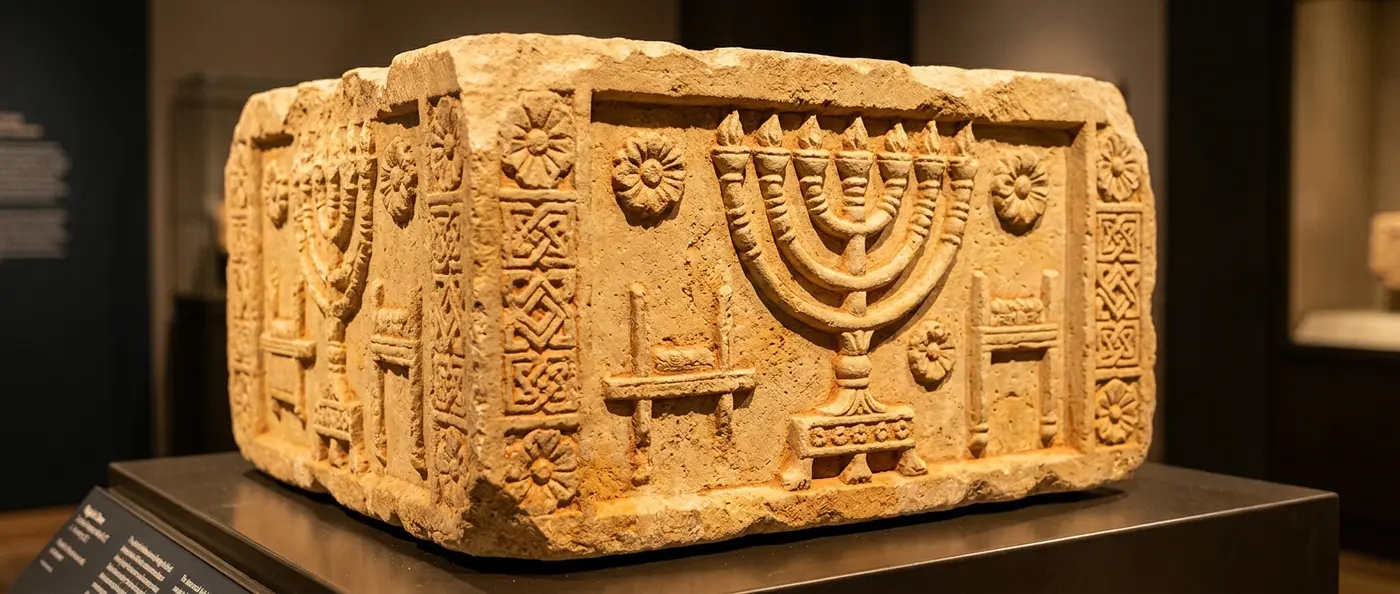
Inside a small room believed to house Torah scrolls, they found a rectangular limestone block: a rectangular limestone block, roughly 24 by 20 by 16 inches, perched on four stone legs. Five sides bore intricate relief carvings of synagogue objects. The most striking was a seven-branched menorah standing on a square base, flanked by amphoras. Long sides featured rows of rounded arches separated by columns, while the top displayed botanical motifs.
Archaeologist Mordechai Aviam believes the stone served as a base for a Torah reading table. Its decorations depicted the Holy of Holies from Jerusalem's Second Temple — the innermost sanctuary where Jewish tradition placed God's presence. But this wasn't just religious art. It was a memory carved in stone by someone who had witnessed the Temple's glory before Rome destroyed it.
🏛️ The Sacred Menorah's Significance
The seven-branched menorah carved into the Magdala Stone wasn't decorative. It represented the actual golden menorah that burned continuously in Jerusalem's Second Temple, used in daily religious ceremonies. When Romans sacked Jerusalem in 70 CE, they hauled this sacred lampstand through Rome's streets as war booty. The victory parade was later immortalized on the Arch of Titus, where you can still see Roman soldiers carrying the menorah today.
The Magdala Stone predates almost every known menorah carving. Only a handful of Second Temple period menorah depictions have survived, and this might be the oldest. The precision of its details suggests the carver had seen the real thing. Someone had made the pilgrimage to Jerusalem, entered the Temple courts, and witnessed the golden menorah with their own eyes.
That pilgrim likely commissioned this replica for Magdala's synagogue, creating a tangible connection between their small Galilean community and Judaism's spiritual center. For worshippers who couldn't travel frequently to Jerusalem, the stone offered a direct link to the Temple and its sacred rituals. They could touch what their ancestors had seen, maintaining their connection to a tradition that would soon face its greatest crisis.
📖 Read more: 1,400-Year-Old Christian Cross Found in Abu Dhabi Desert
🗿 Secrets Hidden in Stone
The Magdala Stone holds more mysteries than just its menorah. Archaeologists believe its decorations form a symbolic representation of the entire Second Temple. The arches and columns on its sides might depict the Temple's architecture, while the botanical motifs on top could symbolize the Garden of Eden or the celestial sphere.
The stone sat deliberately in the Torah scroll storage room. This location underscored its importance as a sacred object linking Magdala's small community to Jerusalem's religious center. The stone served as more than furniture — it was a three-dimensional prayer, a carved petition to maintain divine connection even at the empire's edge.
Every carved detail connects to Temple worship. Every element connects to Temple worship: the amphoras represent ritual libations, the architectural details mirror the sanctuary's design, and the menorah stands as the centerpiece of divine light. Together, they create a miniature Temple that could function even when the original lay in ruins.
Architectural Symbolism
The carved arches and columns likely represent the Second Temple's interior decoration, creating a miniature version of the sacred space.
Botanical Motifs
The decorative plants on the stone's top connect to Garden of Eden traditions and celestial order in Jewish thought.
Ritual Vessels
The amphoras flanking the menorah represent the ritual libations and offerings that were central to Temple worship.
⏳ A Moment Frozen in Time
The Magdala Stone's dating places it at a pivotal moment in Jewish history. Created and used during the final decades before the Second Temple's destruction, it captures a world on the brink of catastrophe. Judea groaned under Roman occupation, and tensions between Jewish populations and Roman governors escalated toward inevitable conflict.
Magdala's synagogue operated from around 50 CE, when Galilee buzzed with religious activity. The town sat strategically near the Sea of Galilee on a major trade route. Its abandonment around 80 CE, shortly after Jerusalem's destruction, reflects the dramatic changes Roman victory brought to Jewish life throughout the region.
📖 Read more: 1.8-Million-Year-Old Skulls Rewrite Human Evolution
The stone survived intact for nearly 2,000 years because the synagogue's collapse buried and protected it from looters and destruction. Its discovery shows how Jewish communities lived of a Jewish community just before the great catastrophe that forever changed Judaism. Worshippers would gather around it, reading Torah while studying their carved Temple — unaware they would never see the original again.
💡 Did You Know?
Magdala was famous in antiquity for producing and exporting preserved fish. Its ancient name "Taricheae" literally means "place of preserved fish," and its products were shipped throughout the Roman Empire.
🔬 Modern Discoveries and Parallels
The Magdala Stone's significance becomes clearer when compared to other recent discoveries. Archaeologists in Jerusalem recently uncovered a 1,700-year-old oil lamp decorated with Jewish motifs, including a menorah. This lamp dates to the 3rd century CE, more than 100 years after the Second Temple's destruction.
The lamp's discovery near the Mount of Olives is particularly significant because it demonstrates continued Jewish presence in Jerusalem despite Roman suppression efforts after the Bar Kokhba revolt in 135 CE. Emperor Hadrian had restricted Jewish worship and expelled many Jews from Jerusalem, renaming the city "Aelia Capitolina."
These discoveries together create a picture of continuity and resistance. From the Magdala Stone created when the Temple still stood, to the 3rd-century lamp made under oppressive conditions, we see how the menorah remained central to Jewish identity and faith. The symbol transcended the Temple's physical destruction, carrying its light into diaspora communities worldwide.
🎭 The Stone's Legacy
Today, the Magdala Stone stands as one of Jewish archaeology's most important treasures. Its discovery revolutionized our understanding of Second Temple period religious art and practice. For the first time, we have tangible evidence of how Jewish communities outside Jerusalem maintained their connection to the Temple through art and symbolism.
📖 Read more: 2,000-Year-Old Bronze Drum Unearthed in China
The stone teaches us about memory's power and representation's importance. The unknown pilgrim who commissioned its creation couldn't imagine that within years, the Temple he loved would be destroyed. Yet through his act, an image of the Temple survived its destruction, preserved for future generations who would never see the original.
For modern researchers, the Magdala Stone provides invaluable information about Second Temple architecture and decoration. The menorah's details, its placement relative to other ritual objects, and the stone's overall symbolism offer evidence that written sources don't preserve. It's archaeology filling gaps that history left empty.
📊 Menorah Discovery Timeline
🌟 Message for Today
When archaeologists lifted the Magdala Stone from two millennia of burial, they freed more than limestone — they uncovered a direct link between today's menorahs and the golden original that once burned in Jerusalem's Temple.
The seven flames carved in Magdala stone still flicker today — not in Temple courts, but in Jewish homes worldwide every Hanukkah, carrying the same light their carver once witnessed in person.
As Hanukkah, the Jewish festival of lights, is celebrated annually with the lighting of the nine-branched menorah, the Magdala Stone reminds us of this tradition's deep roots. The seven-branched menorah it depicts connects modern celebrations to the ancient Temple, creating an unbroken chain of memory and faith spanning millennia.