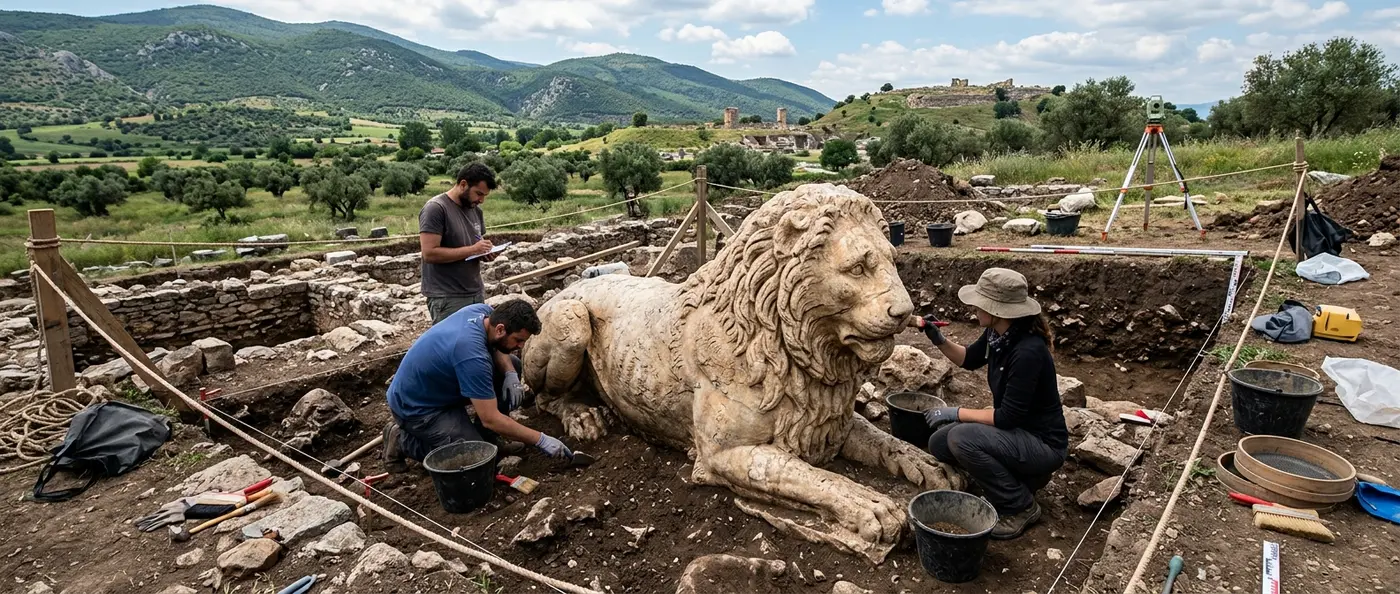
Silence blankets an ancient necropolis near Philippi. Archaeologists crouch over their latest find — a marble lion that's been waiting centuries to tell its story. This isn't just another Roman artifact. The discovery promises to rewrite what we know about ancient Macedonia, connecting to a global tapestry of lion symbolism that spans 40,000 years and every major civilization on Earth.
🦁 Lions: The Universal Symbol of Power
Lions appeared in human art long before marble or bronze. Every major ancient civilization claimed them as guardians, gods, and symbols of divine authority. From religious carvings 40,000 years ago to Roman tombs, lions dominated human belief systems.
Deep in a German cave, archaeologists unearthed humanity's oldest known religious symbol. The "Lion Man" — a 31-centimeter ivory sculpture — dates back 40,000 years. British Museum researchers calculated that crafting it with Ice Age tools would have required 400 hours of meticulous work.
Wear marks across the figurine's body tell a story of ritual use. Hand to hand it passed, generation after generation. The cave where it rested overflowed with perforated arctic fox teeth and reindeer antlers — clear evidence of a ceremonial space where our ancestors first grappled with concepts of the divine.
🏛️ Guardians of the Greco-Roman World
The Greco-Roman world positioned lions as eternal sentries. They guarded springs, gates, palaces, cemeteries, and temples. As protectors of the dead, they appeared on tomb monuments and sarcophagi across the Mediterranean.
At Khirbat Ibreika in Israel, archaeologists recently uncovered four unique bronze objects bearing raised lion heads, roughly 1,900 years old. Dating to the 1st or 2nd century CE, these artifacts lay carefully arranged at a tomb's southern edge.
Four bronze rings accompanied the lion-head discs, likely attached to the heads themselves. What makes this find unusual: while similar discs appear throughout the Roman world, rings typically passed through the lion's mouth, not over the head.
⚔️ The Mystery of Deliberate Placement
A large iron nail bearing wood traces hints at a wooden sarcophagus that time erased. Researchers believe the bronze objects with their rings functioned as handles for carrying the coffin.
But something doesn't add up. Why did all four discs end up in a careful pile on one side of the tomb? Archaeologists Elie Haddad and Elisheva Zwiebel note the puzzle: "If the discs were sarcophagus handles, why were they stacked in what appears to be a deliberate placement on one side of the tomb? While one could argue they fell from the wooden sarcophagus during burial, it seems unreasonable that all four discs would fall to the same side."
This raises the possibility that these objects held special symbolic or ritual significance we haven't fully grasped.
Protection Symbol
In the Greco-Roman world, lions served as guardians of the dead, protecting eternal rest from malevolent forces.
Status Marker
Such elaborate bronze objects indicate the deceased held high social position or economic power in their community.
Cosmic Symbolism
Rings positioned above lion heads may represent the "wheel of the zodiac, wheel of life," connecting death to existence's cyclical nature.
🗿 From Beast-Men to Marble Lions
Humanity's ability to imagine hybrid beings — half human, half animal — proves our species' early religious thinking. Adam Brumm, archaeologist at Australia's Griffith University, explains that therianthropes provide "evidence for the ability to conceive of the existence of a supernatural being, something that does not exist in real life."
Recent dating of Indonesian cave paintings revealed an even older therianthrope, 51,200 years old, proving humans conceived human-animal hybrids far earlier than previously thought.
From these primitive representations to the exquisitely carved marble lions of classical antiquity, we trace a continuous evolution in art and symbolism. The marble lion of Philippi represents the culmination of this millennia-long tradition.
💡 Did you know?
In ancient Egypt, the lioness goddess Sekhmet was considered so powerful she could cause epidemics but also cure them. Her priests often served as doctors, combining medicine with magic for protection against disease.
📜 New Discoveries Rewrite History
Archaeology continues to surprise us. In Cornwall, England, charred hazelnut shells discovered at Tregunnel Hill near Newquay overturned the dating of the region's Neolithic period by at least a century.
Radiocarbon dating of the shells yielded dates between 3985 BCE and 3793 BCE, firmly placing activity in the Early Neolithic period. These dates rank among the oldest confirmed evidence for this period in Cornwall, pushing the Neolithic's start before 3800 BCE.
Meanwhile, in Egypt, an Egyptian-German archaeological mission discovered 13,000 inscribed pottery fragments, known as ostraca, at the ancient site of Athribis in Upper Egypt's Sohag. Among them, over 130 texts relate to ancient astrology, including horoscopes and zodiac signs.
🔬 The Power of Small Finds
Seemingly insignificant discoveries often hide the biggest revelations. Cornwall's hazelnut shells, usually dismissed as food waste, proved exceptional time capsules. Within their charred remains lay preserved the exact moment when a new way of life took root in one of Britain's most ancient landscapes.
Similarly, Athribis's ostraca — essentially antiquity's notebooks and scratch paper — were used for over a thousand years, providing a continuous record of city life. The content of these ancient texts spans an amazing range: administrative records, tax receipts, school exercises, religious texts, and astrological calculations.
📊 Timeline of Major Discoveries
🏺 The Future of Archaeological Research
Ongoing excavations at Philippi will determine the marble lion's significance to ancient Macedonian society. Its position in the necropolis, artistic execution, and discovery context will help us better understand burial practices and religious beliefs of the era.
Modern technology now allows more detailed analyses. From radiocarbon dating to 3D scanning, archaeologists possess tools their predecessors couldn't imagine. This means even finds discovered decades ago can now be studied in new ways and reveal information that remained hidden.
The marble lion of Philippi isn't just another archaeological find. It's a link in a chain connecting prehistoric art to classical antiquity, the first Neolithic farmers to Ptolemaic Egypt's astrologers. Each discovery adds a piece to humanity's historical puzzle, helping us understand not only the past but our place in civilization's long journey.