📖 Read more: Augustus: Emperor Who Transformed Rome Forever
🏛️ Forging an Ancient Masterpiece
The statue was created around 175 AD, during the reign of the philosopher-emperor Marcus Aurelius (161-180 AD). Roman metalworkers pushed their craft to its limits with this bronze casting. Craftsmen used the "lost wax" (cire perdue) method, creating a work weighing approximately 1,800 kilograms.
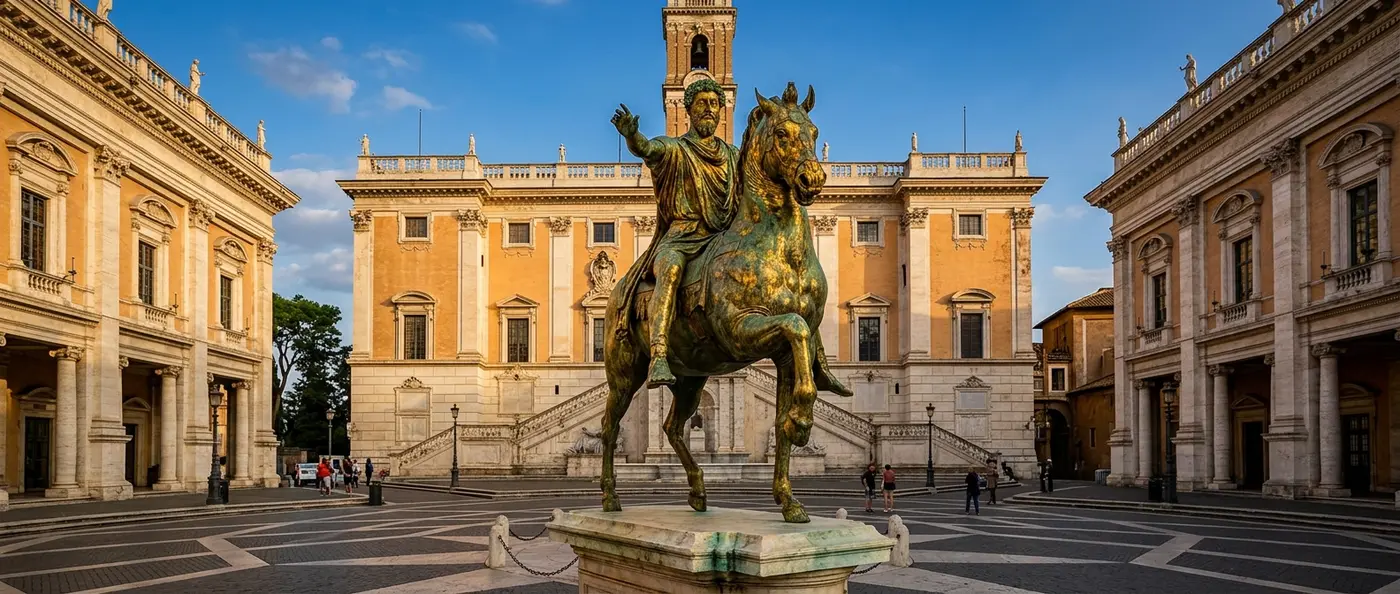
The statue depicts the emperor in a pose of calm authority, his right hand raised in a gesture of peace and clemency. The curly hair and philosophical beard capture Marcus Aurelius as the Stoic thinker he was. The horse walks forward with one hoof raised, frozen mid-stride.
Originally, the statue was positioned in the Roman Forum or Colosseum Square. Historians believe that beneath the horse's raised hoof once stood the figure of a barbarian enemy, symbolizing Rome's victory over its foes. The gilding that originally covered the statue has almost completely disappeared, though traces remain visible in certain areas.
⚔️ The Philosopher on Horseback
Marcus Aurelius, known as the last of the "Five Good Emperors," was a unique figure in Roman history. Despite his military obligations and constant wars on the empire's borders, he remained devoted to Stoic philosophy. His "Meditations," the philosophical work he wrote during his campaigns, remains one of the most important texts of Stoic thought to this day.
His depiction in the statue reflects this dual nature. He wears not military armor but a toga, the traditional Roman garment of citizens. His raised hand holds no weapon but is open in a gesture of peace. This choice wasn't accidental — Marcus Aurelius wanted to be remembered not as a conqueror but as a peacemaker and philosophical leader.
The period of his reign (161-180 AD) marked the end of the Pax Romana, the long period of peace and prosperity in the Roman Empire. Despite challenges — plague pandemic, rebellions, barbarian invasions — Marcus Aurelius managed to maintain the empire's cohesion by applying Stoic principles of self-control and duty.
🗿 The Mystery of Survival
What saved this statue when hundreds of others vanished? Of the hundreds of bronze statues that adorned Rome, almost all were melted down during the Middle Ages to reuse their bronze for other constructions. How did Marcus Aurelius' statue escape this fate?
The answer lies in a historical misunderstanding. For centuries, Rome's inhabitants believed the statue depicted Constantine the Great, the first Christian emperor. This mistaken identification saved the statue from destruction, as the Church protected monuments connected to Constantine.
In 1538, Pope Paul III decided to move the statue to Capitoline Hill, at the center of the square designed by Michelangelo. There it remained for over 400 years, becoming a symbol of eternal Rome. In 1981, due to atmospheric pollution threatening its integrity, the original was moved to the Capitoline Museums, where it's preserved under controlled conditions. An exact replica was placed in the square.
💡 Did You Know?
Marcus Aurelius' statue is the only bronze equestrian statue from ancient Rome that survives intact. It's estimated that Rome once had more than 20 similar imperial statues, but all others were destroyed to recycle their bronze.
🎨 Technical Excellence and Artistic Innovation
Roman metalworkers achieved something extraordinary with this statue. Craftsmen used advanced techniques for their time, creating a work that combines monumental scale with stunning detail. The statue was cast in multiple separate pieces that were then welded together with perfect precision.
Special attention was paid to rendering details. The veins in the horse's legs, the texture of its mane, the folds of the emperor's garment — all show precise craftsmanship. Even Marcus Aurelius' eyes, originally inlaid with other materials to give the impression of life, show the attention to detail.
The horse's stance is also noteworthy. Unlike other equestrian statues of the era depicting dramatic battle scenes, here the horse walks calmly with controlled movement. This choice reinforces the message of peace and stability the emperor wanted to project.
Construction Technique
Used the "lost wax" method with casting in multiple sections. Assembly was done with perfect precision, without visible joints.
Artistic Details
Realistic rendering of anatomy, clothing, and expressions. Eyes were originally inlaid for greater liveliness.
Gilding
The statue was originally covered with gold leaf, giving the impression of a golden statue gleaming in the sun.
📖 Read more: Celts: The Warriors Who Terrorized Rome
🏰 From Forum to Capitol
The statue's history after the fall of the Roman Empire is as fascinating as its creation. During the Middle Ages, the statue stood near the Lateran, the Pope's seat before the Vatican. There it became a reference point for pilgrims and city visitors.
Its transfer to the Capitol in 1538 marked a new era. Michelangelo designed the entire Piazza del Campidoglio around the statue, creating an architectural ensemble that enhanced its monumentality. The square's oval design with geometric patterns on the ground creates a visual perspective that leads the eye to the center, where the bronze emperor dominates.
For centuries, the statue became a symbol of Roman power and continuity. Each new Pope passed before the statue during his enthronement ceremony. Artists from across Europe came to study and copy it. It became the model for countless equestrian statues of rulers throughout Europe.
🔬 Modern Conservation and Protection
The decision to move the original statue indoors in 1981 was inevitable. Rome's atmospheric pollution had begun corroding the ancient bronze at an alarming rate. Experts found that more damage had occurred in the last 50 years than in the previous 18 centuries.
The conservation work that followed stretched over five years. For five years, teams of specialists worked to clean, stabilize, and protect the statue. Laser technologies were used for cleaning, while special coatings were applied to protect the metal.
During conservation, significant discoveries were made. Traces of original gilding were found in protected areas, confirming historical sources that spoke of a "golden" statue. Analysis of the metal also revealed the exact composition of the alloy and techniques used in casting.
⚖️ Before and After Conservation
🌍 Global Influence and Legacy
The influence of Marcus Aurelius' statue extends far beyond Rome's borders. It became the prototype for equestrian statues of rulers throughout the Western world. From Charlemagne's statue in Paris to Peter the Great's in St. Petersburg, all follow the model established by this Roman masterpiece.
During the Renaissance, artists like Donatello and Verrocchio studied the statue exhaustively to understand ancient bronze-working techniques. Donatello's Gattamelata in Padua and Verrocchio's Colleoni in Venice are direct descendants of Marcus Aurelius' statue.
Even today, the statue continues to inspire. It's one of Rome's most recognizable symbols, appearing in countless films, books, and artworks. Italy's euro depicted the statue on the 50-cent coin, recognizing its significance as a national symbol.
Beyond its artistic value, the statue remains a symbol of leadership and wisdom. In an era when power is often associated with violence and imposition, the image of the philosopher-emperor raising his hand in a gesture of peace offers an alternative model of leadership based on wisdom and clemency.
🎭 The Paradox of Preservation
Ironically, the statue of Marcus Aurelius, the last great pagan emperor and persecutor of Christians, was saved because medieval Christians mistook it for a statue of Constantine, the first Christian emperor. This historical misunderstanding preserved one of antiquity's most important artworks.
📚 Lessons from the Bronze Philosopher
Marcus Aurelius' statue isn't just an artwork — it's a history lesson cast in bronze. It teaches us about art's power to survive and transmit messages across centuries. It reminds us that true greatness lies not in conquest but in wisdom and humanity.
The statue's survival is also a lesson about the importance of preserving cultural heritage. If the misunderstanding with Constantine hadn't occurred, if Michelangelo hadn't placed it at the center of the Capitol, if modern conservators hadn't acted in time, this masterpiece would have been lost forever.
Today, as we stand before the statue — whether the original in the Capitoline Museums or the replica in the square — we see something more than an emperor on horseback. We see the continuity of human civilization, art's ability to transcend time and circumstances, and the eternal quest for wisdom and balance that Marcus Aurelius embodied.
The bronze emperor has outlasted the empire that created him, watching Rome transform from imperial capital to papal seat to modern city.