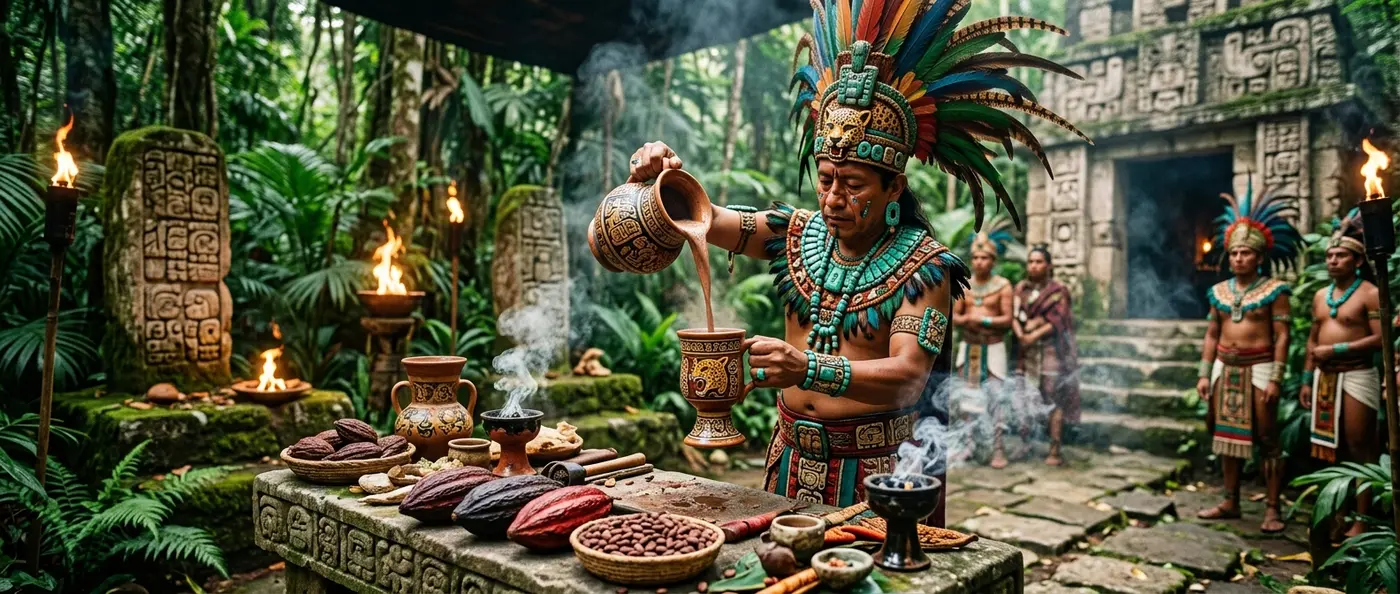
Deep in Central America's steaming jungles, the ancient Maya created a drink from bitter cacao beans. They called it xocolatl — not just a beverage, but liquid divinity. Gods' blood. Imperial currency. The secret to immortality.
📖 Read more: Aztec Death Whistles Fed the Sun God
🍫 Divine Origins of Cacao
Maya mythology credits Quetzalcoatl, the feathered serpent god of wisdom, with gifting cacao beans to humanity. Priests believed each bean contained a fragment of divine essence. This belief shaped every detail of cacao cultivation and consumption.
The Madrid Codex, one of the few surviving Maya manuscripts, shows gods offering cacao beans in fertility and rebirth ceremonies. Every harvest required elaborate thanksgiving rituals. The Maya didn't just grow cacao. They worshipped it.
Cacao trees weren't planted randomly. The Maya selected specific regions with precise climatic conditions, mainly in the lowlands of present-day Mexico and Guatemala. They planted cacao trees under taller canopy trees that provided shade, creating microclimates that encouraged growth.
Sacred Groves
Cacao trees grew in sacred gardens near temples. Only priests could tend them during their first months of growth.
Ritual Harvest
Pods were collected only on specific days of the sacred calendar, when astrological conditions were deemed favorable.
Blood Offerings
Before each harvest, cultivators offered blood from small cuts on their ears as gratitude to the gods for the crop.
🏺 The Art of Preparation
Transforming cacao beans into xocolatl required specialized knowledge. Beans were first roasted in clay vessels over slow fires. Temperature had to be exact — too much heat destroyed precious oils, while too little failed to release the aroma.
After roasting, beans were ground on special stone mills called metates. The process was grueling and required hours of continuous grinding. Women who specialized in this art guarded their exact techniques, passing them from mother to daughter.
Xocolatl bore little resemblance to modern chocolate. The Maya used no sugar. Their drink was bitter, spicy, and aromatic — a flavor explosion that shocked the first Europeans who tried it.
💡 The Secret of Foam
Foam was sacred to the Maya — they believed it held the drink's spiritual essence. The richer the foam, the more blessed the beverage. To create it, they poured the liquid from height, from one vessel to another, again and again.
👑 The Elite's Drink
Xocolatl wasn't for everyone. Only the ruling class, priests, and warriors enjoyed it regularly. For common people, cacao was so valuable it served as currency. One turkey cost 100 cacao beans, while an avocado cost just three.
In Maya palaces, xocolatl was served in elaborate ceramic cups decorated with mythological scenes. Each cup was a unique work of art. Archaeologists have discovered hundreds of such vessels in noble tombs, filled with ancient cacao residue.
Maya kings consumed massive quantities of xocolatl. Montezuma II, the last Aztec emperor who inherited the tradition from the Maya, drank up to 50 cups daily. He believed it gave him strength, wisdom, and sexual prowess.
🔱 Rituals and Sacrifice
Xocolatl played a central role in Maya religious ceremonies. During solar eclipses, nobles offered their blood mixed with cacao to the sun god Kinich Ahau. They believed the sun "died" during eclipses and needed the sacred drink's energy to be reborn.
At aristocratic weddings, couples shared a cup of xocolatl to seal their union. The drink symbolized fertility and prosperity. Archaeological findings show many tombs contained vessels of cacao to accompany the dead on their journey to the underworld.
Warriors drank xocolatl before battle. The drink energized them and made them feel invincible. After victory, captured enemies were sacrificed and their blood symbolically mixed with cacao in special thanksgiving ceremonies to the gods.
🌍 The European Encounter
In May 1502, Christopher Columbus first encountered cacao beans during his fourth voyage to the New World. He wasn't impressed. The plain brown beans looked worthless. The Spanish needed years to understand this treasure's value.
When Hernán Cortés returned to Spain in 1521 after conquering Mexico, he brought xocolatl's secret with him. He presented the drink to King Charles V. But the Spanish couldn't stomach the spicy taste. They added sugar and the drink transformed.
Monasteries became major consumers. The Cistercian monastery of Piedra in Aragon is said to be the first place in Spain where chocolate was made. However, its consumption sparked theological debates. Was it permissible to drink such a rich beverage during fasting?
⚔️ Xocolatl vs European Chocolate
🗿 Legacy of the Sacred Drink
Today, chocolate is everywhere. From luxury pralines to supermarket bars. Few know its sacred origins. In Maya communities across Mexico and Guatemala, traditional xocolatl is still prepared for special occasions.
Modern archaeologists continuously discover new evidence of cacao's significance in Maya culture. Recent analyses of residues in ancient vessels revealed the drink contained other psychotropic plants, enhancing its mystical properties.
Cacao transformed from Maya sacred ritual to Spanish luxury to global commodity. From Maya temples to European palaces to our homes, chocolate's journey is one of cultural transformation that continues today.
Next time you enjoy chocolate, remember the ancient Maya who first unlocked cacao beans' secret. Every bite contains a story thousands of years old — the story of a drink once worth the blood of gods.