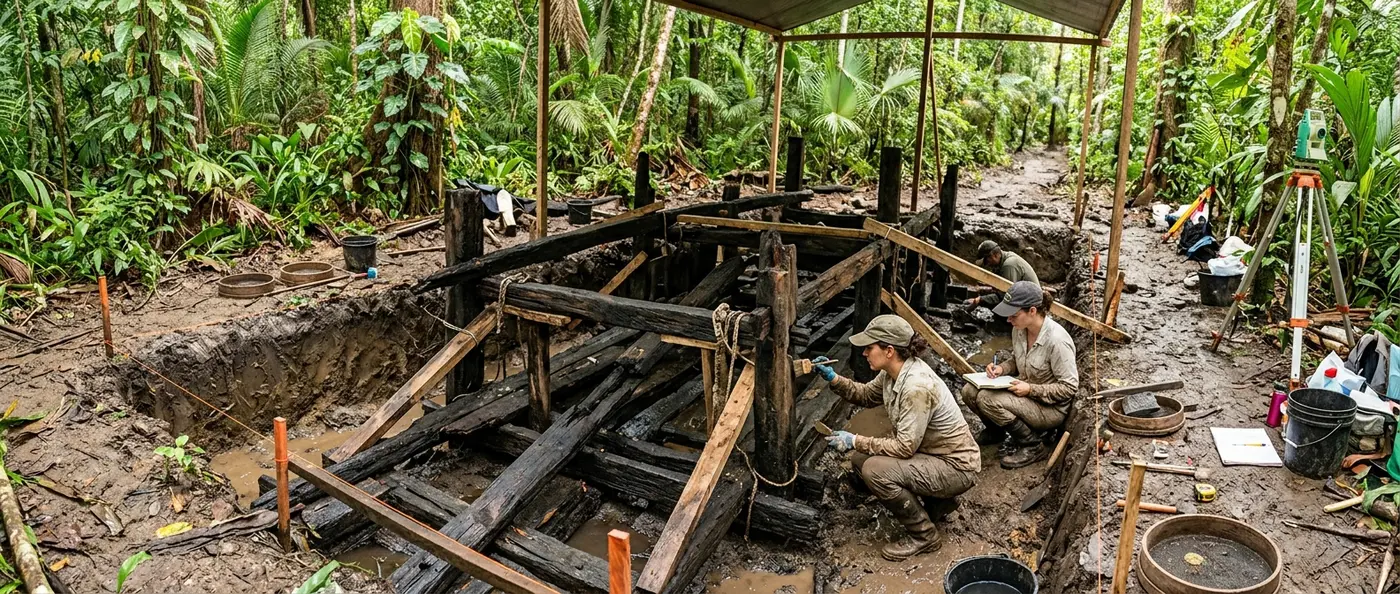
🏛️ The Discovery That Stunned Archaeologists
Caracol keeps delivering shocks. After 40 years of digging through Belize's largest Maya site, University of Houston archaeologists finally found what they'd been hunting for: the tomb of the city's first ruler. Te K'ab Chaak took the throne in 331 AD and died around 350 AD, leaving behind a dynasty that ruled for over 460 years.
This marks the first identifiable royal tomb ever discovered at Caracol since Diane Chase and Arlen Chase began excavations decades ago. The burial chamber sits in the "Northeast Acropolis" — an elevated complex just outside the city center where Maya royalty lived and conducted state ceremonies.
At its peak during the 6th and 7th centuries AD, Caracol housed over 100,000 people across 177 square kilometers. Paved roads connected agricultural terraces, residential complexes, and monumental architecture. The 43-meter-tall Caana pyramid still ranks as one of Belize's tallest structures today.
🗿 Inside the Royal Burial Chamber
Te K'ab Chaak's tomb was one of three major burials discovered in the Northeast Acropolis. The skeletal remains reveal a man about 5'7" tall who died toothless in old age — but his grave goods tell the real story of Maya power and international connections.
The burial chamber held treasures that mark royal status. Exquisitely crafted ceramic vessels. Carved bones. Seashells from distant coasts. Tubular jade beads. And the crown jewel: a death mask constructed from jade mosaic pieces that would have covered the king's face for eternity.
One ceramic vessel depicts a Maya lord gripping a spear while receiving offerings. Another shows Ek Chuah, the Maya merchant god, surrounded by tribute goods. These images capture the dual foundations of early Caracol power: military might and trade networks that stretched across Mesoamerica.
💎 Treasures That Reveal International Networks
The timeline complicates the narrative. A 2010 discovery in the same area had already turned up objects from central Mexico — including obsidian blades — suggesting influence from Teotihuacan, located roughly 1,200 kilometers away. But these new tombs predate that influence by at least a generation.
According to anthropology professor Arlen Chase, Caracol's early rulers maintained deep connections with the Teotihuacan region and other parts of Mesoamerica long before the famous "Teotihuacan arrival" event. Both central Mexico and the Maya area clearly knew each other's ritual practices despite the vast distances separating them.
The presence of exotic materials in Te K'ab Chaak's tomb proves that Maya elites had access to luxury goods from far-flung regions. These weren't just random trade items — they were carefully selected symbols of power and divine connection that legitimized royal authority.
Ceramic Art
Vessels depicting gods and rulers that reveal the religious and political life of the era.
Jade Mastery
Tubular beads and mosaic death mask showcasing advanced Maya craftsmanship.
Trade Networks
Obsidian from central Mexico proving extensive exchange systems.
🏰 Caracol's Architectural Legacy
Archaeological surveys have revealed that Caracol once boasted extensive paved roads, agricultural terraces, buildings, and monumental constructions. The most impressive remains the Caana pyramid — 43 meters of limestone blocks that the Chase team discovered and which still towers over the Belizean landscape.
The city's ruins now lie buried in mountainous jungle in Belize's Cayo region, about 85 kilometers from the Caribbean coast and 72 kilometers southeast of the Maya city of Tikal in Guatemala. This location placed Caracol at the crossroads of major trade routes connecting the Maya heartland with coastal resources and highland materials.
Caracol reached its zenith during the 6th and 7th centuries AD but declined by 900 AD along with many other Maya settlements. The collapse likely resulted from warfare, environmental stress, and political fragmentation.
🔬 Did You Know?
Caracol's water management system was so advanced it could support over 100,000 people in the middle of the jungle, surpassing many contemporary European cities in size and sophistication.
🔱 Diplomatic Relations and Cultural Exchange
The connections between Caracol and Teotihuacan appear to have been maintained by the rulers themselves. Te K'ab Chaak and other Maya kings may have engaged in formal diplomatic relations with Teotihuacan, creating a network of cultural exchanges that spanned all of Mesoamerica.
These contacts weren't limited to trade goods. Clear exchanges of ideas, technologies, and religious practices occurred. The presence of central Mexican objects in Caracol's tombs suggests Maya elites had access to luxury items from distant regions — but more than that, they understood their symbolic meaning.
The discovery of these tombs offers a unique opportunity to understand Caracol's early development phases before intense Teotihuacan influence. The evidence shows the city had already developed its own powerful identity and cultural traditions that would endure for centuries.
⚓ What This Discovery Means for Maya Studies
Te K'ab Chaak's tomb represents far more than another royal burial. It reveals how one of the Maya world's most powerful cities began and shows the political and cultural forces of the Early Classic period.
For the first time, archaeologists can directly study the material remains of Caracol's dynastic founder. This allows for more detailed understanding of how the Maya organized political power and how early rulers established their legitimacy in a competitive landscape.
The longevity of Te K'ab Chaak's dynasty — over 460 years — suggests he laid solid foundations for political stability and economic prosperity. This stability allowed Caracol to evolve into one of the largest urban centers in the Maya world, rivaling even Tikal in size and influence.
📊 Maya City Comparison
🌾 Future Excavations at Caracol
After 40 years of continuous research, Caracol continues revealing its secrets. The royal tomb discovery opens new prospects for understanding the city's early history and relationships with other Mesoamerican centers.
Archaeologists plan to continue excavations in the Northeast Acropolis, where they believe more royal tombs may exist. Each new discovery adds another piece to the Maya historical puzzle, building a more complete picture of this remarkable civilization.
Modern technologies like remote sensing and DNA analysis promise to reveal even more information about life in ancient Caracol. These techniques can help understand diet, health, and genetic relationships among the city's inhabitants across different time periods.
Caracol ranks among the most important sites for understanding Maya civilization — a culture that dominated Central America's jungles for over a millennium.