📖 Read more: Maya King's 1,600-Year-Old Tomb Discovered in Belize
🏛️ The Hidden Chamber Beneath Sacred Ground
The breakthrough came during excavations at a Maya ballcourt in Campeche state, Mexico. Ivan Šprajc, an archaeologist from Slovenia's Institute of Anthropological and Spatial Studies, calls the discovery exceptional — ballcourts typically appear only in major Maya cities that served as regional political centers.
The structure dates to the Early Classic period (200-600 CE) and preserves a layer of painted stucco. Ancient pigments still cling to the walls, offering a rare window into Maya artistic expression. Šprajc's team used lidar technology to map the area, firing millions of laser pulses from aircraft that bounced back from the ground, creating detailed topographic maps that revealed hidden structures beneath the jungle canopy.
The preservation sets this discovery apart. Maya murals rarely survive the tropical climate. The underground location created a microenvironment that protected these artworks from centuries of rain, humidity, and decay that would have destroyed surface paintings long ago.
Dating
The underground structure dates to the Early Classic period (200-600 CE), an era of major flourishing for Maya civilization in the Yucatan Peninsula.
Murals
The chamber walls preserve painted stucco, a rare discovery that reveals details of Maya art and religious practices from the Early Classic period.
Sacred Ballgame
The ballcourt above the chamber hosted the ritual ballgame, a sacred practice with deep religious and cosmological significance in Maya culture.
🔥 The Royal Burning at K'anwitznal
At K'anwitznal (also known as Ucanal) in northern Guatemala, archaeologists uncovered evidence of a dramatic public ritual connected to violent regime change. Christina Halperin, an anthropology professor at the University of Montreal, describes finding a massive concentration of soot, charcoal, and ash mixed with burned bones and fragments of jade and marine shells that had been heated so intensely they cracked and exploded.
Radiocarbon dating revealed an intriguing chronological puzzle: while the charcoal dates between 773 and 881 CE, the bones come from decades earlier. The tomb was reopened decades later to burn the royal remains, then incorporated into a new phase of the temple-pyramid.
The burned offerings included remnants of a green stone mask made from jade and two pieces of obsidian that would have served as eyes for the mask, similar to other masks worn by Maya royal family members. Archaeologists also found a diadem — something only royalty would wear.
⚔️ Dynasty Change and Political Crisis
The team identified remains from at least four individuals, with at least two being royal family members. One was definitely an adult male. The burning coincided with a regime change where community members rejected a Late Classic period dynasty (600-810 CE) and established a new political order by installing a new ruler known as Papmalil, who may have been a foreigner.
This wasn't random violence — it was calculated political theater. The public burning of royal ancestors sent a clear message: the old order was dead, literally and symbolically. By destroying the physical remains of the previous dynasty, the new rulers attempted to erase their legitimacy and establish their own.
🗿 New Discoveries in the Jungle
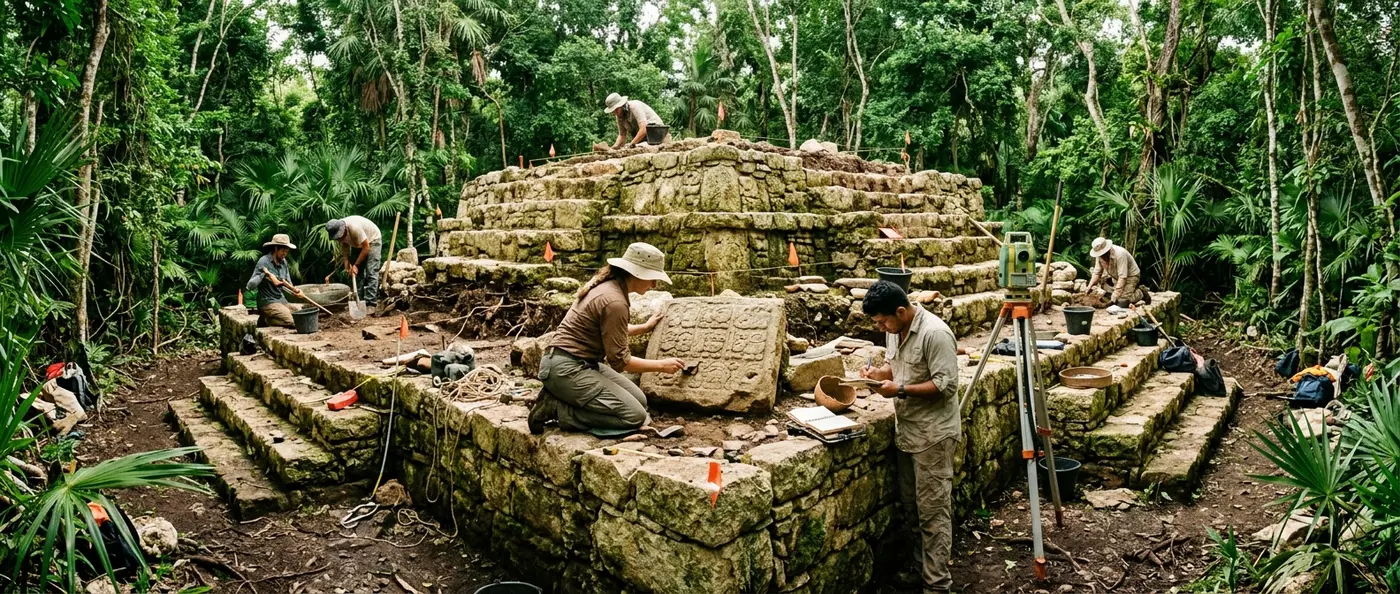
Šprajc's team also located another significant site featuring a plaza, a 16-meter-tall pyramid, and a rectangular water reservoir. At the pyramid's summit, archaeologists discovered offerings including ceramic vessels, a ceramic animal foot (possibly from an armadillo), and a flint knife or spear point.
These offerings were placed atop the temple during the Late Postclassic period (1250-1524 CE), the final centuries before Spanish conquistadors arrived. Despite the Maya lowlands having already descended into political turmoil, people remained in the area after the crisis that led to dramatic population decline in the 9th and 10th centuries.
The persistence of ritual activity at these sites reveals something profound about Maya culture. Even after the collapse of major urban centers, small groups continued to visit these locations, placing offerings on the buildings of their ancestors. This shows a continuity of cultural memory and religious practices that survived political collapse.
📖 Read more: Chichen Itza's Snake Pyramid Hides Two Others Inside
💡 The Mystery of Survival
Despite the collapse of major Maya urban centers, small groups of people continued to wander the area, placing offerings on their ancestors' buildings. Cultural memory and religious practices outlasted the political collapse.
🏺 Ritual Practices and Cosmology
Tomb reentry was common among the Maya, as hieroglyphic texts reveal similar acts of desecration throughout the years. The ancient Maya constantly reshaped their society, for better or worse, and often found themselves in states of transition.
Ballcourts weren't just athletic venues but cosmological centers where they reenacted the mythical battle between gods and underworld forces. The discovery of the underground structure beneath such a court reinforces the idea that these spaces had multiple layers of religious and ritual significance.
The painted chamber beneath the ballcourt likely served as a portal between worlds — the upper realm of the living and the underworld of the dead and gods. Maya cosmology viewed the ballcourt as a crack in the earth's surface, a dangerous threshold where supernatural forces could break through into the human world.
🔬 Modern Technology Serves Ancient Mysteries
Lidar technology has revolutionized archaeological research in the Yucatan jungle. This technique allows researchers to "see" through dense foliage and locate structures that would otherwise remain hidden for centuries. In this case, the team managed to map a large area of the Maya lowlands in Campeche state, revealing several ancient settlements with residential remains and temple-pyramids.
In 2023, the same team discovered Ocomtún, a lost Maya city with several large pyramids from the Classic Maya period (roughly 200-900 CE). The new site lies in a previously unexplored area south of Ocomtún, suggesting the region was far more densely populated than previously believed.
Lidar surveys accomplish in weeks what ground teams needed decades to map. Each lidar survey reveals dozens of new sites, creating a backlog of archaeological work that will keep researchers busy for generations.
📊 Discovery Timeline
🌿 Maya Legacy Today
These discoveries come at a crucial time for modern Maya communities in the Yucatan. The Camino del Mayab, a 110-kilometer hiking trail that opened in late 2020, attempts to revitalize Maya communities through sustainable tourism. The trail follows old henequen transport routes through 14 Maya villages, from the former plantation village of Dzoyaxché to the ancient Maya city of Mayapan.
Eighty percent of trail profits remain in Maya villages through hiring local guides, camping on community lands, and consuming home-cooked meals prepared by village cooks. This initiative represents an effort to reverse centuries of colonial exploitation and provides Maya communities with the means to maintain their culture and traditions.
The new archaeological discoveries not only enrich our understanding of ancient Maya civilization but also strengthen the cultural pride of their modern descendants. Each new find is a puzzle piece that helps reconstruct the rich and complex history of one of humanity's most impressive civilizations.
Each discovery connects to a living culture that survived conquest, colonization, and marginalization. Every painted chamber and royal burning validates the cultural continuity that modern Maya communities have maintained for centuries.